What Is The Spiritual Lore Of Sri Ramanujacharya Jayanti On Vaishakha Shukla Shashthi?
By Pt. Nilesh Sharma
Vaishakha Shukla Shashthi, Vishishtadvaita Philosophy, Gopuram Ashtakshara Revolution And Social Unity
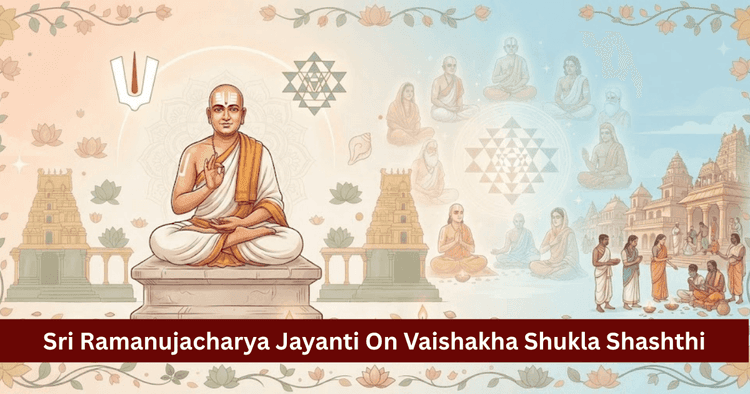
Table of Contents
Panchang Description And The Astrological Dimensions Of Ramanujacharya's Advent
Within classical predictive astrology, the liturgical records of the Sri Vaishnava Sampradaya and the foundational compendiums of Vedantic philosophy, the sixth lunar day of the waxing fortnight in Vaishakha-Vaishakha Shukla Shashthi-is celebrated throughout the Indian subcontinent as Jagadguru Sri Ramanujacharya Jayanti. Within Sanatana intellectual and devotional history, Ramanujacharya is revered as the direct descent of Adishesha (the primordial serpent sovereign) and Lakshmana, appearing to harmonize non-dual philosophical inquiry with personal devotional surrender (Bhakti-Prapatti).
From an astronomical perspective, Vaishakha Shukla Shashthi aligns with the maximum solar dignity of Lord Surya Deva, who transits through his sign of deep exaltation in cardinal fiery Aries (Mesha). Concurrently, the Moon aligns across the sensitive threshold between Ardra and Punarvasu Nakshatras, balancing intellectual discernment with universal compassion. Appearing in Samvat 1074 (1017 CE) at Sriperumbudur in Tamil Nadu to the devout couple Kanthimathi and Asuri Keshava Somayaji, the child initially named 'Ilaya Perumal' matured into a philosopher-statesman whose teachings reoriented medieval Indian thought.
At a historical junction marked by social fragmentation, rigid caste boundaries and the dominance of abstract intellectualism that dismissed phenomenal reality as an illusion, Ramanujacharya composed his monumental commentaries on the Brahma Sutras (the Sri Bhashya), the Bhagavad Gita and the Upanishads, establishing the school of Vishishtadvaita Vedanta (Qualified Non-Dualism). He articulated that the individual soul (Chit) and the phenomenal universe (Achit) are not illusory but constitute the real, living body (Sharira) of the Supreme Consciousness (Brahman/Narayana). Simultaneously, he championed social inclusivity, ascending the temple tower at Thirukoshtiyur to share the sacred Ashtakshara Mantra with the entire community.
| Astrological Factor | Scriptural, Astrological and Historical Detail |
|---|---|
| Calendrical Station | Vaishakha Month | Shukla Paksha Shashthi (6th Waxing Lunar Day) |
| Avataric Classification | Direct Incarnation of Adishesha / Lakshmana (Anantavatara) |
| Nativity & Lineage | Sriperumbudur (Tamil Nadu) | Vadama Brahmin (Harita Gotra) |
| Parents | Mother Kanthimathi and Sage Asuri Keshava Somayaji |
| Monastic Lineage | Sri Sampradaya (Lakshmi-Narayana Lineage) | Tridandi Sannyasa |
| Core Philosophical Doctrine | Vishishtadvaita Vedanta (Qualified Non-Dual Realism) |
| Foundational Commentaries | Sri Bhashya, Gita Bhashya, Vedartha Sangraha, Gadyatrayam |
| Primary Centers of Practice | Srirangam (Sri Ranganatha Swami), Kanchipuram, Melkote |
| Social Reformation | Granted marginalized groups the title Thirukkulathar and temple entry |
| Bestowed Spiritual Fruit | Awakening of absolute surrender (Prapatti), social harmony, liberation |
To align with the teachings of Sri Ramanujacharya on his appearance day, an aspirant should observe disciplined daily habits:
- Awaken before sunrise during Brahma Muhurta, bathing in ambient cool water consecrated with drops of sacred Kaveri or Ganga water while meditating upon the master.
- Cleanse the body, adorning the forehead with the sacred Urdhva Pundra of the Sri Vaishnava tradition (white clay lines enclosing the central yellow or red streak representing Sri Lakshmi).
- Install consecrated icons of Lord Sri Lakshminarayana and Sri Ramanujacharya upon an altar draped in clean yellow silk.
- Conduct Shodashopachara worship honoring Lord Narayana and Ramanujacharya with white sandalwood paste, fresh tulsi leaves and seasonal yellow flowers.
- Present cooling summer foods-such as roasted barley sattu sweets, spiced raw mango coolers and clarified butter sweets.
- Recite or study classical verses from the Saranagati Gadyam or devotional hymns from the Divya Prabandham.
- Recite the sacred Ashtakshara formula Om Namo Narayanaya at least 108 times using a rosary of lotus seeds or tulsi beads.
- Extend respect, practical assistance, food and cool water to underprivileged or marginalized individuals, putting social harmony into practice.
Vishishtadvaita Vedanta: The Organic Unity Of Soul, Nature and God
In response to perspectives that described the physical universe as an ungrounded illusion, Sri Ramanujacharya synthesized scriptural teachings into the systematic school of Vishishtadvaita (Qualified Non-Dualism):
1. Tattva-Traya (The Three Foundational Realities)
Ramanujacharya articulated that reality comprises three eternal, interrelated principles:
- Chit (The Conscious Souls): Infinite, individual centers of consciousness (Jivas) possessing self-awareness and moral agency.
- Achit (The Inanimate Universe): Unconscious, physical nature (Prakriti) undergoing continual cyclical transformation.
- Ishvara (The Supreme Consciousness): Lord Sriman Narayana, the sovereign, self-luminous Absolute ground of being, endowed with qualities of compassion, justice and grace.
2. Sharira-Shariri Bhava (The Body-Soul Paradigm)
The core insight of Vishishtadvaita lies in the Sharira-Shariri Bhava (the Organic Model of Reality): Just as the human physical body (Sharira) is sustained, animated and directed by the indwelling soul (Atman), the entire cosmic order-all sentient souls (Chit) and all physical matter (Achit)-constitutes the living body of the Supreme Lord Narayana, who abides as the Inner Controller (Antaryamin) of all.
- therefore the created universe is not a false mirage; it is a sacred manifestation of the Divine.
- The Supreme Divine is not an impersonal void but the personal, loving Preserver of all life.
| Metaphysical Aspect | The Vishishtadvaita Perspective | Expression in Daily Life |
|---|---|---|
| Nature of the Divine | Personal, benevolent, all-encompassing Sriman Narayana | Encourages direct devotional connection and love |
| Status of the Universe | Real, sacred, forming the living body of the Divine | Inspires environmental care and reverence for nature |
| Path to Liberation | Pure devotion (Bhakti) and surrender (Prapatti) | Makes spiritual liberation accessible to every human being |
The Historic Gopuram Incident: Universal Compassion Over Personal Salvation
Sri Ramanujacharya was more than a systematic philosopher; he was an active social reformer. His life is characterized by deep compassion, exemplified by the historic event at the temple tower of Thirukoshtiyur:
To receive initiation into the sacred, liberating eight-syllabled formula-Om Namo Narayanaya-Ramanujacharya journeyed on foot eighteen times to the hermitage of his teacher, Goshtipurna:
- After testing his perseverance, the teacher imparted the formula under a strict condition: "Ramanuja! This formula possesses the power to grant liberation. You must keep it confidential. If you disclose it to unauthorized listeners, they will attain liberation but you will suffer spiritual degradation for disobeying your preceptor."
- Ramanujacharya received the formula with deep gratitude. Yet as he walked through the streets, he looked upon the suffering and struggles of the townspeople and his heart was moved by compassion.
- He reflected: "If the disclosure of this sacred truth brings liberation to thousands of living beings, I will willingly accept whatever spiritual suffering comes upon me alone."
- Without hesitation, he climbed the towering Gopuram (gateway tower) of the Thirukoshtiyur temple and called out to the gathered laborers, artisans, elderly and disenfranchised townspeople.
- From the height of the tower, he proclaimed the sacred formula in a clear, resonant voice: "Om Namo Narayanaya!"-sharing the path of liberation with everyone present.
When Goshtipurna learned of the disclosure, he confronted his disciple in anger. But when Ramanujacharya bowed with humility, explaining his willingness to suffer if it meant others found liberation, the teacher was moved to tears. Embracing him, Goshtipurna declared: "You are no longer merely my student; you are Emperumanar-our most revered guide!"
Social Inclusivity: The Title 'Thirukkulathar' And Temple Access
A millennium before modern social reform, Ramanujacharya challenged artificial societal barriers through practical action:
- Thirukkulathar (The Noble Kin of God): He conferred the respectful title Thirukkulathar (those belonging to the family of the Divine) upon the most oppressed communities, ensuring they were treated with respect.
- Temple Entry at Melkote: When consecrating the Cheluvanarayana Swamy sanctuary in Melkote, Karnataka, he invited Dalit and tribal communities into the temple precincts, granting them formal roles in liturgical service and festival celebrations.
- Reverence for Kanchipurna: Despite being born into an orthodox family, Ramanujacharya looked to the non-Brahmin saint Kanchipurna as his mentor, demonstrating that spiritual realization transcends lineage and social labels.
Prapatti: The Path Of Loving Surrender
Within Vishishtadvaita, the most direct path to peace is Prapatti (Sharanagati)-unconditional surrender to the Divine. Ramanujacharya taught that while complex scriptural scholarship and rigorous yogic disciplines may not be accessible to everyone, heartfelt surrender is open to all:
Anukulyasya sankalpah pratikulyasya varjanam.
Rakshishyeetī vishvaso goptritva-varanam tatha.
Atma-nikshepa-karpanye shad-vidha sharanagatih.
The Six Dimensions of Sharanagati
- Anukulyasya Sankalpah: Resolving to live in harmony with dharma, compassion and the welfare of others.
- Pratikulyasya Varjanam: Abandoning actions, speech and habits that cause harm or division.
- Rakshishyatiti Vishvasah: Maintaining unshakable trust that the Divine watches over and protects every life.
- Goptritva-Varanam: Consciously choosing the Divine as one's sole guardian and refuge.
- Atma-Nikshepah: Entrusting personal ego, ambitions and the fruits of actions into the hands of the Divine.
- Karpanyam: Remaining humble and acknowledging one's limitations before the vastness of existence.
Philosophical Essence: The Inherent Dignity Of Every Soul
The observance of Sri Ramanujacharya Jayanti conveys an essential truth for human society:
"The physical form is transient but the conscious soul within is an eternal ray of the Divine; and the soul carries neither caste, social rank, nor external label."
When an individual treats another human being with contempt based on external background, ancestry or worldly status, they fail to recognize the divine presence residing within that person.
Sri Ramanujacharya demonstrated that genuine wisdom is found not merely in scholarly debate but in practical compassion-lifting up the vulnerable and recognizing the shared dignity of all life.
On Vaishakha Shukla Shashthi, let us honor Jagadguru Sri Ramanujacharya by setting aside prejudice and pride, looking upon all beings with respect and living the timeless truth that humanity is a single, interconnected family.
FAQ
When and where was Sri Ramanujacharya born?
Sri Ramanujacharya was born on the sixth lunar day of the waxing fortnight of Vaishakha (Vaishakha Shukla Shashthi) in Samvat 1074 (1017 CE) at Sriperumbudur, Tamil Nadu.
Whose incarnation is Sri Ramanujacharya considered to be?
He is revered as the direct descent of Adishesha (the cosmic serpent sovereign) and Lakshmana (Anantavatara).
What is the core philosophy propounded by Sri Ramanujacharya?
He formulated Vishishtadvaita Vedanta (Qualified Non-Dualism), demonstrating that individual souls and physical nature form the real, living body of the Supreme Lord Narayana.
Which mantra did Ramanujacharya proclaim from the temple tower and why?
He proclaimed the sacred eight-syllabled formula "Om Namo Narayanaya" from the temple tower of Thirukoshtiyur to ensure the spiritual welfare and liberation of all citizens, regardless of social rank.
What are the primary literary and philosophical works of Ramanujacharya?
His foundational works include the Sri Bhashya (commentary on the Brahma Sutras), the Gita Bhashya, the Vedartha Sangraha, the Vedanta Dipa and the Gadyatrayam.
Get your accurate Kundali
Generate KundaliDid you like it?
Author

Pt. Nilesh Sharma (63)
Experience: 20
Consults About: Family Planning, Career
Clients In: Punjab, Haryana, Delhi
Share this article with friends and family
WELCOME TO
ZODIAQ
Right Decisions at the right time with ZODIAQ
