Ketu Graha: Detachment, Inner Search and Release from Old Patterns
By Pt. Narendra Sharma
Turning from Outer Life Toward Inner Journey
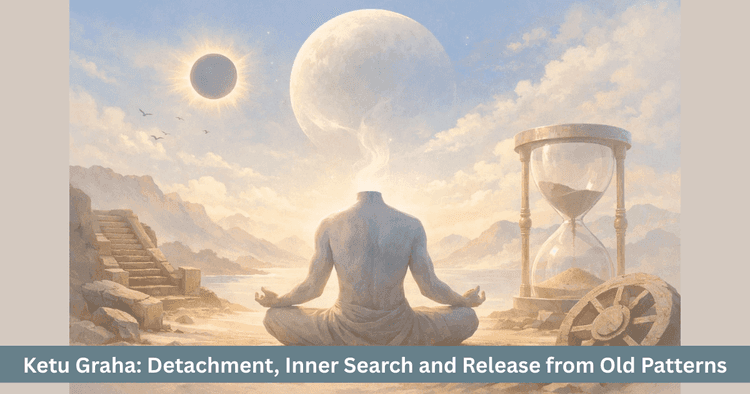
Table of Contents
There are phases when a person seems to have much on the outside yet still feels an emptiness within. Success, relationships and comfort may be present, yet the heart quietly seeks a deeper meaning. In Vedic astrology such inner turning, subtle withdrawal and search for truth are closely related to Ketu Graha. Ketu is the shadow planet that gently points a person from the outer world toward the inner journey.
Ketu does not signify separation for its own sake. It symbolises the understanding that everything has a limit and a time. Wherever Ketu sits in the kundli, life may show sudden changes, unexpected distance and powerful experiences that eventually deepen awareness. From that very place, introspection, spirituality and the unfolding of old karmic layers begin.
Which sign is Ketu linked with
In traditional astrology Ketu is associated as a co ruler with Vrishchika rashi, Scorpio. The depth of Scorpio and the detached energy of Ketu form a very subtle combination.
| Sign | Main Ketu and Vrishchika related qualities |
|---|---|
| Vrishchika | Deep transformation, intensity, rebirth, emotional strength, inward journey |
Scorpio itself is connected with depth, secrecy, transformation and rebirth. When Ketu influences this kind of energy, a person often passes through inner pain, old wounds or intense experiences and changes from within. The transformation is not only external. It works at the level of mind and consciousness.
What does Ketu represent in the birth chart
In Vedic astrology Ketu is regarded as the planet of detachment, spirituality and past life influences.
Ketu mainly
- indicates the impact of karmas carried from earlier births.
- can create tendencies of renunciation, distance from outer attachment and longing for inner peace.
- encourages meditation, spiritual practice, introspection and interest in subtle or esoteric subjects.
- may also show itself as lack of clear direction, sudden disconnection or loss that cannot be easily explained.
The house occupied by Ketu often feels unusual. A person may sense incompleteness, strange attraction or hidden burden around that area. In time the same field can become a doorway for inner transformation, whether it relates to relationships, career, health or spiritual life.
Ketu, spirituality and the value of silence
Ketu is frequently linked with spirituality and meditation, yet its path is rarely straightforward.
- When balanced, Ketu helps a person become comfortable with silence and solitude.
- It can deepen practice in meditation, japa, yoga, prayer or any form of inner discipline.
- Such individuals do not feel lonely easily and are able to discover clarity and peace in quiet time.
In its clearer expression, Ketu
- gives the ability to rise above small issues.
- brings a more even view of both pleasure and pain.
- and teaches that life is not only about gaining, it is also about understanding and letting go.
If Ketu is confused or disturbed, even spirituality can become restless. A person may keep changing practices or paths without feeling truly settled.
Signs of strong and weak Ketu
Ketu often speaks in subtle ways, yet some patterns reveal its condition.
Indications of a strong or benefic Ketu
- natural attraction toward the inner world and comfort in being alone.
- deep interest in meditation, yoga, mantra, scriptures, astrology or other subtle subjects.
- tendency to look beyond surface events and search for hidden meaning.
- gentle form of detachment even in success, with less craving for constant attention.
Indications of a weak or imbalanced Ketu
- confusion about direction, jumping from one interest to another without stability.
- feeling lost in thoughts without gaining clarity.
- remaining stuck in past memories, regrets or unresolved experiences.
- sensing separation from others and struggling to explain why.
In its troubled form, Ketu keeps the mind circling old impressions. In its balanced form, the same energy turns those impressions into insight.
Ketu and connection with past life karma
Ketu is often associated with karmas from previous births.
- Astrologically it is seen as a marker of areas where the soul has prior experience.
- Because of this, one may show unusual detachment or a very different understanding in those fields.
- A person may not know why some situations feel heavy or unnecessary, even when everything appears normal outwardly.
Ketu here suggests that old patterns in that area may need to be completed or released. Alongside Rahu, it helps show what must be left behind and where fresh growth is required.
Ketu, detachment and the search for meaning
The deepest teaching of Ketu is that real detachment is not running away. It is letting go with understanding.
- When the same themes keep slipping out of one’s hands, it can be helpful to consider Ketu’s message.
- Ketu sometimes removes what is no longer helpful, even if the mind still clings to it.
- Through such experiences, a person may recognise which relationships, desires or habits have already served their purpose.
This form of detachment does not reject responsibility. It invites a more mature way of holding and releasing things, with awareness instead of bitterness.
A story of Ketu dasha and the inner journey
A woman had Ketu in the fourth house in Vrishchika rashi. From childhood she felt an odd emptiness in the emotional atmosphere of home, although outward conditions seemed fine. She immersed herself in study, work and constant activity, avoiding quiet time with herself.
When her Ketu mahadasha began, several changes unfolded. Work shifted, she had to move to a new city and some old relationships naturally faded. At first she felt that everything was collapsing. Gradually she began to sit quietly, explore meditation and read about inner healing and spirituality. She revisited childhood memories and long held feelings with new honesty.
Years later she realised that the same Ketu which once felt like insecurity had actually guided her toward inner grounding. With less external support, she had discovered a deeper support within. From an astrological perspective, fourth house Ketu in Vrishchika was slowly transforming old emotional patterns and opening space for genuine inner stability.
Karma, liberation and the role of Ketu
In the sphere of karma and destiny, Ketu acts with great subtlety.
- It loosens bonds that have weighed on consciousness for a long time.
- It reveals attachments that now obstruct the soul’s movement forward.
- At times Ketu’s influence brings events that shake a person deeply, yet later those very events prove to be turning points.
Ketu teaches that lasting peace does not arise from outer possession or recognition. It arises from honest self understanding and quiet acceptance. Ketu frees but first it brings one face to face with truth.
How to strengthen and balance Ketu
To balance Ketu, spiritual and practical habits both play a supportive role.
- Practise regular meditation, japa, pranayama or simply sitting quietly with awareness of breath. This gradually settles scattered thoughts.
- Approach yoga or any spiritual discipline sincerely, not for display.
- Relate to material things as tools rather than identity, reducing unnecessary accumulation over time.
- Release bitterness and regret by viewing past events as lessons instead of lifelong burdens.
- Keep a little time each day for self reflection, silently observing thoughts and emotions without judgement.
With such practices, Ketu’s energy begins to appear not as fear or confusion but as guidance and gentle detachment.
Moving toward inner peace with a balanced Ketu
Ultimately Ketu reminds that the journey of life is not limited to outer achievements.
When
- a person recognises that every relationship, possession and situation has its own season.
- learns to see letting go as maturity rather than defeat.
- and values inner peace and awareness alongside outer progress.
then it becomes evident that Ketu is not only a sign of loss, emptiness or confusion. It is also a doorway to deeper calm, spiritual growth and self knowledge. A balanced Ketu helps a person walk free not through escape but through understanding.
Common questions about Ketu
Does Ketu always bring loss and suffering?
Ketu can appear to remove certain things, yet often it is clearing unnecessary weight so that inner strength may grow. Its purpose is awakening rather than punishment.
Does a strong Ketu mean a person must leave ordinary life?
A strong Ketu can incline toward spiritual interest but not everyone becomes a renunciate. Many live in the world with greater simplicity, depth and honesty through Ketu’s influence.
Does Ketu always create confusion in life direction?
Imbalanced Ketu can cause confusion at first, yet with practice and guidance it can also bring very clear understanding about what to drop and what to nurture.
Is Ketu concerned only with past life karma or also with present choices?
Ketu points to past patterns, yet it works through current experiences and decisions. It brings old themes to the surface so that they can be recognised and transformed now.
What is the simplest habit to balance Ketu?
Regular quiet time in meditation, gradual reduction of unnecessary attachments and a steady habit of self reflection are simple and powerful ways to harmonise Ketu.
Get your accurate Kundali
Generate KundaliDid you like it?
Author

Pt. Narendra Sharma (63)
Experience: 20
Consults About: Family Planning, Career
Clients In: Punjab, Haryana, Delhi
Share this article with friends and family
About ZODIAQ
ZODIAQ is an online Vedic Astrology platform. It connects clients seeking astrological advice to experienced astrologers with deep knowledge. Our users also generate kundali and perform kundali milan for free. ZODIAQ also offers services to the Astrologers. Astrologers utilize various offerings by ZODIAQ to serve their clients effectively.
If you are a User
Consult with experienced astrologers and seek their guidance. You can also order handwritten Janm Patrika report with life prediction prepared by experienced astrologers. Generate accurate Kundali, perform Kundali Matching and check horoscope and muhurat. Utilize our online library for all the necessary astrological and spiritual information.
If you are an Astrologer
Create accurate kundali for your clients and perform Kundali Matching for up to 5 people at a time. Write comprehensive Janm Patrika report for your clients with ZODIAQ. Check client details anytime by saving it in client directory. Become more productive by tracking how many clients you guide every day.
WELCOME TO
ZODIAQ
Right Decisions at the right time with ZODIAQ
