Chaturmas Begins: A Sacred Season of Stillness, Discipline and Compassion
By Pt. Narendra Sharma
Understanding the spiritual meaning of Chaturmas as a four-month practice of restraint, compassion, and inner reflection
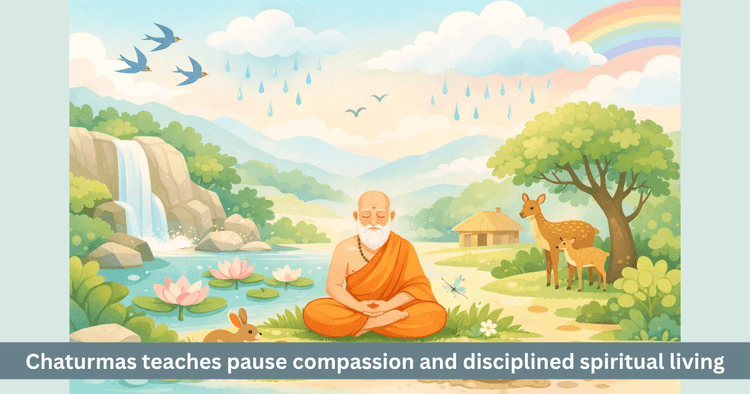
Table of Contents
In the Sanatana tradition, some sacred periods are not merely dates in a calendar. They are profound spiritual signals that reshape the rhythm of life itself. Chaturmas is one such holy period. Beginning from this full moon, these four months are not only known as the time when saints and monks remain in one place. They represent a beautiful union of nature, dharma, compassion, austerity, restraint and sensitivity toward even the smallest forms of life. At first glance, the rule may appear simple, that holy men stop traveling during the rainy season. Yet within it lies the subtle vision of Indian thought, a vision that treats even the most minute forms of life upon the earth as worthy of moral care.
The Skanda Purana gives the indication that during the rainy season countless subtle creatures appear more actively on the ground, in vegetation, near water and along pathways. Continuous travel in such a season may unintentionally destroy many forms of life. This is why, from this full moon onward, saints and monks are said to remain in one place for the next four months. This is not merely an outward rule. It is a declaration that dharma is not only worship but conduct rooted in compassion. The beginning of Chaturmas is considered so important because it turns a person from speed toward pause, from outer movement toward inner depth.
What Is Chaturmas and Why Is Its Beginning Considered So Special
Chaturmas literally means a period of four months. But in religious and spiritual life, it refers to that sacred span within the rainy season when spiritual disciplines such as restraint, recitation, vows, scriptural listening, guru service and introspection are given special importance. This period is not meant only for ascetics. It is also regarded as a time for householders to cultivate self discipline and refinement of life.
The fact that it begins on a full moon also carries a beautiful symbolic meaning. The full moon represents fullness, illumination and ripened awareness. For such a bright point to mark the beginning of Chaturmas suggests that the coming four months are not merely for stopping. They are meant for stabilizing inner light. It is a sacred pause that asks a person whether life is being lived only in constant motion or whether there is also the courage to stop and examine one’s conduct, thoughts, food, speech and actions.
Why Do Saints and Monks Stay in One Place
Indian wisdom understood that the life of a saint is not only for personal liberation but also for the instruction of society. When saints continue traveling, they spread dharma outwardly. But when they remain in one place, they deepen dharma within a community. This is the double significance of remaining in one place during Chaturmas. On one side, it is for the protection of subtle living beings. On the other side, it allows for stable practice and profound spiritual dialogue with society.
During the rainy season, roads become difficult, the earth softens, insects and tiny creatures appear in greater numbers and the balance of nature becomes intensely active. To stop traveling in such a time is not only ecological sensitivity. It is a practical form of ahimsa, non violence. That is why the stillness of saints during these months is not considered laziness but a highly alert form of dharmic living.
Main reasons saints remain in one place during Chaturmas
- Protection of subtle living beings
- Avoiding unintended violence during the rainy season
- Opportunity for deeper and more concentrated practice
- Giving sustained spiritual guidance to local society
- Strengthening recitation, austerity, vows and scriptural reflection
What Is the Relation Between the Rainy Season and Subtle Life
One of the most beautiful and surprising dimensions of the Chaturmas tradition is that ancient India understood long ago that the rainy season does not bring only weather change. It also awakens subtle layers of life. When the earth becomes wet, when water collects, when the soil softens and when moisture settles upon leaves and pathways, many tiny beings, worms, insects and subtle forms of life become more active upon the surface of the earth. If someone continues to travel constantly, especially on foot, many such beings may be harmed unknowingly.
This insight is not only religious caution. It also reflects a science of sensitivity toward life. It teaches that Indian tradition never separated dharma from nature. Dharma was not merely about rules for human conduct. It was about living in a way that also protected the existence of other beings. This makes the beginning of Chaturmas spiritually profound and also deeply relevant in ecological terms.
Is Chaturmas Only for Ascetics
No, it is not limited to monks and renunciates. Although their staying in one place is the most widely known feature of this period, Chaturmas is also highly significant in the life of householders. It is considered a favorable time for dietary restraint, disciplined speech, regularity in daily living, scriptural listening, charity, fasting and mental purification. The rainy season affects the body, mind and digestion in special ways. Therefore simplifying life and making it more deliberate during this time has also been regarded as practically beneficial.
For householders, Chaturmas may become a sacred opportunity to take some stable vows. These do not need to be extreme. They may include simpler food, reducing unnecessary anger, daily recitation, remembrance of the guru, satsanga or consciously working to reduce a particular weakness. In this way Chaturmas becomes not only a monastic observance but also a festival of inner discipline within family and society.
What Is the Spiritual Meaning of Chaturmas
If one looks more deeply, Chaturmas is not merely a rule against travel. It is an invitation to pause the outer speed of life for a while and observe the inner movement. Human beings often remain so absorbed in outer activity that they hardly notice their own impurities, imbalances, desires, restlessness and inner emptiness. Chaturmas says stop, slow down, observe and understand where you are moving.
This sacred period silently asks:
- Is your speech pure
- Is your food disciplined
- Is your mind steady
- Is your daily life aligned with dharma
- Is compassion still alive within you
Thus the spiritual meaning of Chaturmas is awakening through pause.
Why Is the Connection Between Compassion and Dharma So Important Here
If dharma is reduced only to ritual, it can become hard. If it is reduced only to emotion, it can become unstable. Indian tradition placed compassion as a bridge between the two. Chaturmas is a living example of that bridge. Here dharma does not only say practice spirituality. It also says that even while walking, remain so aware that no tiny life is harmed unnecessarily.
This perspective also softens human ego. A person begins to understand that the world has not been made for human comfort alone. There exists a moral universe greater than one’s convenience, a universe that includes ants, insects, worms, vegetation, water, soil and seasons. When dharma descends to this level of refinement, it no longer remains merely ritual. It becomes reverence toward life itself.
The Relation Between Chaturmas and Austerity
Stopping is not easy. Outward movement is often easier than inward stillness. One important dimension of Chaturmas is that it is considered a time of tapas, spiritual austerity. Tapas does not only mean suffering. It means keeping oneself within discipline. When saints remain in one place, it also signifies that they are withdrawing the mind from outer variety into deeper steadiness. When householders adopt sacred restraints, that too becomes tapas. Simplicity in food, restraint in speech, moderation in sleep and control of the senses all become part of the austerity of Chaturmas.
Common disciplines associated with Chaturmas
| Practice | Inner Purpose |
|---|---|
| Japa | To gather the mind at one point |
| Vows | To strengthen will power |
| Satsanga | To give thought a pure direction |
| Listening to scripture | To deepen understanding of dharma |
| Charity | To lighten selfishness |
| Restrained diet | To steady both body and mind |
Is There Also a Practical Life Science Behind Chaturmas
Yes and it is deeply interesting. During the rainy season, the state of nature changes. The climate becomes moist, digestion may be affected, vulnerability to imbalance can increase and the mind may also become somewhat heavy or restless. In such a time, simple food, disciplined routine, limited movement and greater inwardness are practically beneficial. Thus Chaturmas is not only spiritual. It is also a seasonal discipline of balanced living.
Here the subtlety of ancient tradition becomes visible. It did not separate weather, ecology, bodily condition, mental tendency and spiritual practice. Chaturmas is the integrated answer to all of them. That is why it should not be seen only as an outward religious observance.
What Is the Importance of Chaturmas in Modern Life
Modern life is marked by speed, constant movement, overconsumption and mental agitation. People keep moving forward but often without the opportunity to ask where they are heading. In such a time, the tradition of Chaturmas becomes especially meaningful. It teaches that life should contain periods when speed is reduced, the inner world is examined, nature is respected and compassion and discipline are consciously restored.
In the modern context, Chaturmas offers these teachings:
- Constant movement is not the same as real growth
- Sometimes stopping is itself a sacred act
- A life that ignores nature eventually becomes inwardly unstable
- Respect for subtle life makes human beings more humble
- Spiritual practice needs a reduction of speed and distraction
How May the Beginning of Chaturmas Be Observed Spiritually
This full moon can become a beautiful gateway into spiritual discipline. If a person wishes to take Chaturmas seriously, one may adopt some small but steady rules for the coming four months. These need not be severe. What matters is that they are maintained with sincerity and that they gradually reshape the inner life.
Some meaningful resolutions for Chaturmas
- Daily japa or meditation at a fixed time
- Simpler food on a chosen day each week
- A conscious effort to reduce harsh speech and anger
- A little daily scriptural reading or listening to sacred discourse
- Steady work on reducing one personal weakness
- More alert and compassionate behavior toward living beings and nature
What Is the Deepest Message of This Whole Theme
The deepest message in the beginning of Chaturmas is that dharma does not live only in temples, mantras or formal worship. It seeks to enter our pace of life, our movements, our food, our compassion and our conduct. The decision of saints to stop traveling during the rainy season teaches that spirituality is measured not only by elevated thought but also by refined sensitivity. One who honors even the smallest life form begins to understand the true compassion of dharma.
This sacred period also teaches that pause is not emptiness. A proper pause awakens much within. When outer movement slows, inner seeing can deepen. That is one of the most beautiful truths of Chaturmas.
Final Reflection
The tradition indicated in the Skanda Purana, that from this full moon Chaturmas begins and saints remain in one place for the next four months, reveals the extraordinary subtlety of Indian dharma. It is not merely a rule to stop traveling. It is a combined discipline of ahimsa, compassion, ecological sensitivity, austerity, self observation and spiritual practice. The awareness that subtle beings become more visible in the rainy season makes this tradition even more meaningful, because here dharma is not centered only on human convenience. It becomes responsibility toward all life.
therefore it may be said that the beginning of Chaturmas is not merely a religious calendar point but an invitation to restore balance in life. One who understands this period knows that sometimes stopping is itself a deeper form of moving forward.
Frequently Asked Questions
When does Chaturmas begin
Traditionally it begins from a sacred full moon and continues for the next four months.
Why do saints remain in one place during Chaturmas
Because during the rainy season subtle beings appear in greater numbers upon the earth and travel may lead to unintended harm.
Is Chaturmas only for monks
No, householders too may observe it through restraint, recitation, vows, satsanga and self reflection.
What is the main spiritual purpose of Chaturmas
To deepen compassion, restraint, practice and inner awareness by slowing external movement.
Does Chaturmas also have practical benefits
Yes, during the rainy season limited travel, simple food and regulated living are considered balancing for both body and mind.
Get your accurate Kundali
Generate KundaliDid you like it?
Author

Pt. Narendra Sharma (63)
Experience: 20
Consults About: Family Planning, Career
Clients In: Punjab, Haryana, Delhi
Share this article with friends and family
About ZODIAQ
ZODIAQ is an online Vedic Astrology platform. It connects clients seeking astrological advice to experienced astrologers with deep knowledge. Our users also generate kundali and perform kundali milan for free. ZODIAQ also offers services to the Astrologers. Astrologers utilize various offerings by ZODIAQ to serve their clients effectively.
If you are a User
Consult with experienced astrologers and seek their guidance. You can also order handwritten Janm Patrika report with life prediction prepared by experienced astrologers. Generate accurate Kundali, perform Kundali Matching and check horoscope and muhurat. Utilize our online library for all the necessary astrological and spiritual information.
If you are an Astrologer
Create accurate kundali for your clients and perform Kundali Matching for up to 5 people at a time. Write comprehensive Janm Patrika report for your clients with ZODIAQ. Check client details anytime by saving it in client directory. Become more productive by tracking how many clients you guide every day.
WELCOME TO
ZODIAQ
Right Decisions at the right time with ZODIAQ
