Why Dattatreya is Remembered on Guru Purnima Through 24 Gurus
By Pt. Narendra Sharma
Understanding the deeper Guru principle through Dattatreya’s 24 Gurus story
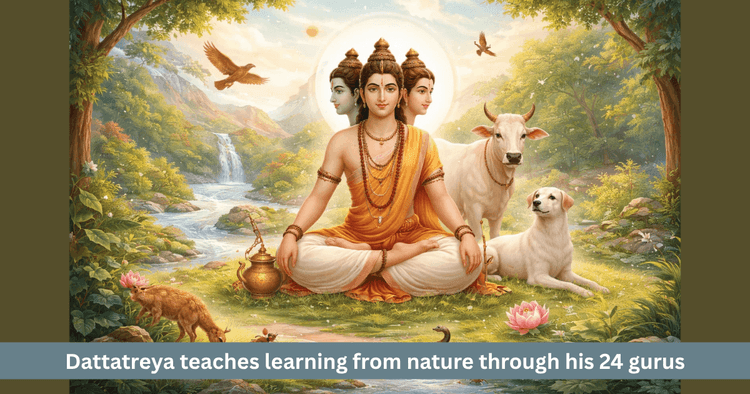
Table of Contents
Guru Purnima is generally understood as a sacred day of reverence, surrender and gratitude toward the Guru, yet there are also certain stories associated with this day that make the meaning of the Guru far wider and more alive. One of the most inspiring among them is the remembrance of Lord Dattatreya. He is not worshipped only as an ascetic or yogi, but also understood as a great knower who showed that wisdom is not confined only to an ashram, a scripture or a formal teacher. If vision is pure, the mind is humble and the flame of learning is alive within, then the whole of nature can become Guru.
This is why the story of Dattatreya’s 24 Gurus is regarded as deeply inspiring in Indian spiritual tradition. It is said that he accepted the ant, the sky, the sun, the earth, water, fire, air and many other beings and elements as his teachers. This story is not merely symbolically interesting. It offers a very expansive understanding of the Guru principle. It teaches that learning does not arise only through formal instruction, but also through observation, contemplation, experience and dialogue with nature.
Why is the remembrance of Dattatreya on Guru Purnima so important
Guru Purnima is generally seen as the day of remembering the Guru tradition. On this day, Maharshi Vedavyasa, Adi Guru Shiva and many acharyas are remembered. In this very stream, the remembrance of Lord Dattatreya carries a special meaning, because he takes the idea of Guru beyond one human figure and reveals it as living wisdom pervading all creation.
The teaching of Dattatreya shows that the true disciple is the one who can learn from every circumstance. If Guru Purnima makes us humble, Dattatreya teaches that the next step of humility is to recognize Guru tattva in every direction. That is why remembering him on this day is not merely a custom, but an invitation to understand the depth of discipleship.
Who is Dattatreya and why is his Guru form so unique
Lord Dattatreya holds a very unique place in Indian spirituality. He is associated with yoga, detachment, spontaneous wisdom, alert awareness and the Avadhuta tradition. His form teaches that the true knower is not only a scholar of scripture, but one who can absorb essence from every dimension of life and nature.
His uniqueness lies in the fact that he did not confine wisdom to one narrow structure. He did not say that only the one seated formally as Guru can teach. He showed that if the vision is pure, then the ant can become Guru, the sky can become Guru and the sun can become Guru. This is what makes his Guru form so vast.
Main qualities of Dattatreya as Guru
- He symbolizes spontaneous wisdom
- He offers the vision of accepting nature as Guru
- He inspires the seeker to learn from life itself
- His form is linked with Avadhuta wisdom and profound detachment
What does the story of the 24 Gurus say
The story of Dattatreya’s 24 Gurus tells us that he saw teachings in various objects, beings and natural elements of life. This learning did not come in the form of a formal classroom. It arose from direct observation of life. For example, he learned patience and forbearance from the earth, nonattachment from the air, vastness from the sky, purity from water and selfless action and radiance from the sun.
In the same way, even the smallest creatures and the most ordinary looking scenes became Gurus for him. This is the greatest strength of the story. It teaches that a true seeker does not search only for loud instruction. One develops such a way of seeing that meaning becomes visible everywhere. The story of the 24 Gurus is truly a story of awakened vision.
Can even an ant become Guru
Yes. This is one of the most wonderful dimensions of Dattatreya’s teaching, that even an ant can be accepted as Guru. The ant appears ordinary, yet it carries remarkable examples of effort, the intelligence of gathering, patience, continuous labor and collective discipline. For an alert seeker, all of this can become deep spiritual instruction.
The ant also teaches that a small body or limited means do not imply limited capacity. Through continuity, effort and direction, much can be achieved. The vision of Dattatreya reveals that where an ordinary person sees merely an insect, the wise can see a teacher. That is the uniqueness of his insight.
What does it mean to accept the sky as Guru
The sky is a deeply meaningful symbol in Indian philosophy. It holds everything, yet clings to nothing. Everything appears within it, yet it remains free. Dattatreya learned from the sky that the seeker should become inwardly so vast that the events of life may come and go, but the essential consciousness does not become bound to them.
Another meaning of the sky is limitlessness. If the disciple remains imprisoned within narrow opinions, concepts and egoic boundaries, one cannot receive greater wisdom. The sky teaches that there must be space within. Receptivity comes only when the mind is not cramped. In this way, the sky becomes Guru and teaches the seeker expansion, freedom and witness awareness.
Teachings received from nature as Guru
- Even what appears small can be a deep teacher
- Every element in nature is like a living instruction
- The worthiness of the disciple lies in observation
- Guru tattva is not limited, but a vast field of consciousness
Why is the sun regarded as Guru
The sun holds an important place among the Gurus of Dattatreya because it gives light without preference. It does not shine for itself alone, but illumines the whole world. From this comes the teaching of selfless action, service, energy, regularity and responsibility. The sun teaches that true greatness lies in sharing one’s light rather than keeping it hidden.
The sun also points toward inner illumination. It removes outer darkness. In the same way, the seeker should awaken such wisdom within that confusion and laziness begin to diminish. In the vision of Dattatreya, the sun is not merely a celestial body. It is Guru as duty, light and generosity.
How does the story of the 24 Gurus transform the definition of Guru
This story makes the definition of Guru extraordinarily wide. Ordinarily, one thinks of Guru as a human teacher, and that understanding is right and valuable. Yet Dattatreya adds that Guru tattva is not confined to one person alone. Wherever there is wisdom, wherever life reveals truth and wherever a deeper lesson appears, Guru tattva may be present.
This does not mean that the need for a traditional Guru disappears. Rather, it means that the true Guru awakens the disciple so deeply that the disciple can recognize teaching throughout the world. In this way, the story of Dattatreya does not diminish the greatness of the Guru. It makes it even more vast.
What does the tradition linked with Avadhuta Gita and Srimad Bhagavatam suggest
This story is generally associated with the traditions of the Avadhuta Gita and the Srimad Bhagavatam, especially the stream linked with Uddhava Gita. In these traditions, Dattatreya appears as a being of great freedom, beyond outward formalism and filled with direct wisdom. There, knowledge is connected less with argumentative scholarship and more with living awareness.
The philosophical current linked with Srimad Bhagavatam suggests that the seeker who sees the world with awakened attention can transform every experience into a means of spiritual growth. The spirit of the Avadhuta Gita also points in the same direction, that when inner freedom awakens, the outer world ceases to be bondage and becomes an open scripture of wisdom. The 24 Gurus of Dattatreya are chapters of that open scripture.
How can a seeker bring this story into life
The simplest way to bring the story of Dattatreya’s 24 Gurus into life is to learn how to observe. A seeker can ask daily, what did life teach today. Did the earth teach patience. Did water teach simplicity. Did fire inspire purification. Did the sun teach steadiness and generosity. Did the ant teach persistence.
When this becomes a regular practice, the world no longer remains a collection of events. It becomes a field of instruction. Then the seeker becomes less reactive and more aware. This is the grace of Dattatreya, that he gives the eyes to see life itself as Guru.
Practical direction for the seeker
- Practice learning from one natural element each day
- Look at small events with deeper vision
- Draw one spiritual teaching from every experience
- Remain humble, because an ego driven mind cannot see the Guru
- On Guru Purnima, bow to the Guru outside and seek the Guru within
Is this vision useful even today
The modern human being is surrounded by information, yet often lacks depth of learning. Much is heard, little is observed. In such a time, the story of Dattatreya’s 24 Gurus becomes highly relevant. It teaches that wisdom is not confined to the screen, the book or the lecture. It also exists in nature, in relationships, in failure, in labor and in silence.
This vision makes a person humble. It teaches that learning does not require only grand opportunities. A small ant, the vast sky and the rising sun can also offer direction. This is the wonderful contemporary relevance of Dattatreya’s wisdom.
A simple table to understand this topic
| Element | Deep Meaning |
|---|---|
| Dattatreya | An avadhuta sage who sees the guru principle in nature |
| 24 Gurus | Diverse lessons learned from life and nature |
| Ant | Hard work, patience, and discipline |
| Sky | Vastness, detachment, and witness consciousness |
| Sun | Light, selfless action, and regularity |
The deepest message of Dattatreya’s story
The story of Dattatreya and his 24 Gurus teaches that Guru is not only the one who sits before us and instructs, but also that through which truth reveals itself in any form of life. This vision is as humble as it is vast. In it, nothing is too small, nothing is useless and nothing is trivial. If the seeker is ready, the whole world can become Guru.
This is the most enduring teaching of the story. On Guru Purnima, the remembrance of Dattatreya reminds us that the search for Guru must begin outside, but ultimately it must transform the way we see. When vision changes, the world appears changed. Then the ant, the sky, the sun and every event of life begin to speak like silent Gurus.
Frequently asked questions
What is the story of Dattatreya’s 24 Gurus
It is the story that Lord Dattatreya accepted 24 different beings and elements of nature and life as his teachers and learned from them.
Is even the ant considered a Guru
Yes. The ant is understood as a teacher of effort, patience and discipline.
What does it mean to accept the sky as Guru
The sky symbolizes vastness, nonattachment and witness awareness.
Why is Dattatreya remembered on Guru Purnima
Because he teaches that the true disciple can recognize Guru tattva throughout all creation.
With which sources is this episode generally associated
It is generally associated with the traditions linked with the Avadhuta Gita and the Srimad Bhagavatam, especially the stream of Uddhava Gita.
Get your accurate Kundali
Generate KundaliDid you like it?
Author

Pt. Narendra Sharma (63)
Experience: 20
Consults About: Family Planning, Career
Clients In: Punjab, Haryana, Delhi
Share this article with friends and family
About ZODIAQ
ZODIAQ is an online Vedic Astrology platform. It connects clients seeking astrological advice to experienced astrologers with deep knowledge. Our users also generate kundali and perform kundali milan for free. ZODIAQ also offers services to the Astrologers. Astrologers utilize various offerings by ZODIAQ to serve their clients effectively.
If you are a User
Consult with experienced astrologers and seek their guidance. You can also order handwritten Janm Patrika report with life prediction prepared by experienced astrologers. Generate accurate Kundali, perform Kundali Matching and check horoscope and muhurat. Utilize our online library for all the necessary astrological and spiritual information.
If you are an Astrologer
Create accurate kundali for your clients and perform Kundali Matching for up to 5 people at a time. Write comprehensive Janm Patrika report for your clients with ZODIAQ. Check client details anytime by saving it in client directory. Become more productive by tracking how many clients you guide every day.
WELCOME TO
ZODIAQ
Right Decisions at the right time with ZODIAQ
