Ekalavya’s Invisible Guru Dakshina: A Sacred Story of Discipline and Devotion
By Pt. Nilesh Sharma
How Ekalavya’s inner surrender to Dronacharya became a timeless symbol of discipline, beginning in Ashadha
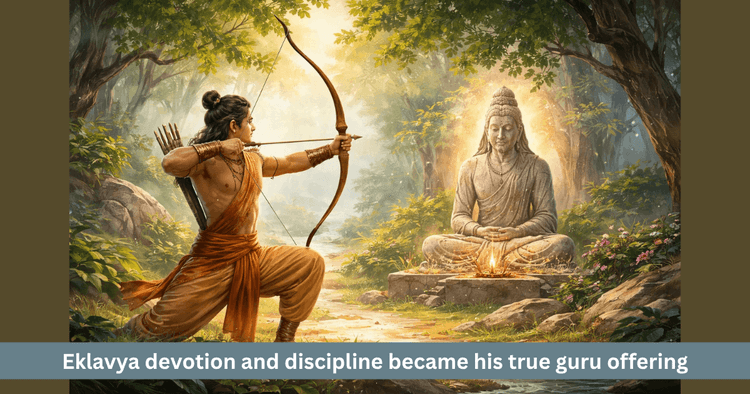
Table of Contents
In Indian tradition, Guru Purnima is not merely a festival. It is the day on which a disciple expresses gratitude toward the force that gives direction, discipline, inspiration and knowledge in life. Many stories are remembered on this day but among them one story returns again and again, the story of Ekalavya and Dronacharya. Most people reduce this episode only to the moment when Ekalavya offers his thumb. They assume that this alone was his guru dakshina. But if the story is observed more carefully, it becomes clear that Ekalavya’s true and invisible guru dakshina had begun much earlier. It began the moment he awakened within himself such deep reverence for the guru that even without receiving direct instruction he made an image of Dronacharya and dedicated himself to practice before it.
This episode becomes even deeper because a traditional understanding suggests that Ekalavya began the making of Dronacharya’s image in the month of Ashadha itself. If this indication is read in the wider spirit of the Mahabharata, then one begins to understand that Ashadha is not merely the beginning of the rains. It is also a time of inner discipline, receptivity, austerity and invisible surrender. That is why this beginning was not merely an act of image making. It was the first and deepest dakshina that his soul offered to the guru.
The greatest uniqueness of this story lies in the fact that the relationship between guru and disciple here is not based only on outward contact. The grace of the guru is not outwardly visible, yet the reverence of the disciple is absolutely visible. In Ekalavya’s life, that reverence becomes the center of his discipline. He asks for instruction, he is denied, yet the devotion to the guru within him does not break. This makes the episode one of the most extraordinary in the Indian understanding of discipleship.
Why should the story of Ekalavya not be limited only to the offering of the thumb
Whenever the name of Ekalavya is mentioned, the image that instantly appears in the mind is that of the thumb being offered to Dronacharya. Certainly that moment is deeply moving, complex and layered. Yet if the entire story is confined only to that event, the loftiest dimension of Ekalavya’s spiritual discipline is lost. His greatest offering was not the thumb. His greatest offering was turning stubbornness into reverence, transforming pain into discipline and converting deprivation into practice.
Some of the early forms of Ekalavya’s invisible guru dakshina may be understood as follows
- he did not choose rebellion against the guru even after rejection
- he transformed humiliation into inner practice
- he established Dronacharya as guru not outwardly but inwardly
- through the image he gave his practice a center
- even without recognition he kept the feeling of discipleship alive
All of this shows that his dakshina did not happen in a single day. It was a long inward offering.
What subtle relationship may exist between this episode and the month of Ashadha
Ashadha is regarded as a very special month in Indian tradition. It stands at the threshold of the rains. The earth moves from dryness toward inward moistening. Dust begins to settle and clouds gather in the sky. This outer change is also a beautiful symbol of inner discipline. When a seeker enters an Ashadha like phase in life, one becomes inwardly more receptive, more serious and more inclined toward solitude.
If Ekalavya began constructing Dronacharya’s image in Ashadha, then several levels of meaning open up
| Aspect of Ashadha | Its symbolic meaning in Ekalavya’s discipline |
|---|---|
| Gathering clouds | The deepening of inner question and pain |
| Waiting for rain | Waiting for the grace of the guru |
| Receptive earth | The prepared heart of the disciple |
| Mood of solitude | The condition of self directed practice |
| Moist clay | The shaping of the image and the stabilization of devotion |
This table makes it clear that Ashadha here is not merely a seasonal marker. It is also a deeply symbolic atmosphere of practice. Ekalavya’s discipline takes shape like rain softened earth.
Why was the making of Dronacharya’s image so significant
Making an image may seem like an ordinary act but for Ekalavya it was not merely memorial construction. It was the installation of the guru within consciousness. He did not allow Dronacharya to disappear from his inner vision. He received no formal instruction, yet he did not let his practice collapse into disorder. He knew that discipline needs a center, a direction and a standard. By making the image of Dronacharya, he gave form to that direction.
Through this image, Ekalavya accomplished several inward acts
- he transformed his practice from an anonymous effort into guru centered discipline
- he converted inner turbulence into worship
- he proved that the feeling of the guru does not end because of outer distance
- he created both a mental focal point and an emotional foundation for his discipline
In this way, the image was not a substitute for the absent guru. It became a new form of the guru’s presence.
Can the feeling of the guru awaken even through an image
The answer of Indian tradition is yes. When devotion is true, an image does not remain merely clay, wood or stone. It can become the center of remembrance, reverence, discipline and presence. That is exactly what happened in the story of Ekalavya. He practiced before the image of Dronacharya, bowed before it, learned in its presence, corrected himself and tried to keep his discipline worthy of the guru he had inwardly accepted.
An important distinction must be understood here. The image did not teach him technique but it preserved within him the discipline of the guru. He never allowed himself to become careless. He tried to make his effort worthy of the unseen gaze of the guru. This is where the invisible guru dakshina begins.
What was the invisible guru dakshina in truth
Ekalavya’s invisible guru dakshina began the day he decided that even if Dronacharya would not instruct him directly, he would still accept him as guru. That decision itself was immense. For here the disciple’s ego breaks and becomes reverence. He did not have the comfort of being formally accepted, yet he kept himself within the dignity of the guru disciple relationship.
The invisible forms of his dakshina may be understood as
- reverence that remained alive even after rejection
- discipline that continued without supervision
- practice that did not stop
- surrender that did not weaken even without reward
- silent acceptance that did not allow pain to become rebellion
That is why when the later episode of the thumb offering comes, it does not feel like an isolated event. It feels like the final visible expression of a much longer inward sacrifice.
What does the discipline of Ekalavya teach us
The episode of Ekalavya is not only historical or epic in value. It is also a profound example of the psychology of discipline. In life, every seeker does not receive ideal conditions. Sometimes the worthy guide remains distant, sometimes opportunity is denied, sometimes recognition does not come and sometimes the structure of society itself does not support the seeker. Most people either break under such conditions or become bitter. Ekalavya chooses a third path. He chooses discipline without comfort.
Some of the major teachings of this episode are
- devotion to the guru does not depend only on ease
- rejection does not mean the end of discipline
- a true disciple can fill outer absence with inner discipline
- the deepest practice is that which continues not for recognition but for transformation
- guru dakshina is not merely a material offering but the refinement of one’s own ego
Can the making of the image itself be called a form of guru dakshina
If guru dakshina is understood only as a gift offered after the completion of instruction, then perhaps not. But if guru dakshina is understood as the offering of one’s capacity, time, mind and life at the feet of the guru, then surely the discipline of Ekalavya is a very high form of dakshina. He received nothing outwardly, yet made the guru the foundation of his effort. He offered his labor in the name of the guru. He did not turn his achievement into private pride. These are among the loftiest forms of offering.
Why is this story remembered again and again on Guru Purnima
This story is remembered on Guru Purnima because it reveals an aspect of the guru disciple relationship that has become rare in modern times. Today many relationships are based on gain, recognition and direct interaction. But the story of Ekalavya teaches that the guru may also be that ideal before whom the disciple silently shapes oneself.
This remembrance becomes especially relevant on Guru Purnima for the following reasons
| Spirit of Guru Purnima | Its expression in Ekalavya’s story |
|---|---|
| Gratitude | Reverence even after rejection |
| Surrender | Construction of the image and constant practice |
| Discipline | Unbroken effort |
| Guru feeling | Inner nearness despite outer distance |
| Dakshina | Offering of ego and labor |
This table makes clear that the story is not recalled merely for emotion. It is recalled for profound self reflection.
Do pain and inspiration both move together in this story
Yes and that is what makes it deeply human. The story of Ekalavya is full of inspiration but it also contains pain. It contains devotion but also difficult questions. It contains surrender but also social complexity. That is exactly why the story is not merely idealistic. It becomes a mirror of life’s difficult truths. Its depth lies in the fact that it not only moves the heart but also compels thought.
The pain of Ekalavya shows that talent is not always recognized. His inspiration shows that practice is still possible even without recognition. His dakshina shows that devotion to the guru is not tested only in favorable situations.
What does Ekalavya’s invisible dakshina mean in modern life
Modern human beings also go through similar experiences. One does not always get the right opportunity. Effort is not always acknowledged. Skill is not always recognized. In such circumstances, the story of Ekalavya teaches that the true worth of a person is not decided only by outward certification. Its real strength lies in discipline, inward sincerity and perseverance.
A modern seeker or student may learn the following from this story
- if inspiration comes from outside, it is good but if it does not, practice must still continue
- one may shape oneself by holding an ideal person in the heart
- not every guru is physically present, yet some transform life even as an inward ideal
- true dakshina may at times be not success but constancy itself
The final light of this episode
The true guru dakshina of Ekalavya was not only the one that later became visible to the world. His real and invisible offering had already begun much earlier, when in the month of Ashadha he made the image of Dronacharya and established the feeling of the guru within himself. This traditional understanding connected with the Mahabharata makes the episode even deeper. Then it no longer remains only a story of sacrifice. It becomes a story of transforming rejection into discipline.
This is the greatest message of the episode. Guru dakshina is not only what is given by the hand. At times it is what begins in the heart. Sometimes it begins with an image, sometimes with silent practice, sometimes with gratitude and sometimes with the slow melting of one’s own ego. The invisible dakshina of Ekalavya teaches that a true disciple does not merely receive knowledge from the guru. One disciplines one’s life itself until it becomes worthy of the guru.
Frequently Asked Questions
What is meant by Ekalavya’s invisible guru dakshina
It refers to the inward offering that began long before the thumb offering, when he made the image of Dronacharya and began his discipline.
What is the connection of this episode with the month of Ashadha
According to traditional understanding, Ekalavya began making Dronacharya’s image in the month of Ashadha, linking the beginning of his discipline with that sacred time.
Is it accepted in Indian tradition to practice before an image as guru
Yes. When devotion is true, an image can become a center of remembrance, discipline and inward presence of the guru.
Why is this story told on Guru Purnima
Because it is one of the most moving examples of guru devotion, discipline, gratitude and invisible surrender.
What is regarded as the main source of this episode
The principal source of the story is the Mahabharata.
Get your accurate Kundali
Generate KundaliDid you like it?
Author
Pt. Nilesh Sharma (63)
Experience: 20
Consults About: Family Planning, Career
Clients In: Punjab, Haryana, Delhi
Share this article with friends and family
About ZODIAQ
ZODIAQ is an online Vedic Astrology platform. It connects clients seeking astrological advice to experienced astrologers with deep knowledge. Our users also generate kundali and perform kundali milan for free. ZODIAQ also offers services to the Astrologers. Astrologers utilize various offerings by ZODIAQ to serve their clients effectively.
If you are a User
Consult with experienced astrologers and seek their guidance. You can also order handwritten Janm Patrika report with life prediction prepared by experienced astrologers. Generate accurate Kundali, perform Kundali Matching and check horoscope and muhurat. Utilize our online library for all the necessary astrological and spiritual information.
If you are an Astrologer
Create accurate kundali for your clients and perform Kundali Matching for up to 5 people at a time. Write comprehensive Janm Patrika report for your clients with ZODIAQ. Check client details anytime by saving it in client directory. Become more productive by tracking how many clients you guide every day.
WELCOME TO
ZODIAQ
Right Decisions at the right time with ZODIAQ
