Meaning of Guru: Journey from Darkness to Light in Gu and Ru
By Aparna Patni
Understanding the deeper meaning of Guru as the remover of ignorance and the awakener of inner consciousness
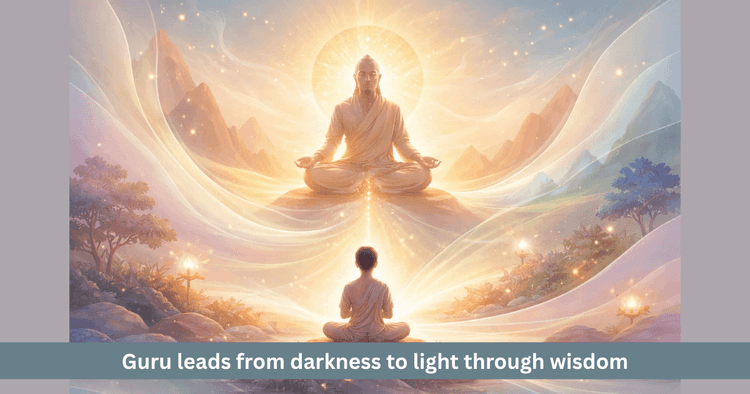
Table of Contents
In the Indian spiritual tradition, there are certain words which are not merely titles or forms of address. They contain within themselves an entire philosophy. Guru is one such word. In ordinary life, guru is often understood to mean teacher, guide, acharya or one who gives instruction. This meaning is valid in its own place but the scriptural vision is much deeper. In the Guru Gita, the explanation of the word guru reveals that the guru is not merely a person. The guru is the light of consciousness that removes ignorance, confusion, doubt and inner darkness from the human mind. There it is said that gu means darkness and ru means that which removes or destroys it. Thus the guru is the one who removes the darkness of the mind through the light of knowledge.
This explanation may appear simple at first, yet when understood deeply, it contains the whole essence of the guru principle. The greatest problem in life is not always outer lack. The deeper crisis is often within. A person may have resources, education and experience, yet may still fail in judgment, remain trapped in relationships, wander in ego or live in spiritual emptiness. This happens because inner darkness is not created merely by lack of information. It is born of ignorance, confusion, ego, misidentification, lack of discernment and inner disorder. The explanation in Guru Gita reveals that the task of the guru is not simply to provide information but to identify inner darkness and remove it.
Why Is This Explanation of Gu and Ru Considered So Deep
In Indian tradition, the interpretation of words is not merely a matter of language. It is often a pathway from sound to meaning and from meaning to philosophy. When the word guru is explained through gu and ru, it is not a poetic ornament or a linguistic play. It is an attempt to express the living experience through which a person moves from ignorance to illumination. Gu is darkness but not merely absence of visible light. It is that state of consciousness in which truth is present and yet not recognized. Ru is not merely a force of removal. It is the divine intervention that awakens light within.
This explanation is considered profound for several reasons:
- It raises the guru beyond a social role into a spiritual force
- It shows that the real problem is not outer but inner darkness
- It clarifies that knowledge is not mere information but illumination
- It transforms the idea of guru from a person alone into a living principle
For this reason, this explanation is not merely beautiful. It is deeply practical for spiritual life.
What Does Darkness Really Mean Here
When the scriptures speak of darkness, they do not merely mean lack of book learning or lack of literacy. The meaning here is subtler. Darkness is the condition in which a person does not know one’s real nature. One identifies only with the body, the mind, one’s role, position, wealth or temporary identity. That too is darkness. One keeps repeating the same mistakes and still does not understand the cause. That too is darkness. One stands before truth and still cannot accept it because ego blocks the way. That too is darkness.
Main forms of inner darkness
| Form of darkness | Its effect |
|---|---|
| Ignorance | Failure to recognize truth |
| Confusion | Taking the false to be true |
| Ego | Losing the ability to learn |
| Lack of discernment | Inability to distinguish right from wrong |
| Attachment | Seeking lasting fulfillment in temporary things |
| Doubt | Creating obstacles in decision and practice |
This table shows that darkness is not only absence of knowledge. It is also imbalance in consciousness.
What Does the Guru Remove and How
The guru removes darkness but this removal takes place on many levels. Sometimes the guru teaches through words. Sometimes through example. Sometimes through silence. Sometimes the guru cuts through the disciple’s confusion. Sometimes the guru carries the disciple beyond questions altogether. Therefore the work of the guru is not merely giving advice. The guru prepares the disciple inwardly in such a way that truth begins to reveal itself.
The removal of darkness through the guru may be understood through several stages:
1. Turning confusion into clarity
The guru shows what the disciple cannot yet see.
2. Turning ego into humility
Without humility, learning remains incomplete.
3. Turning information into realization
Hearing knowledge is not enough. It must descend inwardly.
4. Turning aimlessness into practice
The guru gives life a center.
5. Giving steadiness to an unstable mind
The guru reconnects the disciple with the deeper Self.
Is the Guru Only a Person
This is a very important question in Indian tradition. Certainly the guru may appear in the form of a person. A seeker may receive guidance from a teacher, saint, acharya or realized being. But the scriptures also teach that the guru principle is not limited to a physical person alone. It is a divine principle of awakening that may work through a human guide, through scripture, through a transformative experience or through the dawning of deeper insight within.
This makes the explanation of gu and ru even more profound. If the guru were only a person, the meaning would remain limited. But if the guru is the divine power that removes darkness, then the guru principle can operate through many forms in life. This is why Indian tradition speaks of the initiating guru, the teaching guru, the inner guru and even the scriptural guru.
What Is the Difference Between a Teacher and a Guru
Not every teacher is a guru and not every guru is only a formal teacher. A teacher may give information, explain a subject or transmit a skill. The guru goes further. The guru transforms the way a disciple sees reality. A teacher deals with outward knowledge. A guru changes the way one sees oneself. A teacher may prepare one for an examination. A guru prepares one for life. A teacher may improve memory. A guru awakens direct understanding.
Difference between a teacher and a guru
| Aspect | Teacher | Guru |
|---|---|---|
| Function | To teach a subject | To illumine consciousness |
| Area | Outer learning | Inner awakening |
| Result | Information | Transformation |
| Relationship | Formal | Spiritual and inward |
| Scope | Limited to a field | Extends to life and realization |
Once this distinction is understood, the dignity of the word guru becomes clearer.
What Is the Importance of This Explanation in Spiritual Practice
If a seeker truly understands that the guru is the one who removes darkness, the whole approach to spiritual life begins to change. Then the guru is not seen merely as a miracle giver, a comfort giver or one who grants favors. The seeker begins to look at what darkness the guru is revealing within. Sometimes grace comes as comfort. Sometimes it comes as a correction. Sometimes it comes through waiting. Sometimes through questions. Sometimes through silence. The purpose remains one, light.
Seen in this way, the relationship with the guru also becomes more mature. The disciple becomes less demanding and more receptive. One begins to ask:
- What darkness still remains within
- Do I truly wish to learn
- Do I seek only comfort or also truth
- Am I ready to let go of my confusion
These are the questions from which real spiritual life begins.
Can the Guru Remove Darkness Without the Disciple’s Readiness
The guru principle may always be luminous but receptivity is also necessary in the disciple. The sun shines equally for all, yet one who sits inside a closed room receives less light. In the same way, the presence of the guru may be available but if the mind is filled with ego, doubt, laziness and resistance, then the full benefit does not unfold. Therefore the explanation in Guru Gita also makes the disciple responsible. The guru removes darkness but the disciple must at least turn toward the light.
Main dimensions of a disciple’s readiness
- Reverence
- Humility
- Honesty in questioning
- Willingness to learn
- Courage to accept inner transformation
Why Is This Explanation of Guru So Relevant in Modern Life
Today’s world is full of information, yet not full of clarity. People read much, hear much and speak much, yet inner darkness often remains unchanged. Confusion is great, direction is weak. Confidence appears strong but self knowledge is shallow. In such a time, this scriptural explanation of the word guru brings us back to the essential truth. It tells us that the real guru is not the one who creates impression but the one who gives light. Whoever reduces inner darkness represents the guru principle.
Some major directions this teaching gives in modern life are these:
| Modern condition | Teaching from the guru principle |
|---|---|
| Excess of information | Learn to recognize essence and truth |
| Mental confusion | Seek inner clarity |
| Spiritual display | Value real transformation |
| Ego driven knowledge | Learn through humility |
| Lack of direction | Seek guidance that gives light, not mere influence |
Is the Guru Necessary Only in a Religious Sense
No, the meaning of guru is much wider than a narrow religious context. Wherever there is darkness, there is a need for light. For a student, the guru may be one who teaches not only facts but right thinking. For a seeker, the guru is one who shows the direction of self realization. For a confused person, the guru is one who brings clarity of judgment. At times even a life experience, a deep suffering or a silent truth may become guru like if it removes darkness.
Still, in the highest scriptural sense, the guru is that principle which finally leads a person to the truth of one’s own Self. This is the ultimate meaning of the explanation in Guru Gita.
What Is the Deepest Message of This Whole Theme
The explanation of gu and ru reveals that the center of spiritual life is not outer ritual alone but transformation of consciousness. The guru helps the seeker recognize the night within. Before giving something new, the guru removes what obstructs the truth. Therefore the greatest work of the guru is not merely answering questions. It is to awaken such light that the seeker can begin to see truth directly.
This teaching seems to say:
- Darkness is greater within than outside
- Knowledge is not information but illumination
- The guru may be a person but is even more deeply a principle
- True guidance is that which reconnects the soul with its own truth
Final Reflection
The explanation found in the Guru Gita, that gu means darkness and ru means that which removes it, expresses the heart of the Indian guru tradition in a simple and beautiful form. The guru is the one who removes ignorance, confusion, doubt and inner forgetfulness and lights the lamp of knowledge within. In this sense, the guru is not only a revered person but the doorway through which light enters life. The guru turns the disciple from the outer world toward the inner truth. The guru prepares the ground through which self confidence may deepen into self realization.
therefore it may be said that to understand the true meaning of the word guru is already half the journey of spiritual life. One who understands that the guru’s work is to remove darkness begins to seek that light with greater seriousness. That is the most beautiful, deepest and most life giving truth of this sacred explanation.
Frequently Asked Questions
What do gu and ru mean
According to the traditional explanation, gu means darkness and ru means that which removes darkness.
What is the real work of the guru
The real work of the guru is not merely to teach but to remove ignorance, confusion and inner darkness through knowledge.
Is every teacher a guru
No, a teacher may teach a subject but a guru illumines consciousness and changes one’s way of seeing life.
Is the guru only present as a person
No, the guru principle may also work through scripture, experience, silence or inner awakening.
Why is this explanation in Guru Gita important
Because it reveals that the guru is not merely a title but a divine force that removes darkness.
Get your accurate Kundali
Generate KundaliDid you like it?
Author

Aparna Patni (63)
Experience: 20
Consults About: Family Planning, Career
Clients In: Punjab, Haryana, Delhi
Share this article with friends and family
About ZODIAQ
ZODIAQ is an online Vedic Astrology platform. It connects clients seeking astrological advice to experienced astrologers with deep knowledge. Our users also generate kundali and perform kundali milan for free. ZODIAQ also offers services to the Astrologers. Astrologers utilize various offerings by ZODIAQ to serve their clients effectively.
If you are a User
Consult with experienced astrologers and seek their guidance. You can also order handwritten Janm Patrika report with life prediction prepared by experienced astrologers. Generate accurate Kundali, perform Kundali Matching and check horoscope and muhurat. Utilize our online library for all the necessary astrological and spiritual information.
If you are an Astrologer
Create accurate kundali for your clients and perform Kundali Matching for up to 5 people at a time. Write comprehensive Janm Patrika report for your clients with ZODIAQ. Check client details anytime by saving it in client directory. Become more productive by tracking how many clients you guide every day.
WELCOME TO
ZODIAQ
Right Decisions at the right time with ZODIAQ
