Significance of Guru Paduka Worship on Guru Purnima
By Pt. Sanjeev Sharma
Understanding surrender, grace, and spiritual humility through Guru’s Paduka
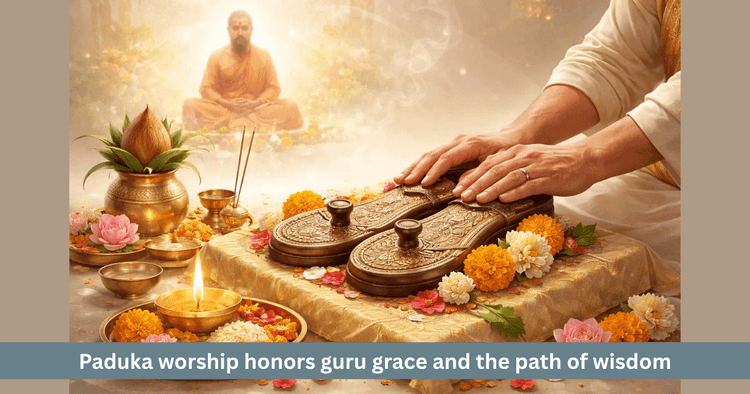
Table of Contents
The day of Guru Purnima is not only a festival of reverence in Indian spiritual tradition. It is also the moment when the disciple tries to recognize the true source of wisdom, direction, humility and grace in life. For this reason, Guru vandana, reverence to the Guru, Guru smarana, remembrance of the Guru, and worship of the Guru’s Paduka, the sacred sandals or foot symbols of the Guru are considered especially important on this day. The Guru’s Paduka is not seen merely as an object made of wood, metal or symbolic form. It is regarded as the touch of that path on which the seeker walks from ignorance toward light. On Guru Purnima, the feeling of Paduka worship is therefore considered deeply tender, serious and spiritual.
In Guru Paduka Stotra, the hymn in praise of the Guru’s sacred sandals, one finds a special glorification of the Guru’s Paduka, and in Hindu tradition this feeling is deeply connected with the understanding that the Guru’s feet are centers of energy, grace and spiritual protection. Traditional belief also says that many subtle currents of the body connect with and release into the earth through the feet. In such a view, the Guru’s feet do not remain merely a part of the body. They are understood as the base of that consciousness which gives the disciple steadiness, peace and an upward moving vision of life. This is why the worship of the Paduka on Guru Purnima is seen not only as a ritual, but as a practice of surrender, receiving energy and spiritual humility.
What does worship of the Guru’s Paduka signify
The outer form of Paduka worship may appear simple, yet its inner meaning is very deep. The Paduka reminds the disciple of the path on which the Guru has walked. When the disciple bows before the Paduka, what is being saluted is not only a symbol of feet, but the discipline, austerity, wisdom and lived realization that made the Guru a Guru. This worship does not teach blind reverence toward a person. It teaches respect for the height that the Guru has established through life and practice.
Another subtle feeling is hidden in this worship. To place the head below the feet is not only an outer gesture of humility. It is also a discipline of lowering the ego within. To bow before the Guru’s Paduka is like accepting that intellect alone is not enough, logic alone is not enough, and that realized wisdom and the touch of grace are also needed to give life the right direction.
Why are the feet regarded as a center of energy
In Indian traditions, the feet are viewed with great reverence. Touching the feet of parents, bowing at the feet of saints and worshipping sacred footprints in pilgrimage traditions all arise from one common feeling, that the feet symbolize journey, contact, grounding and direction. When the feet of a Guru are spoken of, this feeling becomes even deeper, because the Guru does not only walk, but teaches others how to walk.
From the traditional perspective, it is believed that the subtle energy of the body has an important relationship with the earth through the feet. On this basis, the idea also developed that in the Guru’s feet there abides that steady energy, disciplined force and spiritual vibration that have matured through austerity, mantra practice, wisdom and compassion. For this reason, the disciple does not offer respect to the Guru’s feet only as a gesture of honor, but also with the feeling of receiving blessing and inward balance.
The spiritual symbolism of the feet
- The feet symbolize guidance
- The Paduka is a living memory of spiritual practice
- Touch awakens the feeling of receiving grace
- Humility becomes the first step of discipleship
- Energy is seen as a power that steadies and directs
Why is Paduka worship considered special on Guru Purnima
Guru Purnima is linked with the fullness of the Guru principle. This day is not only the birthday or memorial of a particular person. It is the day of gratitude toward the lineage of wisdom. On such a day, Paduka worship gives concrete form to the feeling that the path shown by the Guru is not to be heard only, but to be lived with resolve.
When Paduka worship is performed on Guru Purnima, spiritual practice unfolds at many levels together. The hands engage in worship, the mind settles in reverence, the intellect remembers the Guru’s teaching and the heart learns humility. That is why this worship does not remain a mere procedure. It becomes an inner reordering. The disciple places the self once again in the right position and remembers that the center of life should not be ego, but light.
How does Guru Paduka Stotra deepen this feeling
Guru Paduka Stotra connects the Guru’s Paduka with the power to remove ignorance, show the path and lead one toward liberation. For this reason, the Hindu tradition of spiritual practice did not regard Paduka worship as merely an emotional symbol. It was also understood as a means of spiritual elevation. The feeling of the hymn suggests that the Guru’s Paduka represents that consciousness which can steady the mind, clarify the intellect and empower spiritual discipline.
When a hymn offers such glory to the Paduka, it does not mean that the object itself performs wonders. It means that the Guru’s Paduka awakens within the disciple a state in which life may be connected with higher discipline, deeper humility and steady practice. That inner state is what slowly transforms the seeker.
Is Paduka worship only symbolic
This question is important because many people leave Paduka worship at the level of a religious symbol alone. In truth, this worship is both symbolic and practical for spiritual life. It is symbolic because it preserves the memory of the Guru’s path, austerity and presence. It is practical because it builds humility, discipline, receptivity and devotion within the disciple.
If the worship remains only an outer act, its effect may remain limited. But if the disciple bows with the understanding that the Guru’s feet are the direction of wisdom, then Paduka worship can become a means of inner transformation. Its value therefore lies not only in how many flowers were offered, but in how much ego was released and how deeply the path was accepted.
How should the relation between the Paduka and discipleship be understood
Discipleship does not mean only receiving knowledge. It means making oneself worthy of learning. Paduka worship begins precisely this process. When the disciple sits before the Guru’s Paduka, there is also an inner question. Is there real readiness to receive instruction. Is the desire only for inspiring words, or also for actual discipline. Is blessing wanted, while life remains unchanged. These questions make Paduka worship serious.
What Paduka worship teaches the disciple
- To bow is not to lose, but to learn
- Reverence remains incomplete without practice
- The Guru’s path is meant to be lived, not merely heard
- Receiving energy becomes possible only when there is inward quiet
- Grace stays where humility is present
The spiritual meaning of the body’s energy and its relation to the earth
When it is said that the energy of the body is released into the earth through the feet, it is not enough to understand this only in physical language. Its spiritual meaning is also that all human activity ultimately rests upon a foundation. The feet are that foundation. They hold the body, give balance and maintain real contact with the earth. The Guru’s feet are therefore regarded as the center of steadiness because they symbolize not only physical support, but the grounded earth of spiritual practice.
The Guru’s mind is beyond wavering, so the Guru’s feet become symbols of stability. When the disciple performs Paduka worship, it is as if that stability is being invited within. The disciple seeks to connect inner scatteredness with a center. This is why the feet are seen as centers of energy. Here energy means not power alone, but also balanced consciousness.
Which feelings are central in the traditional method of Paduka worship
The outer method may vary across traditions, but the inner feelings remain largely the same. Bathing, a clean seat, lamp, flowers, rice offering, sandal paste, mantra, bowing and meditation together complete the worship. Even so, the center of Paduka worship is not the material used, but the feeling carried within. Where reverence is absent, the method may become dry. Where inner feeling is present, even a simple worship may become profound.
The main feelings in Paduka worship
| Element | Inner meaning |
|---|---|
| Offering of water | Purification and surrender |
| Sandal paste | Coolness and reverence |
| Flowers | Devotion of the heart |
| Bowing | Lowering of the ego |
| Meditation | Connection with the Guru consciousness |
Does worship of the Guru’s Paduka calm the mind
Yes, if this worship is performed with feeling, it can give deep steadiness to the mind. The mind often remains entangled in surface thoughts, anxieties, insecurities and desires. Paduka worship pauses all of this for a moment and reminds the disciple that there is also a center in life that stands above these disturbances. The Guru’s Paduka becomes the memory of that center.
When the forehead touches the feet, inward tension may begin to loosen. When the eyes are closed and the Guru is remembered, the mind may return from scatteredness. When the Paduka is worshipped with devotion as a center of energy, a subtle trust may awaken within the seeker that the path is not abandoned and that protection remains present.
What does Paduka worship teach in the present age
The present age is marked by speed, mental noise, excess information and self centered living. In such a time, the feeling of Paduka worship appears even more necessary because it returns the human being to humility, respect, listening, patience and spiritual discipline. It reminds one that wisdom is not mere information and the Guru is not merely an inspiring personality. The Guru is one before whose feet the disciple learns to let go of inner hardness.
This worship also teaches the modern seeker that energy is not only something to acquire. One must also become worthy of holding it. To regard the Guru’s feet as centers of energy means exactly this, that power remains safely held where there is discipline, peace and austerity.
The feeling of grace gathered in the feet
The significance of worshipping the Guru’s Paduka on Guru Purnima lies in the fact that it returns the disciple to the essential truth. Wisdom may appear to come from the head, yet its roots lie in the conduct of life. The Guru’s feet are that conduct. They are that austerity. They are that journey. They are the ground on which wisdom became living. Therefore, to worship the Guru’s Paduka is to bow before the whole discipline that is far greater than words.
This traditional feeling affirmed through Guru Paduka Stotra, that the Guru’s feet are centers of energy, gives deep reassurance to the disciple. Its essence is not that some outer wonder will occur. Its essence is that where the touch of the Guru’s feet is remembered, there is direction. Where there is direction, there is steadiness. Where there is steadiness, there is peace. And where there is peace, true spiritual practice begins.
Frequently asked questions
Is it considered special to worship the Paduka on Guru Purnima
Yes, on this day Paduka worship expresses the feeling of Guru reverence, surrender and discipleship in a very deep way.
Why is the Guru’s Paduka given so much importance
Because it is regarded as a symbol of the Guru’s path, austerity, grace and steady consciousness.
Why are the feet called centers of energy
According to traditional belief, the subtle energy of the body has a deep relation with the earth through the feet, so the Guru’s feet are seen as centers of steady energy.
Is Paduka worship only symbolic
No, it is both symbolic and practical for spiritual life because it awakens humility, reverence and receptivity within the disciple.
What is the relation of Guru Paduka Stotra to this worship
This hymn describes the greatness of the Guru’s Paduka, which helps one understand the spiritual importance of this worship more deeply.
Get your accurate Kundali
Generate KundaliDid you like it?
Author

Pt. Sanjeev Sharma (63)
Experience: 20
Consults About: Family Planning, Career
Clients In: Punjab, Haryana, Delhi
Share this article with friends and family
About ZODIAQ
ZODIAQ is an online Vedic Astrology platform. It connects clients seeking astrological advice to experienced astrologers with deep knowledge. Our users also generate kundali and perform kundali milan for free. ZODIAQ also offers services to the Astrologers. Astrologers utilize various offerings by ZODIAQ to serve their clients effectively.
If you are a User
Consult with experienced astrologers and seek their guidance. You can also order handwritten Janm Patrika report with life prediction prepared by experienced astrologers. Generate accurate Kundali, perform Kundali Matching and check horoscope and muhurat. Utilize our online library for all the necessary astrological and spiritual information.
If you are an Astrologer
Create accurate kundali for your clients and perform Kundali Matching for up to 5 people at a time. Write comprehensive Janm Patrika report for your clients with ZODIAQ. Check client details anytime by saving it in client directory. Become more productive by tracking how many clients you guide every day.
WELCOME TO
ZODIAQ
Right Decisions at the right time with ZODIAQ
