Spiritual Meaning of Trinok Guha and Guru Purnima in Jain Dharma
By Pt. Amitabh Sharma
Exploring devotion, discipline, and Guru reverence on Ashadha Purnima
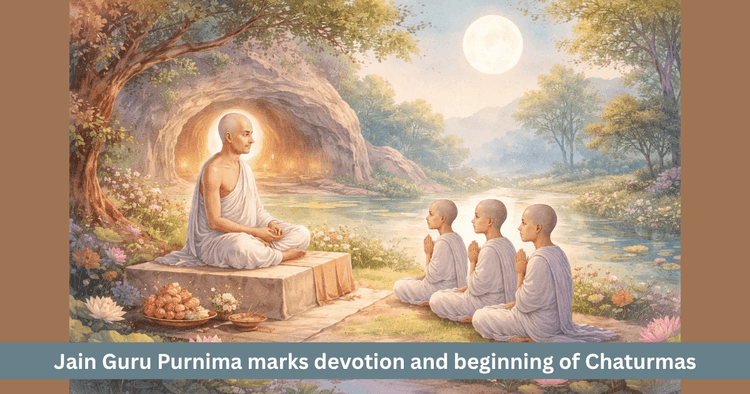
Table of Contents
The day of Ashadha Purnima is viewed with special reverence across Indian spiritual traditions, yet in Jain Dharma it appears with a distinct depth. It is not only a celebration of the fullness of the Moon, but also a day of Guru vandana, reverence to the spiritual guide, self restraint, devotion, vows, and inner preparation for the disciplined period ahead. Jain followers observe this date as Guru Purnima and, while offering humble reverence to their Gurus, take the resolve of Chaturmas, the four month period of disciplined religious observance. In Jain Agama, the scriptural tradition of Jainism, the indication of this practice is linked with reverence toward the Guru and steadiness in spiritual discipline. Alongside this, in Jain monastic tradition, Chaturmas is connected with the disciplined stay of monks and nuns under the guidance of the Acharya, the spiritual head. :contentReference[oaicite:4]{index=4}
The feeling of this day does not remain confined to outer ritual. It becomes a time to look within. The mind reflects on what guidance truly means, whether dedication toward the Guru remains limited to bowing alone or enters daily conduct, and how discipline may rest not on a changing mood but on steady commitment. The indication associated with Trinok Guha creates in Jain religious memory a field of feeling where devotion and restraint stand together. Here the full Moon does not bring only light. It also awakens the call of a disciplined life.
How is Guru Purnima viewed in Jain Dharma
In Jain Dharma, the place of the Guru is considered extremely high. The Guru is not merely a person who imparts knowledge, but a guiding light who shows the path of discipline, character, restraint and spiritual elevation. Therefore, when Jain followers offer reverence to their Gurus on Guru Purnima, it is not merely a social form of respect. It also includes surrender of ego, gratitude and renewed commitment to the path of dharma.
In the Agamic tradition of Jain Dharma, vows, discipline, renunciation and spiritual practice are treated as central foundations of life. Jain Agamas present the tradition of conduct and vows with great seriousness, where principles such as ahimsa, nonviolence, satya, truthfulness, asteya, non stealing, brahmacharya, celibacy or purity, and aparigraha, non possession, become the axis of religious living. In that light, the day of Guru Purnima becomes not only a time to hear these principles, but to establish them again within.
What feeling does the indication of Trinok Guha bring forward
In Jain Dharma, the mention of Trinok Guha gives the spiritual memory of this day a distinct identity. This indication reminds devotees that religion is not only a matter of thought. It is also a process of pausing, becoming still, turning inward and giving one’s resolve a new form in the presence of the Guru. The center of this episode is not outer expansion, but inner gathering. To collect what is scattered, to strengthen what has become weak and to take what is superficial into the depth of discipline is the spiritual message that may be drawn from it.
That is why the worship of this day does not remain merely procedural. It becomes a practice of humility before the self. While offering reverence at the feet of the Guru, Jain followers accept that the path ahead cannot be shaped by ego alone. It requires guidance, it requires austerity and above all it requires a vision that protects the soul from wandering.
Why is the resolve of Chaturmas so important on this day
Taking the resolve of Chaturmas on Guru Purnima is a deeply meaningful feature of Jain tradition. With the arrival of the rainy season, this becomes the time when monks and nuns stay in one place and follow a more focused discipline of spiritual practice, discourse and restrained religious life. In Jain monastic traditions, Chaturmas is regarded as a period of staying in one place and practicing under the direction of the Acharya. :contentReference[oaicite:6]{index=6}
Chaturmas is not merely a seasonal arrangement. It is a period of spiritual deepening. Outer movement decreases so that inner movement may increase. Contact becomes limited so that observation of the mind may grow deeper. Food, conduct, speech, awareness and self study receive greater attention. In this way, the resolve of Chaturmas taken on Guru Purnima teaches that when the season changes, the seriousness of spiritual practice should also deepen.
The practical meaning of the Chaturmas resolve
| Aspect | Meaning |
|---|---|
| Guru vandana | Gratitude and humility toward the guide |
| Chaturmas resolve | Renewal of discipline, steadiness and spiritual practice |
| Inner purpose | To establish the mind in restraint and awareness |
| Community effect | Strengthening discourse, study and religious unity |
| Personal fruit | Self examination and purification of life |
Is this day important only for monks and nuns
No, this day is not important only for the initiated ascetic life. Jain shravakas and shravikas, lay men and lay women followers, also observe it with equal devotion. The difference lies only in the intensity of practice. For monks and nuns, it may become a period of stricter discipline and steady austerity, while for household followers it becomes a time of self restraint, self study, vows, food discipline, forgiveness and bringing the Guru’s teachings into one’s daily life.
For the householder, Jain Dharma has never been merely a philosophy. It is a form of discipline that enters conduct. Therefore, even a small resolve taken on Guru Purnima is not considered ordinary. A person may take a vow to reduce anger. Another may bring restraint into food. Someone may adopt a daily practice of pratikraman, reflective repentance and review, recitation or self study. Someone else may begin the effort to bring the Guru’s words into conduct. These small resolves eventually change the larger direction of life.
What is the Jain feeling behind Guru vandana
In Jain tradition, reverence for the Guru is not personality worship. Its essential feeling is vinaya humility. Vinaya means such a bowing that lightens the soul. When the disciple bows before the Guru, in truth the disciple learns to bow the ego within. This same bowing later becomes the foundation of restraint.
On this day, several subtle feelings work together in Guru vandana:
- Gratitude that someone showed the path of dharma
- Acceptance that spiritual purification requires guidance
- Resolve that what has been heard will be brought into life
- Humility that the door of wisdom opens through gentleness
- Discipline that spiritual practice will be continued with steadiness
That is why the festival of Guru Purnima becomes not merely an occasion for expressing respect, but a day that can redirect life.
What does this day teach from the perspective of Jain Agama
Jain Agamas connect dharma with conduct, vows and awareness. Mere belief is not considered sufficient there. The emphasis falls on shaping life through austerity, restraint and alertness. Against this background, the day of Guru Purnima becomes highly important because devotion and practice do not remain separate here.
The conduct centered tradition of Jain Dharma teaches that religion has value only when it becomes visible in compassion toward living beings, self control, non possession and truthfulness. The resolve of Chaturmas on Guru Purnima strengthens precisely this view of life. The stream of vows and discipline that appears in Jain Agamas gives seriousness to the feeling of this day.
Which inner resolves may be taken on this day
For the resolve taken on Guru Purnima not to remain merely formal, it must stay close to life. For Jain followers, a few resolves may be especially meaningful:
- Practicing restraint in speech
- Bringing ahimsa, nonviolence, more carefully into thought, word and action
- Setting aside some time daily for self study
- Reducing unnecessary accumulation through the feeling of aparigraha, non possession
- Making a real effort to bring the Guru’s teachings into conduct
The value of these resolves does not lie in how large they appear. Their value lies in how much they purify the soul.
Is Guru Purnima in Jain Dharma also a time for self examination
Yes, certainly. This day is as much about reverence toward the Guru as it is about examining oneself. A person may see whether dharma is present only in festivals or also in everyday life. Does restraint break when the moment becomes difficult. Is speech still sharp? Does greed still influence decisions? Is the practice of forgiveness genuine? Such questions give Guru Purnima its depth.
Self examination is a foundational tendency of Jain Dharma. Traditions such as pratikraman, self review and repentance, self study and austerity strengthen this awareness. Therefore, the Chaturmas resolve taken on Guru Purnima is not only a plan for the coming months. It is also a mirror placed before the soul.
The communal beauty of this festival
In Jain society, this day also takes the form of collective devotion. In temples, upashrayas, monastic or religious centers and other sacred spaces, an atmosphere of Guru reverence, discourse, self study and shared resolve arises. Within the community, the feeling strengthens that religion is not only private practice, but also shared ethical life.
There is another beautiful aspect to this. On Guru Purnima, the community does not only offer respect. It also renews the vow to carry forward the living tradition of dharma. Honor toward the Guru is considered complete only when the disciple keeps the teachings alive. That is why the dignity of this day is determined not by outer arrangement, but by inner seriousness.
The mind returning toward spiritual practice
On Guru Purnima in Jain Dharma, the remembrance of Trinok Guha and the resolve of Chaturmas together create a spiritual ground where the mind learns to become still. In the middle of a rushing world, this festival says that pausing is also spiritual practice. Bowing is also a spiritual practice. Listening is also spiritual practice. And then bringing what has been heard into life is an even greater spiritual practice.
This is the true beauty of the day. Here the full Moon does not bloom only in the sky. It blooms in devotion. It blooms in humility. It blooms in that resolve through which a person wishes to adopt dharma not for a short while, but as the nature of life itself.
Frequently asked questions
Is Ashadha Purnima observed as Guru Purnima in Jain Dharma
Yes, Jain followers observe this day as Guru Purnima and offer reverence to their Gurus.
Why is the resolve of Chaturmas taken on this day
Because this period is regarded as one that deepens steady spiritual practice, disciplined living, self study and religious seriousness.
Is Guru Purnima important only for monks
No, it is equally important for household Jain followers as well, because they too take resolves of restraint and dharmic conduct on this day.
What is the main feeling behind Guru vandana
Its main feeling is humility, gratitude, self purification and commitment toward the path of dharma.
Is self examination also important on this day
Yes, this day offers the opportunity to examine oneself, observe one’s conduct and make spiritual practice more serious.
Get your accurate Kundali
Generate KundaliDid you like it?
Author
Pt. Amitabh Sharma (56 Years)
Experience: 20
Consults About: Family Planning, Career
Clients In: Punjab, Haryana, Delhi
Share this article with friends and family
About ZODIAQ
ZODIAQ is an online Vedic Astrology platform. It connects clients seeking astrological advice to experienced astrologers with deep knowledge. Our users also generate kundali and perform kundali milan for free. ZODIAQ also offers services to the Astrologers. Astrologers utilize various offerings by ZODIAQ to serve their clients effectively.
If you are a User
Consult with experienced astrologers and seek their guidance. You can also order handwritten Janm Patrika report with life prediction prepared by experienced astrologers. Generate accurate Kundali, perform Kundali Matching and check horoscope and muhurat. Utilize our online library for all the necessary astrological and spiritual information.
If you are an Astrologer
Create accurate kundali for your clients and perform Kundali Matching for up to 5 people at a time. Write comprehensive Janm Patrika report for your clients with ZODIAQ. Check client details anytime by saving it in client directory. Become more productive by tracking how many clients you guide every day.
WELCOME TO
ZODIAQ
Right Decisions at the right time with ZODIAQ
