Indra and Brihaspati Story: Why Prosperity Fades Without Guru Respect
By Pt. Abhishek Sharma
A Puranic lesson on ego, gratitude, and the power of Guru’s grace
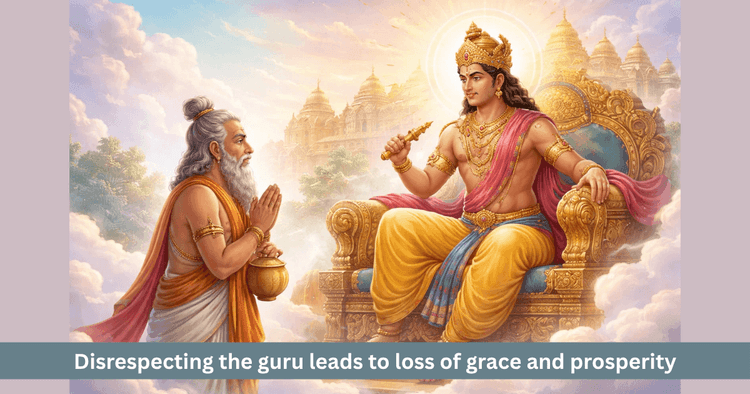
Table of Contents
In Indian Puranic tradition, many stories appear at first to be events among the gods, yet inwardly they reveal profound truths about human life. The episode of Indra and his guru Brihaspati is one such serious and instructive example. This is not only a story of honor and insult. It is a story of ego, gratitude, the grace of the guru, dharma, and the subtle balance that preserves the grace of life. For this reason, this episode is remembered especially on Guru Purnima.
Indra is regarded as the king of heaven. He possessed wealth, power, honor, divine authority, and the highest seat of celestial rulership. He sat upon the throne of the gods, surrounded by splendor and majesty. Yet the Puranas repeatedly remind us that outer power remains stable only as long as it is supported by humility and reverence for the guru. The moment ego enters, the radiance of prosperity begins to fade. This is exactly what happened in Indra’s life. He failed to show proper respect toward his guru Brihaspati, and from that very point the balance of his life began to weaken.
This story teaches that ability, position, and wealth are not enough in life. The grace that remains in a person’s life does not come only from outward achievement. It comes from refinement, reverence, gratitude, and from those subtle blessings that enter life through the guru. Guru Purnima therefore is not merely a festival of worship. It is the day on which the disciple awakens the feeling that if there is light in life, some form of guru has surely stood behind it.
How did this mistake arise within Indra
The greatest test of prosperity is not how much a person gains. The true test is whether one remains aware and humble even after gaining much. Indra had everything. That fullness gradually brought a kind of inward carelessness. When a person receives continuous honor, one may begin to imagine that one is the sole cause of it all. That is the first shadow of downfall.
Brihaspati was not merely the personal teacher of Indra. He was the guru of the gods, the guide of celestial wisdom, and the representative of dharmic discernment. His place in the divine assembly was not ceremonial. He symbolized the wisdom that gives balance to power. When such a guru is insulted, it is not only a person who is dishonored. It is discernment itself that is dishonored. That is why the Puranic tradition presents this event with such seriousness.
Indra’s error was that he allowed his position to grow so large within him that the significance of the guru’s presence became smaller. The same error appears in every age. The moment a person begins to think that one no longer needs guidance, that very moment can become the beginning of decline.
Why was the silence of Brihaspati so powerful
One of the most subtle parts of this story is that Brihaspati did not react with anger, revenge, or harsh speech. He simply withdrew. This silence was not ordinary silence. It was the sign that the grace of the guru had moved away from the life of Indra. Many times in life, the greatest punishment does not come through words, but through the quiet withdrawal of grace.
The departure of Brihaspati shows that the guru does not force blessings upon the disciple. If the disciple loses inner reverence, the presence of the guru naturally becomes distant. That distance may look outward, yet its consequences are deep. Where the light of the guru is absent, decisions become confused, discernment weakens, and prosperity becomes unstable even while still appearing outwardly present.
This makes it easier to understand why the prosperity of Indra began to vanish. His wealth had not rested only upon outer power. It had been balanced by guru grace. As soon as that balance withdrew, his splendor became uncertain.
What is the spiritual meaning of prosperity being taken away
When the Puranas say that Indra’s prosperity was taken away, this should not be read merely as an event involving throne, kingdom, or riches. Prosperity has a much wider meaning. It includes outer wealth, but also honor, confidence, stability, radiance, continuity of success, and that subtle charm which in present language may be called the grace of life.
When reverence for the guru declines, the following blessings also begin to weaken
- clarity in decision making diminishes
- peace does not remain even amidst success
- subtle disturbances begin appearing in relationships
- achievements lose their lasting stability
- the inward foundation of humility becomes weak
It is important to understand that the language of the Puranas is also symbolic. The fading of Indra’s prosperity teaches that disrespect toward the guru eventually disturbs the inner structure of life itself. This consequence may not always look dramatic at first, yet it is deep.
Why is this story remembered on Guru Purnima
Guru Purnima is not merely a day to recall the names of past gurus. It is a day to recognize the guru principle active in one’s own life. The story of Indra and Brihaspati becomes especially meaningful on this sacred day because it reminds us that gratitude is not only refined behavior. It is also one of the foundations of inner protection.
On this day, a disciple must awaken some essential questions within
- is there true gratitude toward the guidance received in life
- has one begun to take direction and wisdom for granted
- does humility still remain even after success
- is there a living awareness that not everything in life has come through personal talent alone
For this reason, Guru Purnima becomes a living discipline. It is not only an observance. It is a purification of the heart.
Why is the relationship between gratitude and grace so deep
In modern language people often say that a person carries a special grace. This grace does not arise merely from beauty, wealth, language, or status. It comes from inward refinement, discipline, values, and blessings. Gratitude toward the guru protects this inner grace. It reminds a person that one is not the sole architect of life. There has been a subtle stream of blessing working behind the journey.
Some of the deeper fruits of gratitude are
| Feeling of gratitude | Its effect in life |
|---|---|
| Humility | It keeps ego within limits |
| Remembrance | It prevents one from forgetting the true source |
| Reverence | It makes one worthy of receiving grace |
| Balance | It keeps a person steady even amidst success |
| Grace | It preserves softness and dignity in life |
This table makes clear that gratitude is not an emotional slogan. It is a practical and spiritual force.
Does disrespect toward the guru always happen outwardly
No. This is one of the most subtle points in the episode. Disrespect toward the guru does not occur only through harsh words. It can also arise through inward carelessness. When a disciple begins to diminish the value of the guru, when one starts to feel that guidance is no longer necessary, when one sees counsel as a burden, or when one begins to regard success as entirely self created, then the guru principle is already being dishonored.
Some subtle forms of disrespect toward the guru are
- failing to value guidance
- ignoring what has been learned and acting only from ego
- treating the guru as useful rather than sacred
- forgetting the true source after success
- abandoning humility after receiving knowledge
The story of Indra teaches precisely this subtlety. Disrespect does not always begin with noise. Very often it begins silently within, and its results appear later.
The place of Brihaspati is not limited only to that of a celestial guru
In Indian tradition, Brihaspati symbolizes wisdom, dharma, auspicious guidance, measured expansion, and right discernment. Therefore the story of Indra and Brihaspati should not be understood only as an event between two beings. It is also a story about the relationship between power and wisdom. When power insults discernment, downfall becomes inevitable. When prosperity separates itself from dharmic intelligence, it begins preparing its own destruction.
In this sense, the story applies to every human being. There is an Indra within each person who seeks achievement, and there is a Brihaspati within who seeks to guide that achievement rightly. The moment the inner Indra stops listening to the inner Brihaspati, unrest begins.
How is this episode relevant in modern life
Modern life is driven by the race for outer success. Position, prestige, wealth, influence, and recognition often become so dominant that people forget those who laid their foundation. The word guru here need not refer only to a traditional spiritual master. It may also refer to parents, teachers, guides, elders, or those values that prevented one from collapsing in difficult times.
Indra’s mistake still appears in many forms today
- forgetting one’s teachers after success
- failing to remain grateful toward those who gave direction
- imagining that achievements are the result only of personal ability
- neglecting values and relationships because of ego
In such a time, this story offers a calm yet profound warning. If one wishes to preserve grace in life, gratitude must remain alive.
What practice can be taken from this story on Guru Purnima
This episode should not be remembered on Guru Purnima only as a narrative. It should also become a form of practice. On this day, alongside outer worship, one may inwardly take certain sacred resolves.
Inner practice for this day
- offer heartfelt thanks to all who gave direction in life
- acknowledge the hidden grace behind one’s success
- recognize one’s own ego honestly
- seek not only blessings from the guru, but also discernment
- resolve to protect the grace already present in life
When this practice is performed with sincerity, Guru Purnima no longer remains only a tradition. It becomes a festival of inward humility.
The final radiance of this episode
The story of Indra and Brihaspati teaches that the prosperity of life is not the result of power alone. It is protected by the grace of the guru, dharmic discernment, and gratitude. The moment Indra lost reverence toward his guru, his splendor began to weaken. This is why the Puranic tradition reminds us that if one wishes to preserve grace in life, reverence for the guru and gratitude in the heart are essential. The tradition associated with the Markandeya Purana turns Guru Purnima into not merely a day of worship, but a day of renewed humility.
This is the deepest message of the story. To bow to the guru on Guru Purnima is not merely to perform a ritual. It is to recognize the source of light in one’s life. It is to accept that whatever is noble, beautiful, and balanced in life has not come through one’s own strength alone. It carries the unseen touch of the guru. And when this remembrance remains alive, life retains not only prosperity, but also grace.
Frequently Asked Questions
Why was Indra’s prosperity taken away
Because he disrespected his guru Brihaspati, and through that the balance of guru grace and dharmic wisdom was lost.
What is the connection of this story with Guru Purnima
This story reminds us that Guru Purnima is the day to express gratitude toward the guru so that grace and balance remain in life.
What does grace mean here
Grace refers to that subtle beauty, steadiness, humility, and blessing in life that does not come from outer success alone.
Can disrespect toward the guru happen without harsh words
Yes. Forgetting the importance of guidance, taking wisdom lightly, and losing humility after success are also forms of disrespect.
What is regarded as the main source of this episode
The principal source of this episode is regarded as the Markandeya Purana.
Get your accurate Kundali
Generate KundaliDid you like it?
Author

Pt. Abhishek Sharma (63)
Experience: 20
Consults About: Family Planning, Career
Clients In: Punjab, Haryana, Delhi
Share this article with friends and family
About ZODIAQ
ZODIAQ is an online Vedic Astrology platform. It connects clients seeking astrological advice to experienced astrologers with deep knowledge. Our users also generate kundali and perform kundali milan for free. ZODIAQ also offers services to the Astrologers. Astrologers utilize various offerings by ZODIAQ to serve their clients effectively.
If you are a User
Consult with experienced astrologers and seek their guidance. You can also order handwritten Janm Patrika report with life prediction prepared by experienced astrologers. Generate accurate Kundali, perform Kundali Matching and check horoscope and muhurat. Utilize our online library for all the necessary astrological and spiritual information.
If you are an Astrologer
Create accurate kundali for your clients and perform Kundali Matching for up to 5 people at a time. Write comprehensive Janm Patrika report for your clients with ZODIAQ. Check client details anytime by saving it in client directory. Become more productive by tracking how many clients you guide every day.
WELCOME TO
ZODIAQ
Right Decisions at the right time with ZODIAQ
