Kabir and Ramanand Episode on Guru Purnima: Meaning of True Guru Blessing
By Pt. Suvrat Sharma
A powerful lesson of humility, devotion, and spiritual readiness
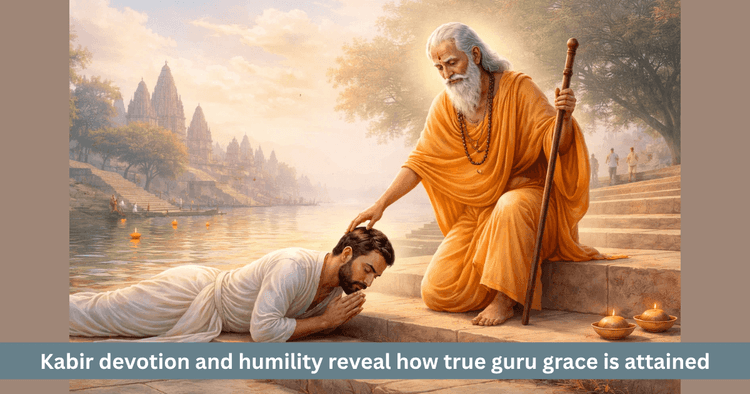
Table of Contents
The day of Guru Purnima is regarded in Indian spirituality as a day of the Guru’s greatness, the disciple’s humility and deep reverence toward the lineage of wisdom. It is not merely a festival, but a remembrance of that unseen thread which leads from ignorance to knowledge, from confusion to clarity and from wandering to spiritual practice. On this day, one episode is remembered with special feeling, and that is the moving account related to Kabir Das and Guru Ramanand, in which Kabir received the decisive spiritual moment of his life by lying on the steps of Panchganga Ghat. This event is not only a story. It has become a deep symbol of the intense longing for the Guru, humility, resolve and the power of the divine name.
Kabir Charit Bodh records that Kabir Das lay on the steps of Panchganga Ghat and received the Ram mantra from Guru Ramanand, and for this reason this episode is discussed with special devotion on Guru Purnima. This event does not speak only of receiving a mantra. It shows that when the heart is true, the seeker’s resolve is pure and the thirst for wisdom within is real, Guru kripa, the grace of the Guru, can descend even in an unexpected way. In this episode, inner worthiness becomes more important than outer formality.
Why is this episode of Kabir and Ramanand so well known
In the Indian bhakti tradition, Kabir holds a truly distinctive place. He was not only a poet, not only a saint, but a seeker who kept devotion, truth, social awareness and spiritual fearlessness alive together. On the other side, Ramanand is regarded as a revered Guru of the Vaishnava bhakti tradition. When the relationship of these two luminous figures is seen through the feeling of Guru and disciple, this episode shines even more brightly.
One major reason for the fame of this account is that the disciple’s longing here is not ordinary. Kabir is not searching for status, position or outer recognition. He seeks only the name, initiation and that spiritual touch which transforms life from within. That is why his decision to lie upon the steps of Panchganga Ghat is not merely a device, but a form of surrendered waiting in which the disciple places the whole of ego below.
What is the meaning of lying on the steps of Panchganga Ghat
This image is deeply powerful in Indian spiritual memory. Imagine a seeker whose longing to receive the mantra from the Guru is so intense that he does not wait for an ordinary path. He places himself at such a spot where the Guru’s feet may fall, where the Guru’s voice may emerge and where one moment of destiny may change the direction of life. To lie upon the steps of Panchganga Ghat is not only a physical event. It is a subtle symbol of abandoning ego, complete humility and offering oneself fully for Guru kripa, the grace of the Guru.
In this episode, the steps themselves become meaningful. Steps indicate both ascent and descent. The one who bows low is the one who is lifted high. Kabir lying below shows that on the spiritual path, one must first bend inwardly before rising. For this reason, remembering this episode on Guru Purnima is not merely recalling history, but understanding the true meaning of discipleship.
Symbolic meanings of this episode
- The steps indicate the journey of practice and inner ascent
- Lying down is an image of humility, surrender and letting go of ego
- The early morning meeting suggests the moment of grace that arrives at its destined time
- The Ram name becomes more than an outer word and turns into a medium of inner awakening
- The Guru’s feet represent not only a person, but guiding consciousness itself
Why is receiving the Ram mantra seen as so profound
In Kabir’s life, Ram is not just a name. It is the center of consciousness, the essence of devotion and the symbol of that truth which goes beyond both the formed and the formless while still dwelling in the seeker’s heart. When it is said that Kabir received the Ram mantra from Guru Ramanand, it does not mean merely hearing a word. It means receiving that name from the Guru’s speech, accepting it as a blessing and then making it the center of one’s life practice.
According to Kabir Charit Bodh, this episode is connected with the Ram name spoken by Guru Ramanand, and for that reason it is remembered with special reverence on this day. A very deep truth is hidden here. A mantra is not only given, it is also held. If the disciple does not carry receptivity within, even spoken words may not descend into the heart. Kabir’s worthiness lay in the fact that he was prepared not merely to hear, but to live the mantra.
Why is this episode remembered especially on Guru Purnima
Guru Purnima is not only a day of worshipping the Guru. It is a day to understand that relationship in which the Guru does not only give knowledge, but gives direction, vision, the foundation of practice and sometimes changes a life through a single word. The episode of Kabir and Ramanand expresses this truth in an especially beautiful and moving way.
When this account is remembered on this day, the seeker gets the opportunity to understand that receiving the Guru is not merely a matter of formality. The true Guru is the one whose speech enters within, awakens the soul and keeps spiritual practice alive through the name. In this story, the moment of mantra is brief, but its effect spreads through an entire lifetime. This too is the essence of Guru Purnima, that a true Guru awakens far more than what is outwardly spoken.
Is this episode only a historical event
This question deserves deep thought. On the outer level, it is a famous spiritual account connected with Kabir Das and Ramanand, but on the inner level, it is also a form of every seeker’s journey. There is a Kabir hidden within every seeker who longs for truth. On every spiritual path there is a Panchganga Ghat where the disciple must step down from inner pride. And in every life there comes a moment when one word, one indication or one name from the Guru gives a new birth within.
For that reason, this episode does not remain only a memory of the past. It becomes a mirror of present spiritual life. It asks whether the disciple is truly ready. Whether there is enough humility within to receive grace. Whether the name is only for uttering or whether there is preparation to bring it into life.
How can the true form of discipleship be understood through this story
This story of Kabir and Ramanand opens many layers of discipleship. To be a disciple is not merely to take the name of a Guru. It is an inner condition that includes hunger to learn, humility, patience and readiness to transform oneself. Kabir’s conduct shows that a true disciple does not search for comfort, but for truth.
What this episode teaches about discipleship
- True longing opens the first door to Guru kripa, the grace of the Guru
- Humility can receive much even without speaking
- Patience is as necessary in spiritual practice as enthusiasm
- The Guru’s word bears fruit only when the disciple is inwardly ready
- The divine name can become not just an utterance, but the foundation of life
These points should not be left as a mere instructive list. These are the very सूत्र, sutras, guiding threads, that keep this story alive.
How does the spiritual atmosphere of Panchganga Ghat deepen this episode
Ghats in Indian spiritual life are not merely stone steps by a river. They are places of meeting. Water, sky, mantra, silence, practice and time all stand together there. The very name Panchganga Ghat brings before the mind a place where the outer world and inner practice meet. To receive the Guru’s word at such a place makes this account even more vivid.
In this episode, the atmosphere of the ghat also suggests that spiritual transformation often unfolds in places that appear ordinary, yet its effect becomes extraordinary. The steps that serve as a common path for everyone become the place of initiation for Kabir. This is a great inspiration for spiritual practice. Grace does not always descend in impossible places. Sometimes the very place where all come and go becomes the doorway of the highest moment for one seeker.
What does the feeling of the Ram name become in Kabir’s spiritual life
The Ram name appears again and again in Kabir’s speech, yet his Ram does not carry a narrow meaning. It is not bound only to image or form. It is also the remembrance of the highest truth, the awakening within, the basis of devotion and the lived experience of relationship with the Divine. Therefore, the episode of receiving the Ram mantra from Guru Ramanand becomes deeply important for understanding Kabir’s entire poetic and spiritual life.
Some feelings linked with the practice of the Ram name
- Remembrance turns the mind again and again toward the Divine
- Name recitation may reduce inner restlessness
- A mantra received from the Guru’s mouth gives a steady foundation to practice
- Ram becomes a symbol of devotion, truth and inner light
- Continuity of the name can make life meaningful rather than merely ordinary
Is Guru kripa received only through formal method
The episode of Kabir and Ramanand gives a subtle answer to this question. Guru kripa may be connected with method, but it is not confined only to method. Where there is sincerity, where there is longing, where there is surrender and where there is worthiness to receive, grace can descend through an unexpected path as well. This is the gentlest and also the most powerful dimension of the story.
This does not teach the seeker disrespect toward outer discipline. Rather, it teaches that the essence of discipline is inner purity. If stubbornness, pride and self interest remain within, even formality may stay empty. If humility, longing and purity are alive within, then even a single word can become initiation.
What can the seeker of today learn from this story
In a time when spirituality may sometimes become limited to display, quick results and outward identity, this episode of Kabir and Ramanand returns the seeker to the essentials. It teaches that before receiving the Guru, one must learn how to become a disciple. Before receiving a mantra, one must prepare the mind. And before repeating the name, one must make a place within for that name.
The seeker of today may learn the following from this account:
| Indication for the seeker | Deeper meaning |
|---|---|
| Search for the Guru | Not merely the search for a person, but the search for direction |
| Humility | The basis of spiritual worthiness |
| Name | The center of steadiness and remembrance in life |
| Waiting | Accepting the timing of grace |
| Surrender | Practicing not with half heart, but with the whole heart |
What does the episode of Kabir and Ramanand awaken within
This episode does not awaken devotion alone. It awakens humility within. It does not merely narrate a story. It gives an inner posture for spiritual practice. It contains the greatness of the Guru, but equally the worthiness of the disciple. It contains the power of the mantra, but equally the value of a receptive heart. That is why the remembrance of this story on Guru Purnima becomes so meaningful. It shows that the light of wisdom descends where space for humility has already been made.
When a seeker listens to this story, questions may also arise within. Has the Guru’s word truly been given a place in life. Is the name only on the tongue or in the heart as well. Is the humility to learn still alive. Has inner pride become light enough for grace to descend. These are the questions that keep this account alive and relevant.
The door of wisdom opens through humility
The episode of Kabir and Ramanand on Guru Purnima is not only a beautiful chapter from the life of saints of the past. It remains equally alive even today because the truth of Guru, mantra, name and discipleship is not bound by time. This event described in Kabir Charit Bodh still seems to say that wisdom is not gained by force. It is gained through humility. It is gained through worthiness. It descends into the heart that is truly prepared to listen.
For that reason, this story does not only tell how Kabir received the Ram mantra. It tells something far greater. It teaches that in spiritual life the greatest preparation does not happen outside, but within. The one who bends within is the one who is truly lifted. The one who receives the name slowly becomes one with the name. And the one who honors Guru kripa finds that spiritual practice becomes not merely an exercise, but the light of life itself.
Frequently asked questions
Is the episode of Kabir and Ramanand especially remembered on Guru Purnima
Yes, this episode is remembered especially on this day because it reveals the deep meaning of Guru kripa, humility and receiving the mantra.
How did Kabir receive the Ram mantra
According to Kabir Charit Bodh, Kabir Das lay on the steps of Panchganga Ghat and there received the Ram mantra spoken by Guru Ramanand.
What is the greatest message of this story
The greatest message of this story is that true surrender, humility and pure longing for the Guru can open the path of spiritual practice.
Is this episode only history or also a sign for spiritual practice
It is not only a historical episode. It is also a living sign for every seeker regarding humility, waiting, worthiness and the value of the Guru’s word.
Why is the Ram name considered so important in this episode
Because here the Ram name becomes not only a word, but a spiritual foundation received through Guru kripa and a mantra that transforms life.
Get your accurate Kundali
Generate KundaliDid you like it?
Author

Pt. Suvrat Sharma (63)
Experience: 20
Consults About: Family Planning, Career
Clients In: Punjab, Haryana, Delhi
Share this article with friends and family
About ZODIAQ
ZODIAQ is an online Vedic Astrology platform. It connects clients seeking astrological advice to experienced astrologers with deep knowledge. Our users also generate kundali and perform kundali milan for free. ZODIAQ also offers services to the Astrologers. Astrologers utilize various offerings by ZODIAQ to serve their clients effectively.
If you are a User
Consult with experienced astrologers and seek their guidance. You can also order handwritten Janm Patrika report with life prediction prepared by experienced astrologers. Generate accurate Kundali, perform Kundali Matching and check horoscope and muhurat. Utilize our online library for all the necessary astrological and spiritual information.
If you are an Astrologer
Create accurate kundali for your clients and perform Kundali Matching for up to 5 people at a time. Write comprehensive Janm Patrika report for your clients with ZODIAQ. Check client details anytime by saving it in client directory. Become more productive by tracking how many clients you guide every day.
WELCOME TO
ZODIAQ
Right Decisions at the right time with ZODIAQ
