Ashadha Purnima and Kokila Vrat: Meaning of Devotion and Reunion
By Pt. Nilesh Sharma
A spiritual journey of longing, austerity, and divine union through Kokila Vrat
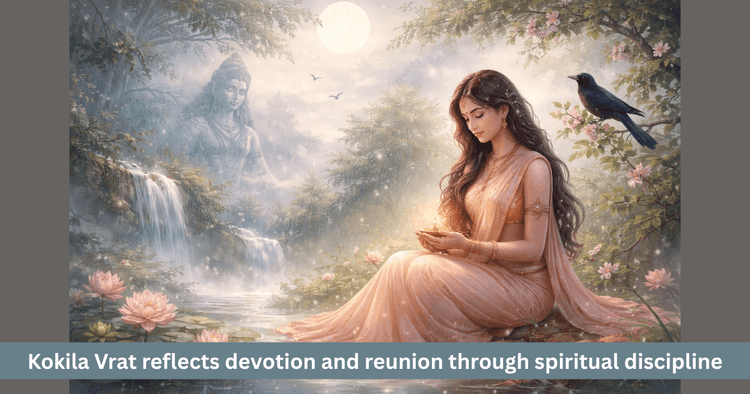
Table of Contents
In the Indian tradition of sacred vows, some observances are not kept merely for obtaining worldly results. They touch the deep emotional world hidden within the human heart. Kokila Vrat is one such subtle and deeply moving observance associated with Ashadha Purnima. In many regions, devotees, especially women, observe this vow on this full moon day. Tradition connects it with the austerity of Mata Sati, who is believed to have taken the form of a kokila, a cuckoo, and through that state of devotion and discipline moved once again toward union with Mahadeva. In the tradition connected with the Bhavishya Purana, this is not just a story. It becomes a profound expression of love, austerity, patience, longing, and sacred reunion.
Ashadha Purnima itself is a highly meaningful tithi. It falls in the early fullness of the rainy season, when the earth is moistened, trees begin to pulse with renewed life, and the sky gathers depth and inwardness. For Kokila Vrat to appear in this seasonal atmosphere carries beautiful symbolic meaning. The call of the cuckoo is associated not only with rain, but also with longing. Its voice is not merely seasonal music. It also represents a deep yearning for reunion. For this reason, the connection between Ashadha Purnima and Kokila Vrat is not only ritual. It is also a celebration of the meeting of emotion and spiritual discipline.
What Is Kokila Vrat and Why Is It Considered So Special
Kokila Vrat is a sacred observance that in many regions is especially associated with women, yet its deeper meaning is not limited to women alone. It symbolizes that state of inner discipline in which love no longer remains mere emotion, but ripens into austerity. In this vow, the cuckoo is not only a bird. It is a symbol of that consciousness which does not allow longing to become helpless sorrow, but transforms it into spiritual strength.
The observance is considered special for several reasons:
- It is associated with the austerity of Mata Sati
- It treats separation not as weakness, but as spiritual force
- It lifts love beyond possession into offering
- It teaches patience, waiting, and inward fidelity
For this reason, Kokila Vrat is not only about ritual practice. It is also about sanctifying emotion.
What Is the Core Meaning of the Story of Mata Sati and the Form of the Cuckoo
In the traditional understanding linked with the Bhavishya Purana, Mata Sati is believed to have taken the form of a cuckoo and performed austerity, and through that discipline moved again toward Mahadeva. The most important feature of this story is that transformation here does not merely mean a change of outer form. It signifies an inner process in which the soul transforms longing into prayer.
The life of Mata Sati itself carries many profound spiritual meanings. Her relation with Shiva is not merely symbolic of marriage. It is often seen as a symbol of the union between the individual soul and the supreme principle. When that union is broken, the pain that arises forms the inner ground of Kokila Vrat. To become the cuckoo in this story is a philosophical symbol. The cuckoo is known not by outer form, but by its voice. This suggests that when outer identity breaks, the true note of spiritual yearning rises from within.
Why Is the Symbol of the Cuckoo So Meaningful
In Indian poetry, seasonal literature, and folk imagination, the cuckoo is not merely a sweet voiced bird. Its call often symbolizes love, longing, memory, waiting, and seasonal awakening. Whenever the atmosphere of Ashadha and the rainy season arrives, the cuckoo’s voice is linked with the deeper emotional layers of the heart. This is why its presence in Kokila Vrat is so fitting.
The symbol of the cuckoo may be understood on several levels:
| Symbol | Deeper Meaning |
|---|---|
| Sweet voice | The true call of the inner heart |
| Presence through sound | Inner influence greater than outer appearance |
| Connection with the season | Awakening of consciousness with time |
| Voice of longing | Patience oriented toward reunion |
Even the dark appearance of the cuckoo may be contemplated, because it teaches that outer beauty is secondary, while inner truthfulness and voice are essential. That is why the symbol of Kokila Vrat is not merely graceful. It is deeply spiritual.
How Should the Connection Between Ashadha Purnima and This Vow Be Understood
Ashadha Purnima marks the deepening beginning of the rainy season. Rain does not change only the weather. It changes the emotional field of life as well. After the dryness of summer, rain brings softness, inwardness, and quiet fullness. For Kokila Vrat to be observed in this period suggests that the ground of spiritual practice becomes more fertile when the heart softens.
The full moon itself signifies fullness, luminous awareness, and inner ripeness. To begin such a vow on this tithi means that the observance should not be understood merely as harsh denial. It is better understood as discipline of feeling. It teaches that true love is not impatient. It waits like the season, gathers like the clouds, and pours like the rain at the right moment.
Is Kokila Vrat Important Only for Women
In folk practice, this vow is especially associated with women, often in connection with marital harmony, auspiciousness, and reunion with the beloved. This is natural, because the story of Mata Sati and Mahadeva itself reflects the ideal of sacred union. Yet if one enters its deeper spiritual meaning, it cannot be restricted only to women. It is meaningful for every seeker who has known longing, inner separation, lost balance, or the desire to regain union with the highest truth.
Its broader teaching is this:
- Lost union may be restored
- Longing is not only sorrow. It can become awakening
- Waiting is not passivity. It can become discipline
- The highest form of love is not possession, but offering
Thus Kokila Vrat may arise in a women centered folk context, but its spiritual meaning is universal.
Why Is the Element of Austerity So Important in This Vow
Love and devotion, if they do not ripen into tapas, often remain emotional intensity alone. The most touching dimension of the story of Mata Sati is that her feeling does not become restless despair. It waits, endures, transforms, and finally finds direction through austerity. Kokila Vrat carries that same truth.
Austerity here does not only mean fasting or physical denial. It means:
- Giving discipline to emotion
- Refusing to let waiting become complaint
- Lifting love above selfishness
- Remaining steady toward the desired truth
- Ripening inwardly through time
For this reason, the vow is also a practice in emotional maturity.
What Is the Relation Between Kokila Vrat and the Conjugal Ideal
In household life, this vow is often connected with conjugal auspiciousness, wellbeing of the husband, and stability in married life. This association is natural, because the story of Mata Sati and Mahadeva reflects divine conjugal symbolism. Yet here marriage is not viewed merely as a social arrangement. It is also seen as fidelity, offering, inner union, and sacred love.
Therefore, the conjugal dimension of Kokila Vrat is important not only for worldly happiness, but also for preserving:
- Patience within relationship
- Mutual regard
- Living memory of the bond
- Faith in the possibility of reunion
- Purity of feeling
Does Kokila Vrat Also Carry a Psychological Meaning
Yes, and it is very beautiful. In human life there are many moments when one breaks inwardly, becomes separated, or loses something deeply precious. At such times, a person may either become hardened or collapse into helplessness. The story of Kokila Vrat offers a third way. It teaches that pain itself can be transformed into voice, remembrance, and spiritual discipline.
This psychological lesson is deeply important:
| Inner condition | Direction given by Kokila Vrat |
|---|---|
| Separation | Patient remembrance |
| Pain | Transformation through austerity |
| Broken bond | Hope of renewed union |
| Emotional intensity | Disciplined love |
| Loneliness | Awareness of divine connection |
In this sense, Kokila Vrat is not only a religious observance. It is also a means of giving sacred direction to emotion.
How Can This Vow Be Understood in Modern Life
In modern times, relationships are often formed quickly and broken quickly. The ability to wait has weakened. People desire emotional intensity, but not always depth and steadiness. In such a world, the message of Kokila Vrat becomes highly relevant. It teaches that love is not only about possession. It is also about remembrance, restraint, and faithfulness to the right time.
For modern life, this vow offers some major teachings:
- Not every separation is final
- Not every waiting is without meaning
- Emotions need maturity
- Love requires more than expression. It requires inner fidelity
- What is true often becomes clearer through time
What Is the Deepest Spiritual Message of Kokila Vrat
The deepest message of this vow is that the relation between the soul and the supreme never truly ends, even if there is distance, longing, or forgetfulness in between. The story of Mata Sati points toward this. The voice of the cuckoo reminds us that if the inner call is pure, it eventually reaches the Beloved. Spiritual practice does not only mean sitting in meditation. It also means refining one’s emotion until it becomes worthy of the Divine.
This vow seems to say:
- Turn love into austerity
- Turn longing into prayer
- Turn waiting into reverence
- Turn remembrance into practice
Final Reflection
The Kokila Vrat of Ashadha Purnima, as remembered in the tradition associated with the Bhavishya Purana, is one of the most beautiful and emotionally rich observances of Indian religious life. Through the image of Mata Sati in the form of the cuckoo, her austerity, and her movement toward reunion with Mahadeva, this vow reveals a profound union of love, patience, remembrance, discipline, and spiritual fidelity. It is not only for the fulfillment of desire. It is also a way of purifying emotion, turning longing into practice, and lifting relationship toward divine depth.
Therefore, it may be said that Kokila Vrat is not merely a folk observance. It is a discipline of purifying the inner voice. One who understands its deeper meaning knows that the most profound call is not always made through many words. Sometimes it rises like the voice of the cuckoo, soft, longing, disciplined, and full of sacred waiting. That is the deepest and most beautiful truth of this vow.
Frequently Asked Questions
On which tithi is Kokila Vrat observed
In many regions this vow is observed on Ashadha Purnima.
With which story is this vow associated
Tradition connects it with the austerity of Mata Sati in the form of a cuckoo and her movement toward reunion with Mahadeva.
Why is the cuckoo a symbol in this vow
Because its voice symbolizes longing, remembrance, sweetness, and the call of the inner heart.
Is this vow meant only for women
In folk tradition it is especially linked with women, but its spiritual meaning is important for every seeker.
What is the main message of this vow
It teaches that separation can be transformed into austerity, love into fidelity, and waiting into spiritual practice.
Get your accurate Kundali
Generate KundaliDid you like it?
Author

Pt. Nilesh Sharma (63)
Experience: 20
Consults About: Family Planning, Career
Clients In: Punjab, Haryana, Delhi
Share this article with friends and family
About ZODIAQ
ZODIAQ is an online Vedic Astrology platform. It connects clients seeking astrological advice to experienced astrologers with deep knowledge. Our users also generate kundali and perform kundali milan for free. ZODIAQ also offers services to the Astrologers. Astrologers utilize various offerings by ZODIAQ to serve their clients effectively.
If you are a User
Consult with experienced astrologers and seek their guidance. You can also order handwritten Janm Patrika report with life prediction prepared by experienced astrologers. Generate accurate Kundali, perform Kundali Matching and check horoscope and muhurat. Utilize our online library for all the necessary astrological and spiritual information.
If you are an Astrologer
Create accurate kundali for your clients and perform Kundali Matching for up to 5 people at a time. Write comprehensive Janm Patrika report for your clients with ZODIAQ. Check client details anytime by saving it in client directory. Become more productive by tracking how many clients you guide every day.
WELCOME TO
ZODIAQ
Right Decisions at the right time with ZODIAQ
