Mahadeva as Adi Guru: The First Teacher of Yoga on Guru Purnima
By Pt. Amitabh Sharma
Understanding why Shiva is remembered as the original Guru who transmitted yoga wisdom to the Saptarishis
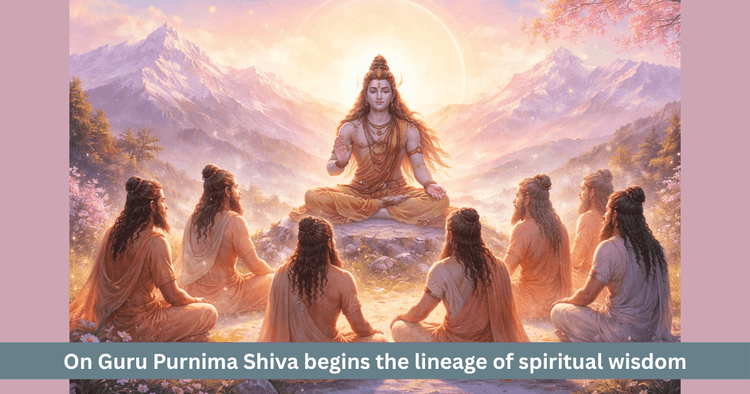
Table of Contents
Guru Purnima is one of those sacred observances in Indian spirituality that is not merely a festival but a living remembrance of the Guru principle. According to tradition, it was on the day of Ashadha Purnima that Lord Mahadeva began imparting the knowledge of yoga to the Saptarishis in the Himalayas. For this reason, the day is regarded not only as a celebration of the Guru but also as the awakening of the Adi Guru, the first Guru of the world.
In memories linked with Yoga Shastra and Shiva Purana, Shiva is understood not merely as a deity but as the first Guru. When he transmitted the wisdom of yoga to the Saptarishis through his silence, meditation, tapas and direct realization, that moment became the foundation of the Guru tradition for humanity. That is why the center of Guru Purnima is not limited to the honoring of one’s personal teacher. It also reaches back to the original source from which yoga, inner realization and awakened wisdom first began to flow.
Why is Ashadha Purnima so important in this context
Ashadha Purnima is considered unique because it is on this day that the Guru form of Mahadeva is said to have manifested. This full moon comes in the early phase of the rainy season, when nature itself becomes inwardly receptive and outwardly softened. In Indian thought, such a season and such a full moon are seen as especially favorable for receiving wisdom. The full moon also symbolizes completeness, clarity and the light within.
That is why Ashadha Purnima should not be seen merely as a religious date or an astrological marker. It is the day on which the seeker is reminded that the Guru does not merely teach. The Guru gives direction to consciousness. Mahadeva beginning to impart yoga to the Saptarishis turns this date into one of the great beginnings in spiritual history.
Why is Mahadeva called the Adi Guru
Lord Shiva is called the Adi Guru because he is seen as the first source from which the tradition of yoga, meditation, Self realization and silent wisdom began to flow. An ordinary Guru carries forward a tradition of knowledge already in motion but the Adi Guru is the one who stands at the very source of that stream. This is the feeling associated with Shiva.
His Guru form is not that of one who only teaches doctrine. He teaches from experience. He does not leave wisdom at the level of concept. He turns it into a direct truth of life. This is why the Adi Guru form of Shiva occupies such a lofty place in the Indian yoga tradition. He teaches that truth is not merely to be heard. It is to be lived, practiced and realized.
Main qualities of Mahadeva as Adi Guru
- He is regarded as the original source of yoga wisdom
- His teaching arises not only from words but from direct experience
- He leads the seeker beyond outer conduct into inner discipline
- His Guru form symbolizes the first great current of wisdom for humanity
Why is the imparting of yoga to the Saptarishis so important
In Indian tradition, the Saptarishis are not merely seven sages. They also symbolize the spread of rishi wisdom, dharmic continuity, sacred memory, discernment and the spiritual extension of human civilization. When Mahadeva gave the knowledge of yoga to the Saptarishis, it did not mean that he taught only seven individuals. It meant that yoga would no longer remain confined to private realization. It would become a path for the world.
That is why this episode may be called the heart of Guru Purnima. Wisdom remains incomplete until it reaches the world through worthy disciples. By transmitting yoga to the Saptarishis, Shiva began that broader work of dharma. In this way, the episode became a symbol of the preservation, transmission and pure lineage formation of sacred knowledge.
Why is this teaching said to have begun in the Himalayas
In Indian spirituality, the Himalayas are not merely mountains. They symbolize stability, tapas, silence, height and closeness to the divine. The fact that Mahadeva gave yoga wisdom to the Saptarishis in the Himalayas is deeply meaningful because the true journey of yoga also demands an inner Himalaya. Where the mind is steady, where the noise of ego is reduced and where patience exists for the ascent of consciousness, there the seed of yoga can be planted rightly.
The Himalayas also symbolize rising upward. When the human being grows spiritually, one moves beyond limited identity. The revelation of wisdom in the Himalayas suggests that the Guru’s teaching is not meant for ordinary mental restlessness but for higher consciousness. For that reason, the setting is not only geographic. It is richly symbolic.
What is the real meaning of imparting the knowledge of yoga
Here yoga does not mean only postures or physical practice. In Indian tradition, yoga fundamentally means union, the experience of oneness, discipline of mind, recognition of the Self and rising beyond ego centered living. When Mahadeva gave the knowledge of yoga to the Saptarishis, it meant teaching them how to see life in its original unity.
Within that wisdom are included the body, the breath, the mind, meditation, silence, tapas, detachment, Self realization and the direction toward ultimate truth. Therefore the Guru form of Mahadeva does not teach merely a technique. He gives a complete vision of spiritual life. That is why to remember Shiva on Guru Purnima is not only a religious act. It is also a remembering of the essential principles of yoga.
Main dimensions of yoga wisdom
- Discipline of the mind
- Balance of breath and awareness
- The practice of rising beyond ego
- The realization of unity between the Self and ultimate truth
Is Guru Purnima only a day of worship
No. Guru Purnima is not only a day of worship. It is a day of self reflection, remembering the Guru, humility before knowledge and renewing the spirit of discipleship. If there is only outer ritual on this day while ego, instability and inertia remain within, then its deeper meaning remains incomplete. The remembrance of Mahadeva as the first Guru teaches that the truest observance of Guru Purnima lies in becoming inwardly receptive.
This day asks the seeker whether one is truly ready to learn. Has there been created within a silence where the word of the Guru may enter. Does one only seek inspiration or also transformation. These are the questions that make Guru Purnima living and real.
Why is the first Guru form of Shiva still relevant today
In the present age there is much information but little direction. There are many thoughts but little realization. There are many words but the wisdom born from silence has become rare. In such a time, the first Guru form of Mahadeva becomes deeply relevant. He reminds us that real knowledge is not the collection of data but inner transformation.
The Guru form of Shiva also teaches that if one wishes to attain inner height, one must first create inward steadiness. If the seeker remains only in debate and never enters practice, yoga wisdom remains distant. The call of Mahadeva is that the disciple should first become quiet, then listen, then practice and then become worthy of knowledge.
What does the tradition linked with Yoga Shastra and Shiva Purana suggest
The memories associated with Yoga Shastra and Shiva Purana make it clear that the Guru form of Shiva is central to Indian spiritual discipline. This tradition does not understand the Guru merely as a social role. It sees the Guru as a living force of wisdom. Shiva imparting yoga to the Saptarishis is the revelation of that force.
This tradition also teaches that in Indian thought Guru and yoga cannot be separated. The Guru is the one who gives the direction of yoga and yoga is the means by which the disciple eventually reaches the truth pointed out by the Guru. In this way, the episode becomes not merely a story but a foundational principle of philosophy and practice.
Deep teachings received from this tradition
- The Guru is the living source of wisdom
- Yoga is not only practice but transformation of life
- The disciple must become humble and receptive to wisdom
- Without silence, tapas and steadiness, higher knowledge cannot remain
How can a seeker bring this episode into daily life
If a seeker wishes to bring this episode of Guru Purnima into life, a few simple but deep practices may help. One may sit in silence each day, live at least one higher principle with discipline, remain grateful toward teachers, understand yoga not merely as exercise but as a means of transforming consciousness and honestly recognize one’s own inner confusions. These are the small steps by which Guru Purnima moves from outward observance into inward discipline.
The first Guru form of Mahadeva also teaches that learning never truly ends. The moment one begins to think oneself complete, one ceases to remain a disciple. And the one who is no longer a disciple slowly loses nearness to the Guru. Therefore the truest honoring of Guru Purnima lies in preserving humility in the mind and continuity in practice.
A simple table to understand this theme
| Element | Deeper meaning |
|---|---|
| Ashadha Purnima | Sacred date of the awakening of the Guru principle |
| Mahadeva | The first Guru and original source of yoga wisdom |
| Saptarishis | Disciples who carry the wisdom tradition forward |
| Himalayas | Tapas, silence, steadiness and higher consciousness |
| Yoga wisdom | The path of self discipline, unity and Self realization |
The deepest message of Guru Purnima
The deepest message of Guru Purnima is that wisdom does not suddenly descend from outside. It awakens through the Guru, enters through the preparedness of the disciple and matures through practice. The first Guru form of Mahadeva presents this truth in a deeply beautiful way. He did not merely give information to the Saptarishis. He gave them such vision that through them the current of yoga could flow into the world.
This is the lasting greatness of the episode. Guru Purnima is not only remembrance but direction. It teaches that if one seeks true light in life, one must first accept the Guru principle. The Adi Guru form of Mahadeva is the divine beginning of that acceptance. That is why remembering him as the first Guru on Ashadha Purnima is held to be deeply sacred and inspiring for the seeker.
Frequently asked questions
Why is Mahadeva remembered as the first Guru on Guru Purnima
Because according to tradition, on Ashadha Purnima Lord Shiva began imparting the wisdom of yoga to the Saptarishis in the Himalayas.
Why is Mahadeva called the Adi Guru
He is regarded as the original Guru source of yoga, meditation and Self realization.
What is the importance of teaching yoga to the Saptarishis
It symbolizes the movement of wisdom from personal realization into lineage formation and wider transmission for humanity.
Why is this knowledge said to have been given in the Himalayas
The Himalayas symbolize tapas, silence, stability and higher consciousness, making them deeply fitting for the revelation of yoga wisdom.
With which sources is this episode generally associated
It is generally associated with the traditions linked with Yoga Shastra and Shiva Purana.
Get your accurate Kundali
Generate KundaliDid you like it?
Author
Pt. Amitabh Sharma (56 Years)
Experience: 20
Consults About: Family Planning, Career
Clients In: Punjab, Haryana, Delhi
Share this article with friends and family
About ZODIAQ
ZODIAQ is an online Vedic Astrology platform. It connects clients seeking astrological advice to experienced astrologers with deep knowledge. Our users also generate kundali and perform kundali milan for free. ZODIAQ also offers services to the Astrologers. Astrologers utilize various offerings by ZODIAQ to serve their clients effectively.
If you are a User
Consult with experienced astrologers and seek their guidance. You can also order handwritten Janm Patrika report with life prediction prepared by experienced astrologers. Generate accurate Kundali, perform Kundali Matching and check horoscope and muhurat. Utilize our online library for all the necessary astrological and spiritual information.
If you are an Astrologer
Create accurate kundali for your clients and perform Kundali Matching for up to 5 people at a time. Write comprehensive Janm Patrika report for your clients with ZODIAQ. Check client details anytime by saving it in client directory. Become more productive by tracking how many clients you guide every day.
WELCOME TO
ZODIAQ
Right Decisions at the right time with ZODIAQ
