Shirdi Sai Baba and Guru Purnima: Lightening the Burden of Karma
By Pt. Abhishek Sharma
Understanding how Sai Baba’s teachings on Guru Purnima reveal grace, karma, and inner transformation
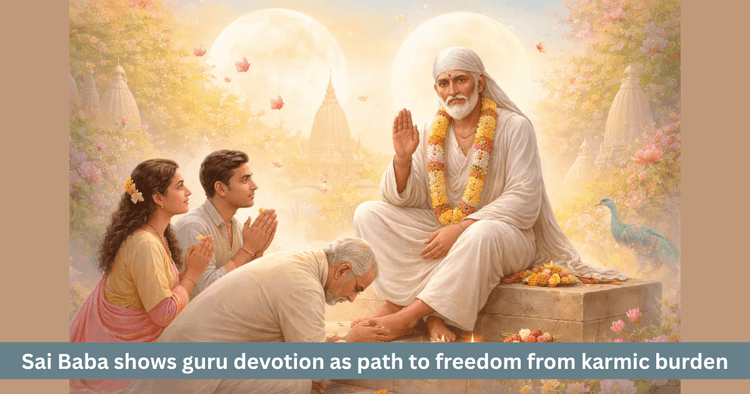
Table of Contents
In Indian spiritual tradition, Guru Purnima is not merely a festival. It is the day on which a human being expresses gratitude toward the force that gives direction, discipline, inspiration, and wisdom in life. This sacred day reminds us that effort alone is not enough in life. Right direction is also necessary. Mere accumulation of knowledge is not enough. One also needs that presence which shows how to live that knowledge rightly. For this reason, Guru Purnima holds a very exalted place in Indian consciousness. Yet when this sacred day becomes associated with Shirdi Sai Baba, its meaning becomes even more living, compassionate, and beneficial for the world.
In the tradition of Shirdi, the importance of Guru Purnima grew not merely because devotees began celebrating it, but because Sai Baba himself placed the principle of the guru at the center of life. The beginning of Guru Purnima observance in Shirdi came through his devotees, yet this was not simply an outward arrangement. It was the natural expression of the feeling that had spontaneously arisen in their hearts toward Baba. They did not experience him merely as a fakir, saint, or accomplished soul. They felt in him a living guru who taught not through complex scriptural language, but through life itself.
In the tradition of the Shri Sai Satcharitra, there is a living devotional understanding that Baba said that worship of the guru on this day helps to lighten the burden of karma. This statement appears simple, yet its meaning is deeply profound. The lightening of karmic burden here does not mean that fate is magically erased or that all hardship suddenly disappears. It means that through the grace of the guru, a human being begins to understand one’s karma, gains the strength to endure it, receives the insight hidden within it, and develops such inner steadiness that the burden of life no longer feels unbearable. This is the most beautiful and spiritual meaning of the episode.
How did the observance of Guru Purnima begin in Shirdi
The celebration of Guru Purnima in Shirdi did not begin through royal decree, nor through a rigid theological command. It began through the spontaneous devotion of the devotees. They felt that sitting at the feet of Sai Baba, opening their hearts before him, and receiving meaning from his silence and speech, all of this belonged to the sacred relationship between guru and disciple. It therefore became natural for them to feel that there should be one day in the year on which Baba would be worshipped specifically in his guru form.
A very deep point deserves attention here. Baba did not permit himself to be confined within a narrow label. He was not only Hindu, nor only Muslim. He was not of a single sect, nor of a single external religious identity. Yet devotees recognized the guru in him. This means that the guru principle is greater than outer identity. The beginning of Guru Purnima in Shirdi arose from exactly this recognition.
Some of the main devotional currents behind this beginning appear to be
- deep reverence toward Baba
- inward guidance received from his life and presence
- the felt experience of the guru principle in his words
- the collective recognition of him as a true spiritual foundation
These feelings together transformed Guru Purnima in Shirdi into a living sacred celebration.
Why was Sai Baba seen in the form of the guru
Sai Baba did not establish himself through long scholarly discourses. He did not prove himself by offering philosophical commentaries on sacred texts. He made life itself the teaching. At times through a word, at times through a glance, at times through a delay, at times through rebuke, and at times through blessing, he transformed the lives of people. This is the mark of a true guru. A guru is not merely one who speaks. A guru is one who awakens.
Devotees experienced the following dimensions of the guru in Baba
| Guru principle | Its expression in Sai Baba |
|---|---|
| Compassion | Giving refuge to the sorrowful, sick, and confused |
| Guidance | Explaining the essence of life through simple words |
| Inner knowing | Understanding the devotee’s heart even before anything is said |
| Discipline | Teaching faith and patience |
| Karma awareness | Making a person aware of responsibility toward one’s own life |
This table makes clear that Baba’s guru form was not merely a product of devotional emotion. It was grounded in lived experience.
What does it mean that worship of the guru lightens the burden of karma
This is the central point of the entire episode. When Baba says that worship of the guru on this day lightens the burden of karma, the statement can be understood at several levels.
The first level is psychological. The heaviest burden in human life is often not only the outer situation, but the mind’s response to it. Anxiety, guilt, confusion, fear, insecurity, and loneliness make a burden far heavier than it already is. In the act of guru worship, when a person surrenders sincerely, that inner tightening begins to loosen. One no longer feels entirely alone. One feels that there is a presence that sees, understands, and inwardly supports the journey of life.
The second level is spiritual. The guru does not teach a human being to run away from karma. The guru teaches one how to understand it. When understanding arises, the karmic result may outwardly remain the same, but its inner experience begins to change. Suffering can turn into instruction. Obstacle can become patience. Delay can become maturity. This is what it means for the burden of karma to become lighter.
The third level is devotional. When a person surrenders with sincerity at the feet of the guru, the ego softens. And many times the real weight of life comes not from the circumstance alone, but from ego itself. Guru worship softens this ego. Because of this, the struggles of life are felt less heavily within.
Did Sai Baba change karma or give the strength to endure it
This is a very important question. In devotion, people often assume that the saint or guru will simply change everything outwardly. But Sai Baba’s way was more mature than that. He did not only grant favors and make people dependent. He taught them faith and patience. That itself means that the path will not always become instantly easy, yet the seeker can change inwardly.
For this reason, it is more accurate to say that Baba
- gave the vision to understand karma
- gave the strength to endure difficult phases
- gave the inspiration to choose rightly amidst confusion
- gave inner balance in the midst of agitation
That is why the worship of the guru in his tradition becomes associated both with purification of karma and with understanding of karma.
What kind of spiritual atmosphere is associated with Guru Purnima in Shirdi
In the tradition of Shirdi, Guru Purnima is not merely a festive date. It is regarded as a day of gentle yet profound spiritual depth. It is the time when devotees experience their relationship with Baba not only as petition, but as gratitude. They do not come merely to ask. They come to acknowledge that whatever direction came in life, whatever protection came, whatever warning came, whatever grace came, all of it came through the guru.
Some of the principal emotions associated with this day may be understood as
- gratitude
- self reflection
- surrender
- asking forgiveness
- renewed resolve
That is why the celebration of Guru Purnima in Shirdi becomes less a display of outer grandeur and more a festival of inward depth.
How do faith and patience connect with Guru Purnima
Two of Sai Baba’s most famous teachings are Shraddha, meaning faith, and Saburi, meaning patience. If Guru Purnima is seen in the light of these two teachings, its meaning becomes even clearer. Faith does not mean blind belief. It means trust in the truth shown by the guru. Patience does not mean passive waiting. It means calm endurance. The burden of karma becomes heaviest where these two qualities are absent. Where there is no faith, the mind breaks before every difficulty. Where there is no patience, every delay feels like a curse.
During Guru Purnima, when devotees worship Baba, they seek to awaken these two qualities within themselves. This is the deeper inner discipline of the day.
What should one observe in order to understand Sai Baba’s guru form
If one truly wishes to understand why Baba is worshipped as guru, then one should not focus only on stories of miracles. One must also see how Baba transformed people inwardly. At times he taught by giving, at times by delaying, at times by rebuking, and at times by remaining silent. These are all methods of a guru.
Some central dimensions of Baba’s guru form include
- he taught each devotee in the language the devotee could understand
- he did not allow people to escape karma, but helped them face it
- he made seekers inwardly more honest
- he established trust at the center of life
- he valued inner religion over outer display
Is Guru Purnima only a day of worship or also a day of self examination
Guru Purnima is not only a day for offering garlands, performing ritual, or celebrating outwardly. It is also a day of self examination. If the guru is truly present in one’s life, then one must ask whether one has actually begun to walk on the path shown by the guru. In the tradition of Shirdi Sai Baba, this question becomes even deeper because Baba looked beyond outer display and saw the truth of the heart.
On this day, a seeker may ask
- is faith present only in words or also in life
- does patience remain in difficult times
- has one asked only for help or also received the guru’s teaching
- is karma being faced honestly
- has life become a little more compassionate, simple, and truthful
Such questions make Guru Purnima into a living practice.
Why is this episode so relevant in modern life
Modern human beings are outwardly connected, yet inwardly lonely. They have comfort, yet little patience. They have information, yet not enough direction. In such a time, this relationship between Shirdi Sai Baba and Guru Purnima becomes deeply important. It teaches that a human being needs not only solutions, but support. One needs not only achievement, but also inner steadiness. And that is what the guru gives.
The burden of karma is still real today, though its forms have changed. It appears as stress, relational confusion, financial pressure, mental fatigue, and self doubt. In such a time, worship of the guru does not remain only a religious ritual. It can become a profound inner healing process.
The final radiance of this episode
The fact that Guru Purnima in Shirdi began through the devotees, and that Sai Baba was traditionally understood to have said that worship of the guru on this day helps lighten the burden of karma, gives this whole episode great spiritual dignity. The tradition of the Shri Sai Satcharitra presents this feeling not merely as a story, but as a living experience. Here guru worship does not become a magical event that changes destiny. It becomes an inner power through which life can be held with steadiness.
This is the most beautiful meaning of the episode. On Guru Purnima, worship of the guru is not only an act of honor. It is the day on which one acknowledges one’s burden, offers it inwardly, and seeks the strength to carry it with wisdom. The tradition of Shirdi Sai Baba expresses this truth in a manner that is simple, compassionate, and profoundly human.
Frequently Asked Questions
Who began the observance of Guru Purnima in Shirdi
The observance of Guru Purnima in Shirdi was begun by the devotees of Sai Baba.
What did Sai Baba say about Guru Purnima
The devotional tradition holds that Baba said that worship of the guru on this day helps lighten the burden of karma.
What does it mean that the burden of karma becomes lighter
It means that through the grace of the guru, a person gains the strength to understand, endure, and learn from one’s karma.
Is Guru Purnima only a day of celebration
No. It is also a day of self reflection, gratitude, surrender, and renewed resolve to walk on the path shown by the guru.
What is regarded as the main source of this episode
The principal source associated with this episode is the Shri Sai Satcharitra.
Get your accurate Kundali
Generate KundaliDid you like it?
Author

Pt. Abhishek Sharma (63)
Experience: 20
Consults About: Family Planning, Career
Clients In: Punjab, Haryana, Delhi
Share this article with friends and family
About ZODIAQ
ZODIAQ is an online Vedic Astrology platform. It connects clients seeking astrological advice to experienced astrologers with deep knowledge. Our users also generate kundali and perform kundali milan for free. ZODIAQ also offers services to the Astrologers. Astrologers utilize various offerings by ZODIAQ to serve their clients effectively.
If you are a User
Consult with experienced astrologers and seek their guidance. You can also order handwritten Janm Patrika report with life prediction prepared by experienced astrologers. Generate accurate Kundali, perform Kundali Matching and check horoscope and muhurat. Utilize our online library for all the necessary astrological and spiritual information.
If you are an Astrologer
Create accurate kundali for your clients and perform Kundali Matching for up to 5 people at a time. Write comprehensive Janm Patrika report for your clients with ZODIAQ. Check client details anytime by saving it in client directory. Become more productive by tracking how many clients you guide every day.
WELCOME TO
ZODIAQ
Right Decisions at the right time with ZODIAQ
