Sufi Saints and Guru Purnima: Is Pir Devotion Part of Guru Tradition
By Pt. Narendra Sharma
Understanding Guru, Pir, and Murshid as paths of inner transformation
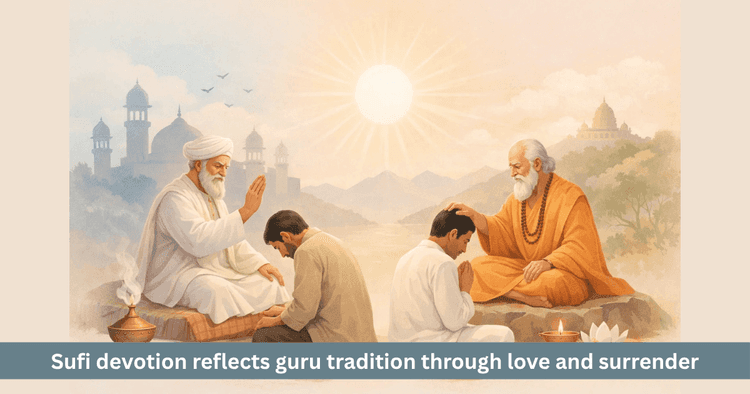
Table of Contents
In the Indian spiritual tradition, the Guru is not seen as merely a teacher. The Guru is regarded as one who gives direction to consciousness, softens ego and leads the seeker out of inner darkness. This is why Guru Purnima is not limited only to Vedic, Sanatan or ashram based traditions. Its spirit appears in different forms across the many streams of Indian spiritual practice. The Sufi tradition is one such stream where the guide is known as a Pir, Murshid or Shaikh, and devotion to that guide is seen as an essential foundation for inner growth.
The central feeling of Guru Purnima is that the one who opens an inner doorway in life, who gives not just knowledge but a new meaning to existence, is the true Guru. The same understanding is found deeply within the Sufi path as well. There, a disciple does not go merely to receive information. The disciple goes to refine the heart, soften inner hardness and walk the path of love, humility, service and remembrance of God under the shelter of the Pir. This is why, in many Indian Sufi spaces, even if the day is not always expressed by the same name, the inner spirit of Guru Purnima is deeply present.
Why can the remembrance of the Sufi tradition on Guru Purnima be considered special
Guru Purnima is a day of gratitude, reverence and inner acknowledgement. It reminds us that the light of wisdom does not come only from books. It comes from a living tradition. The Sufi path also rests upon such a living transmission. There the silsila, which means the lineage of spiritual guides, is considered extremely important. From one Pir to another, not only words but experience, compassion, discipline and spiritual tapasya, which means inner austerity, are passed forward.
The cultural soil of India has for centuries brought different spiritual streams close to one another. Because of this, for many people Guru Purnima is not only a religious date but a day to bow before every source of practice that has raised human consciousness. In Sufi shrines, khanqahs and gatherings too, the feeling of reverence for the Pir, gratitude, kalam, zikr and spiritual remembrance is often seen becoming more intense on this day.
What is the place of the Pir in the Sufi path
In the Sufi tradition, the Pir is not merely a person who gives advice. The Pir is the center in whose presence the seeker begins to recognize inner fragmentation. The Pir does not teach only what to think. The Pir teaches how to live, how to purify the inner voice and how to transform love into spiritual practice.
A few important points help explain the place of the Pir:
- The Pir is a guide who leads the seeker away from outer display and toward inner truth.
- The Pir gives discipline, because the spiritual journey is not completed by emotion alone.
- The Pir gives a spiritual gaze, which in the Sufi tradition is considered a means of inner influence.
- The Pir connects the seeker to tradition, so the disciple does not remain isolated but belongs to a living stream.
- The Pir teaches humility, because as long as ego remains, love for God cannot become steady.
This is why the relationship between disciple and Pir in Sufi practice is never merely formal. It is a bond of reverence, austerity, practice and inner transformation.
How did Indian Sufi saints live the feeling of the Guru
The Indian Sufi tradition has seen many saints whose lives showed that true guidance is offered not only through words but through the fragrance of life itself. Khwaja Moinuddin Chishti, Hazrat Nizamuddin Auliya, Baba Farid, Shaikh Salim Chishti and many others continue to convey the message that the path to God opens through love, service, remembrance and surrender to the Guru.
In their teachings one repeatedly finds the idea that a human being must first remove the hard coverings within. In this process the Pir functions like a mirror. The Pir introduces the disciple to weaknesses and also to possibilities. This is why gatherings held in memory of Sufi saints are never only rituals. They become practices that soften the soul.
Do the feelings of Guru Purnima and the Pir tradition connect with each other
Yes, at a deep level this connection is clearly visible. The names may be different and the modes of worship may differ, yet the essence of the Guru principle appears similar across many traditions. Wherever there is a relationship in which a seeker sits with reverence before an experienced guide and accepts inner transformation, the feeling of the Guru is present.
It is especially important to understand this on Guru Purnima, because India’s spiritual inheritance is not linear. It contains many streams, yet the center of many of them is the Guru. Reverence for the Pir in the Sufi tradition gives a wider shape to the broad Indian spirit of Guru Purnima. It creates the understanding that in spiritual life the need for a guide is universal.
What kind of atmosphere forms in Sufi shrines and khanqahs on this day
In the Indian Sufi tradition, at many places this day is marked through special Sufiyana kalam, zikr, fatiha, dua and remembrance of the teachings of the Pir. Not every place follows the same form, yet the center of devotion remains nearly the same. One feels there that the grace of the Guru or Pir is not only a memory of the past but a living energy of the present.
On such occasions some special feelings become prominent:
- A sense of gratitude, because the seeker acknowledges that walking alone would not have been possible.
- Spiritual humility, because ego cannot remain firm before the Pir.
- Collective remembrance, in which the tradition stays alive through kalam and prayer.
- The inspiration of service, because the Sufi path does not remain limited to private liberation.
- A softness of heart, which is considered one of the greatest signs of Sufi practice.
The kalam recited at many shrines on such a day are not merely poetic compositions. They become means that awaken experiences of love, longing, surrender and nearness to the Divine. This is why the place of Sufiyana kalam is not only musical but devotional.
How can the relationship between Sufiyana kalam and Guru Purnima be understood
In Sufiyana kalam one often sees a dialogue between the lover and the Beloved, yet its depth is not merely worldly. Hidden within it can also be the relationship between disciple and guide, seeker and truth, soul and supreme compassion. When such kalam are recited or sung on Guru Purnima, they intensify the memory of gratitude and the spiritual bond with the Pir.
The impact of kalam works on several levels:
- It melts the heart.
- It awakens remembrance.
- It helps one experience the inner bond with the Guru.
- It makes spiritual practice emotionally alive.
- It helps calm the noise within.
Seen in this way, Sufiyana kalam makes the feeling of Guru Purnima more living, more felt and more sensitive.
What common threads can be seen between the Sufi tradition and the Indian Guru tradition
When both traditions are viewed together, some beautiful similarities appear:
- The Guru or Pir is not merely a teacher but an awakener of consciousness.
- Reverence is regarded as the foundation of practice.
- Without discipline and humility, progress is seen as incomplete.
- The final purpose of wisdom is transformation of life, not argument alone.
- Service, love and inner purification are understood as part of the path.
Understanding these similarities is very important today, because then one sees not competition between traditions but an inner dialogue. On Guru Purnima this perspective offers a wider way of seeing Indian spiritual culture.
What does this subject mean in the present time
The modern person is often full of information and yet inwardly directionless. At such a time, the message of Guru Purnima and the spirit of the Sufi Pir tradition together remind us that information alone does not transform life. Living guidance, discipline of character, softness of heart and true surrender are equally necessary.
The lives of Sufi saints also teach that spirituality does not mean hardness. It means depth. Reverence for the Pir does not mean blind imitation. It means recognizing that light which leads the seeker toward a better inner form. Guru Purnima is a celebration of this recognition.
How can this feeling be brought into one’s own life
Those who wish to remember Sufi saints and the Guru tradition together on this day may adopt a few simple yet serious practices:
- Express gratitude in the heart toward those who have given direction in life.
- Choose one teaching from a Sufi saint or one’s own Guru and reflect upon it deeply.
- Spend some time in silence, prayer or zikr, which means remembrance.
- Perform a small act of service, because reverence feels incomplete without service.
- Recognize ego, comparison and bitterness and resolve to loosen their hold.
These practices may seem small, yet this is how the spirit of Guru Purnima enters the heart. The tradition of the Sufi saints teaches the same truth, that great transformations often begin in very quiet ways.
Source and traditional indications
The basis of this subject rests upon the supreme importance of the Guru, that is the Pir, in the Indian Sufi tradition, and upon the tradition of special recitation of Sufiyana kalam at many Sufi places on Guru Purnima.
Source: Sufi literature
This source offers more than a fact. It points toward the wider cultural truth in which different Indian spiritual streams have continued to regard the Guru as the center of inner life.
To bow the heart is the truest reverence
The meaning of Guru Purnima is not only to bow before the Guru. Its deeper meaning is that a person should recognize the place within where hardness, restlessness and ego still remain. The tradition of the Sufi saints teaches that true respect for the Pir becomes meaningful only when it begins to appear in life as gentleness, service, love of God and spiritual discipline.
For this reason, the relationship between Sufi saints and Guru Purnima is not merely a cultural comparison. It is a sign of that shared spiritual consciousness of India where paths may differ, yet the truth of bowing the heart remains one.
FAQs
Is Guru Purnima only a festival of the Sanatan tradition
The core feeling of Guru Purnima is reverence and gratitude toward the Guru. That is why its spiritual meaning can be experienced in many Indian streams of practice, including the Sufi tradition.
What is the Guru called in the Sufi tradition
In the Sufi tradition the Guru is generally called Pir, Murshid or Shaikh. This is the guide who gives direction to the disciple’s inner journey.
Is Guru Purnima observed at all Sufi shrines
Every shrine or khanqah does not follow the same tradition. Yet at many places one sees a special feeling of reverence for the Pir, prayer, kalam and spiritual remembrance on this day.
What is the importance of Sufiyana kalam in this context
Sufiyana kalam softens the heart, awakens remembrance and makes the spiritual relationship between the Pir and the seeker feel more alive.
What can a seeker do on this day
A seeker can express gratitude, reflect on the teachings of the Guru or a Sufi saint, spend time in silence or prayer and bring reverence into life through small acts of service.
Get your accurate Kundali
Generate KundaliDid you like it?
Author

Pt. Narendra Sharma (63)
Experience: 20
Consults About: Family Planning, Career
Clients In: Punjab, Haryana, Delhi
Share this article with friends and family
About ZODIAQ
ZODIAQ is an online Vedic Astrology platform. It connects clients seeking astrological advice to experienced astrologers with deep knowledge. Our users also generate kundali and perform kundali milan for free. ZODIAQ also offers services to the Astrologers. Astrologers utilize various offerings by ZODIAQ to serve their clients effectively.
If you are a User
Consult with experienced astrologers and seek their guidance. You can also order handwritten Janm Patrika report with life prediction prepared by experienced astrologers. Generate accurate Kundali, perform Kundali Matching and check horoscope and muhurat. Utilize our online library for all the necessary astrological and spiritual information.
If you are an Astrologer
Create accurate kundali for your clients and perform Kundali Matching for up to 5 people at a time. Write comprehensive Janm Patrika report for your clients with ZODIAQ. Check client details anytime by saving it in client directory. Become more productive by tracking how many clients you guide every day.
WELCOME TO
ZODIAQ
Right Decisions at the right time with ZODIAQ
