Secret of Vyas Gufa and Writing of Mahabharata in Mana Village
By Pt. Sanjeev Sharma
The sacred Himalayan cave where Mahabharata was composed through divine memory
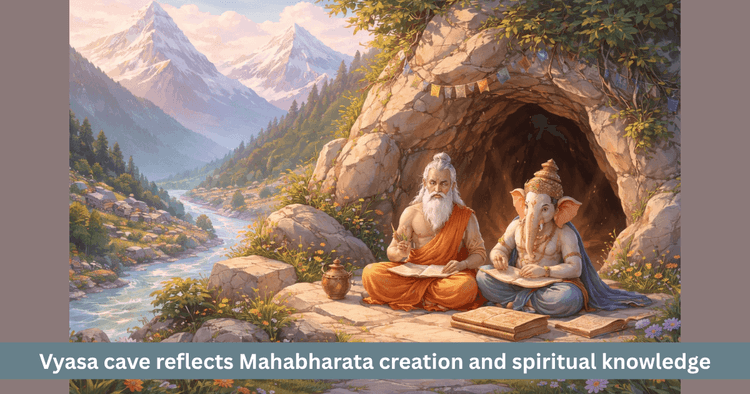
Table of Contents
In the spiritual and literary tradition of India, some places are not merely pilgrimage sites. They become living centers of memory, sacred hearing, austerity, wisdom, and divine creation. Vyas Gufa in Mana Village of Uttarakhand is one such extraordinary place. Nestled in the lap of the Himalayas, this region is sacred not only because of its natural beauty, but also because tradition holds that it was here that Maharshi Veda Vyasa dictated the Mahabharata and Lord Ganesha wrote it down. This story is not merely about literary composition. It symbolizes that moment when divine memory, immense vision, and sacred intelligence came together in one place.
The name of Vyas Gufa does not bring to mind only a stone cave. It opens the sky of Indian spiritual memory. The Mahabharata is not merely the story of a war. It is a vast scripture of dharma, adharma, ethics, compassion, detachment, statecraft, family life, attachment, liberation, and the deepest layers of the human mind. It is difficult even to imagine that such a work could have emerged from an ordinary place. That is why many pilgrims feel that Vyas Gufa is not just a geographical location. It is a place filled with spiritual resonance.
According to local Sthala Purana tradition, it was here that Vyasa recited the Mahabharata and Ganesha wrote it down. An especially wondrous aspect of this place is that the rocks here appear like layers of paper. This naturally evokes the feeling that nature itself became witness to the divine writing of the great epic. That is why Vyas Gufa is not merely a travel destination. It is a sacred symbol of the meeting of word and eternity.
Why did Mana Village become the center of this divine memory
Mana Village is counted among the last villages of India. The seriousness of the Himalayas, the sound of the rivers, the silent presence of stone, and the vast openness of the sky make this whole region naturally suitable for contemplation. In such places the mind turns inward almost on its own. This is why Indian tradition has regarded the Himalayas not merely as mountains, but as a land of austerity and wisdom.
The significance of Mana Village may be understood through a few important points
- it is connected to the sacred consciousness of the Himalayas
- it offers an atmosphere naturally suited for solitude and contemplation
- it is held to be full of memories of the rishi tradition
- its natural structure itself awakens the feeling of sacred listening and composition
Thus the significance of Mana Village lies not only in the location, but also in the inner atmosphere that makes the imagination of a text like the Mahabharata feel spiritually possible.
Why is the story of the joint composition by Vyasa and Ganesha so important
In Indian tradition, the story is widely known that when Maharshi Vyasa resolved to compose the Mahabharata, he needed a scribe capable of writing down the immense flow of wisdom without interruption. Lord Ganesha agreed to do this work. Yet the task was no ordinary one. A profound condition was established between them. Ganesha said that he would write without pause, and therefore Vyasa must also speak without pause. Vyasa, in turn, placed his own condition that Ganesha would write each verse only after fully understanding its meaning.
This episode is deeply significant because two divine powers come together within it
| Element | Vyasa | Ganesha |
|---|---|---|
| Source of knowledge | Divine memory and rishi vision | Intelligence, writing, and ordered expression |
| Role | Revelation and dictation | Writing and preservation |
| Symbol | Sage consciousness | Divine intellect |
| Result | Birth of the Mahabharata | Eternal wisdom preserved in written form |
This table shows that the Mahabharata is not merely the product of a single author. It is the joint wonder of rishi vision and divine intelligence. Vyas Gufa becomes the sacred memory of that union.
Why do the rocks of Vyas Gufa look like layers of paper
This is one of the most captivating features of the place for pilgrims and travelers alike. Local belief says that the stones of Vyas Gufa resemble layered sheets of paper. From a purely material perspective this may be seen as a natural geological formation, yet sacred experience is never interpreted only in material terms. In Indian tradition, nature often becomes a symbol of memory. These layered rocks appear like the frozen pages, stone manuscripts, and silent scriptures of that divine writing.
Several deep symbolic meanings arise from this vision
- it appears as though wisdom itself has been inscribed into nature
- it appears as though stone has taken the form of a manuscript
- it seems as though the Himalaya preserved this story in its own body
- it suggests that the Mahabharata was not merely written, but descended into the earth
That is why the feeling evoked by these rocks is not only wonder, but reverential astonishment.
Is Vyas Gufa only a mythic memorial
No. To regard Vyas Gufa only as a mythic memorial would be to greatly reduce its meaning. This place works on several levels within Indian consciousness.
The layered significance of Vyas Gufa
1. Center of sacred memory
It keeps alive the tradition of the composition of the Mahabharata.
2. Symbol of the guru lineage
Vyasa is not only a composer. He is Veda Vyasa, a source of sacred knowledge.
3. Meeting point of hearing and writing
Here sacred speech and sacred inscription are believed to have come together.
4. Union of silence and epic revelation
The silence of the cave and the vastness of the Mahabharata create a profound spiritual paradox.
5. Witness of Himalayan tapas
It teaches that great scriptures are born not only through talent, but through austerity and concentrated consciousness.
For this reason, it is more fitting to see Vyas Gufa as a symbolic site of Indian wisdom tradition rather than merely a place in a story.
What does the episode of the writing of the Mahabharata teach us
The writing of the Mahabharata is not merely a marvelous legend. It offers many insights into the discipline of wisdom. When the story of Vyasa and Ganesha is read in the context of Vyas Gufa, it becomes clear that great creation requires not only genius, but also discipline, depth, clarity of meaning, and patience.
Some of the main teachings that emerge from this episode are
- wisdom requires intelligence in order to be carried
- intelligence requires rishi vision to be rightly directed
- writing is meaningful only when there is true understanding of meaning
- great scriptures are born not in haste, but in states of elevated consciousness
- words are not only information, they also carry dharma
These teachings remain as relevant today as they must have been then.
Why is the relation between Vyas Gufa and silence so deep
The cave itself is a powerful symbol in Indian spiritual tradition. A cave appears limited from outside, yet inwardly it suggests depth. The mind too is like this. From outside it seems filled with thought, but in deeper discipline a vast inner silence opens. The episode of Vyas Gufa teaches that the greatest literary and spiritual creations often arise from precisely such inner silence.
There is a beautiful paradox here
- the cave is silent, yet it is linked with the vast speech of the Mahabharata
- the stones are still, yet they are linked with a moving history
- the place is small, yet its memory is immeasurable
This is the spiritual beauty of Vyas Gufa.
Can Vyas Gufa also be connected with the guru lineage
Certainly. Veda Vyasa occupies one of the highest places in the Indian guru lineage. In many traditions, Guru Purnima is also honored as Vyasa Purnima. This means that Vyasa is not merely the author of scriptures. He is the guru who gave order to sacred knowledge. He divided the Vedas, gave form to the Purana tradition, and brought forth the Mahabharata. Therefore, to behold Vyas Gufa is also to bow inwardly to that consciousness which gave structure to Indian spiritual memory.
Guru dimensions of Vyas Gufa
- preservation of knowledge
- turning memory into scripture
- expressing complex life through sacred narrative
- offering the world of disciples a mirror of dharma
Seen in this light, Vyas Gufa appears not merely as a place of writing, but as a Himalayan seat of guru consciousness.
Why is local Sthala Purana tradition so important here
Many sacred places in India remain alive not only in great scriptures, but also through local Sthala Purana, oral narratives, temple traditions, and devotional memory carried through generations. The story of Vyas Gufa belongs to that living tradition. The local people do not see this place merely as a historical site. They live it as a sacred and present reality. That is why visitors often feel not only that they are hearing a story, but that they are entering a field of living faith.
What is the message of Vyas Gufa for modern times
Today writing is abundant, but depth is often lacking. Speech is abundant, but meaning is often thin. Information is abundant, but wisdom is scarce. In such a time, the symbolism of Vyas Gufa becomes especially important. It reminds us that great words arise from silence, discipline, austerity, and real understanding. Not every piece of writing becomes a Mahabharata. For that, vision is needed, patience is needed, and inward honesty is needed.
A modern seeker, writer, or thinker may learn from this episode
- first bring inner clarity, then give words
- write only that which you truly understand
- do not treat knowledge as a means of prestige, but as a responsibility of dharma
- only words that arise from silence carry enduring power
The final radiance of this episode
Vyas Gufa in Mana Village of Uttarakhand is one of those sacred centers of Indian consciousness where the tradition of the composition of the Mahabharata by Maharshi Vyasa and Lord Ganesha is still remembered with reverence. According to local Sthala Purana, this is the very place where the divine writing of the great epic took place. The paper like layered rocks of the cave give this tradition even greater symbolic depth, as though nature itself became witness to the epic.
Vyas Gufa teaches us that great scriptures are not merely composed. They are born of discipline. They are not merely written. They emerge from consciousness. And when wisdom, silence, the guru principle, and divine intellect come together, then a timeless stream like the Mahabharata descends upon the earth. This is the deepest and most enduring message of Vyas Gufa.
Frequently Asked Questions
Where is Vyas Gufa located
Vyas Gufa is believed to be located in Mana Village in Uttarakhand.
What is the main religious significance of Vyas Gufa
Tradition holds that it was here that Vyasa dictated the Mahabharata and Ganesha wrote it down.
Why are the rocks here considered special
They appear like layers of paper, which symbolically connects the place even more deeply with writing and sacred knowledge.
Is Vyas Gufa connected with the guru tradition as well
Yes. Since Veda Vyasa is revered as a great guru, the cave may also be seen as a sacred symbol of wisdom and the guru principle.
What is regarded as the main source of this episode
The principal source associated with this episode is the local Sthala Purana tradition.
Get your accurate Kundali
Generate KundaliDid you like it?
Author

Pt. Sanjeev Sharma (63)
Experience: 20
Consults About: Family Planning, Career
Clients In: Punjab, Haryana, Delhi
Share this article with friends and family
About ZODIAQ
ZODIAQ is an online Vedic Astrology platform. It connects clients seeking astrological advice to experienced astrologers with deep knowledge. Our users also generate kundali and perform kundali milan for free. ZODIAQ also offers services to the Astrologers. Astrologers utilize various offerings by ZODIAQ to serve their clients effectively.
If you are a User
Consult with experienced astrologers and seek their guidance. You can also order handwritten Janm Patrika report with life prediction prepared by experienced astrologers. Generate accurate Kundali, perform Kundali Matching and check horoscope and muhurat. Utilize our online library for all the necessary astrological and spiritual information.
If you are an Astrologer
Create accurate kundali for your clients and perform Kundali Matching for up to 5 people at a time. Write comprehensive Janm Patrika report for your clients with ZODIAQ. Check client details anytime by saving it in client directory. Become more productive by tracking how many clients you guide every day.
WELCOME TO
ZODIAQ
Right Decisions at the right time with ZODIAQ
