The Secret of Vyasa: A Divine Office Across Ages
By Aparna Patni
Understanding Vyasa as a recurring spiritual role in every Dvapara Yuga
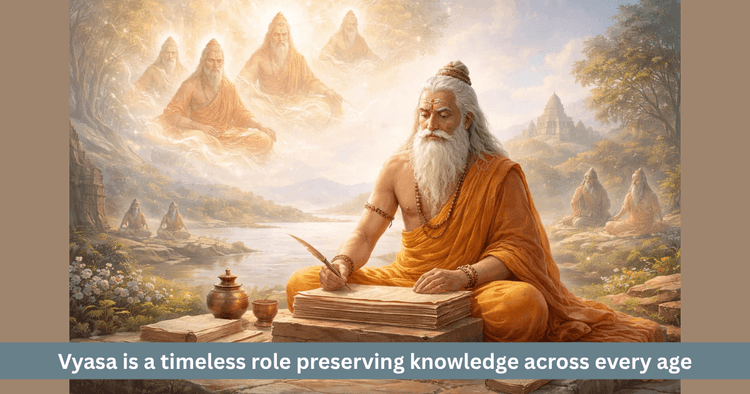
Table of Contents
In the Indian tradition, there are certain names which instantly evoke the image of one towering sage. Vyasa is one of those names. Ordinarily, when Vyasa is remembered, people think of the great seer associated with the Mahabharata, the one who divided the Vedas and the one whose vision gave shape to some of the most profound streams of Indian spiritual literature. This understanding is meaningful, yet the Puranic tradition offers a much wider perspective. There, Vyasa is not merely the name of one individual. It is a divine office that appears in every Dvapara Yuga so that the Vedic knowledge may be re organized, preserved and made accessible for the age that follows.
The Vishnu Purana suggests that in every Dvapara Yuga, a particular great being assumes the office of Vyasa. The task of that being is not merely textual editing. It is to arrange sacred knowledge according to the condition of human consciousness, the decline of memory, the needs of the time and the protection of dharma for the future. Seen in this light, Vyasa is not a simple title. It is a profound spiritual responsibility in which shruti, smriti, history, Purana and the demands of the age all come together. Tradition further says that in the present cycle, Krishna Dvaipayana Vyasa is the twenty eighth Vyasa and that in the future Ashwatthama will become the next Vyasa. This idea is not only fascinating. It is deeply philosophical.
What Is the Real Meaning of the Word Vyasa
The word Vyasa carries the sense of division, arrangement, expansion and systematic presentation. For this reason, it becomes an appropriate name for the great sage who organizes the vast Vedic knowledge into forms that human beings can receive. The Vedas are regarded as limitless, subtle and immense. If left entirely unstructured, they would remain difficult for ordinary people to grasp. Therefore Vyasa is the one who gives order to infinity.
The deeper meaning of the word becomes clear here. Vyasa is not only one who knows. Vyasa is one who makes knowledge suitable for the age. He is not merely a collector but an editor of dharma, a guardian of memory and a bridge of tradition. This is why it is important to understand that in the word Vyasa, there is more function than individual identity and more responsibility than mere name.
Why Is Vyasa Regarded as an Office
If there is one Vyasa in every Dvapara Yuga, then the meaning becomes obvious. This is a continuing responsibility, not a one time historical event. The Indian understanding of time is cyclical rather than linear. Ages change, the condition of dharma changes, the capacity of human beings changes and accordingly the presentation of sacred knowledge must also be renewed. It is at this point that the greatness of the office of Vyasa becomes visible.
There are several deep reasons why Vyasa is understood as an office:
- The capacity to receive knowledge is not the same in every age
- Preservation of the Vedas depends not only on memory but also on order
- Every age needs dharma in a form that can be understood
- The essence of scripture must be made available according to the needs of time
Thus Vyasa represents not merely personal greatness but the service of the age through sacred knowledge.
Why Is a Vyasa Needed in Every Dvapara Yuga
Dvapara Yuga is traditionally understood as a transitional age. Dharma is no longer whole, yet it has not fully collapsed either. It stands at the threshold of Kali Yuga, where memory, discipline, austerity and the ability to receive scripture decline even further. At such a moment, the division and structured presentation of the Vedas becomes especially necessary. This is the work of Vyasa.
The task of Vyasa should not be reduced to dividing the Vedas into four parts. It is much larger. Vyasa prepares the architecture of sacred memory for the coming age. He ensures that when human consciousness declines, the light of dharma does not disappear completely. In this sense, the work of Vyasa is not only scholarship. It is a form of protection of the age itself.
Main functions of the office of Vyasa in Dvapara Yuga
- Division and arrangement of the Vedas
- Making subtle knowledge graspable for society
- Establishing dharma through history and Purana in narrative form
- Creating structures of memory for the coming Kali Yuga
Who Is Regarded as the Present Vyasa
Tradition regards Krishna Dvaipayana Vyasa as the twenty eighth Vyasa of the present cycle. It is he who is commonly remembered as Vedavyasa. He is the great seer associated with the Mahabharata, the Brahma Sutras and the systematic ordering of Vedic knowledge. In the Indian tradition, he is revered with extraordinary devotion because he did not merely preserve scripture. He gave knowledge life through history, dialogue, narrative and philosophical structure.
The work of Krishna Dvaipayana Vyasa was so vast that in later tradition the name Vyasa immediately evokes him. Yet when the Vishnu Purana says that he is the twenty eighth Vyasa, it makes clear that before him there was a long succession of holders of this sacred office. This does not reduce his greatness. It deepens it, because he appears as the present link in a much larger stream of sacred responsibility.
Should Vedavyasa and the Office of Vyasa Be Understood Separately
Yes, this distinction is important. Vyasa is an office, while Vedavyasa is the particular sage who holds that office in the current cycle. Just as a throne is an office and the one seated upon it is the ruler of the time, in the same way Vyasa is a continuing responsibility and Krishna Dvaipayana Vyasa is its present holder in this age cycle. This comparison is only for understanding but it helps clarify why the distinction matters.
The difference between the office of Vyasa and Vedavyasa
| Aspect | Meaning |
|---|---|
| Vyasa | The divine office of arranging Vedic knowledge for the age |
| Vedavyasa | The specific sage who holds that office |
| Nature of the office | Cyclical, recurring and age based |
| Nature of the individual | A particular seer appearing in a given age |
Once this distinction is understood, the Puranic teaching becomes much clearer.
Why Is Ashwatthama Regarded as the Next Vyasa
This idea naturally awakens curiosity. Tradition says that in the future Ashwatthama will become the next Vyasa. This should not be seen merely as a glorification of a warrior. It points toward a deeper spiritual process. In the Mahabharata tradition, Ashwatthama appears as a complex figure marked by strength, pain, error, suffering and prolonged consequence. His life contains heroism, fault, anguish and the burden of long endurance.
To see such a figure as the future Vyasa is to recognize that Indian tradition does not glorify perfection in a shallow way. It honors transformation. A consciousness that has passed through intense conflict, remorse, suffering and the long discipline of time may eventually gain a profound depth of vision. Thus the indication that Ashwatthama will become the next Vyasa also teaches that purification through time, tapas and deep experience can prepare a being for the service of a future age.
What Does This Idea of Ashwatthama as the Future Vyasa Teach
This is not only a statement about the future. It is also a significant philosophical lesson. Indian tradition does not judge a being only by one moment of failure or one period of darkness. It looks at the whole journey. If Ashwatthama on one level represents fall, on another level he also represents long consequence, memory and the possibility of inner ripening. His future as Vyasa suggests that the one who must preserve sacred knowledge for an age must possess not only brilliance but also depth born of suffering and time.
This idea offers several important teachings:
- A single fault is not always the final truth of a being
- Time and tapas can transform consciousness
- To become an instrument of knowledge requires not only talent but also maturity and experience
- Service to an age demands a long and deep vision
What Is the Spiritual Meaning of the Office of Vyasa and the Editing of the Vedas
If this is understood only as literary editing, the real depth is lost. To arrange the Vedas means to bring eternal truth within the capacity of a changing age. This is not merely scholarship. It is also compassion. To present knowledge in such a way that people can understand it, absorb it and live by it, this is real guruhood. In that sense, the office of Vyasa is profoundly spiritual.
The office of Vyasa teaches that truth may be eternal but its presentation must adapt according to time. Water may be the same, yet the vessel may change. The Vedas are eternal but those who receive them change from age to age. Therefore the need for Vyasa remains.
Is This Idea Also Connected With the Guru Tradition
Certainly. Vyasa is not only an editor of scripture but a central force in the guru tradition itself. To organize the Vedas is to become a guru of knowledge for generations yet to come. therefore to understand Vyasa is also to understand guruhood. The guru does not merely speak. The guru shapes knowledge in such a way that the disciple may enter into it. Vyasa does this at a civilizational scale.
This is why Vyasa Purnima, today widely celebrated as Guru Purnima, becomes more than the remembrance of a single sage. It becomes a festival of gratitude toward the entire guru tradition. This itself indicates that Vyasa is linked with a much larger guru principle.
What Is the Importance of Understanding Vyasa as an Office in Modern Times
The modern age is flooded with information but suffers from a lack of order and essence. People know much, yet often fail to discern what is central and what is secondary. In such a time, understanding Vyasa as an office becomes highly meaningful. It teaches that it is not enough to collect knowledge. It must also be organized, purified and made meaningful for the present age.
In a modern context, the office of Vyasa teaches the following:
| Modern problem | Teaching from the office of Vyasa |
|---|---|
| Excess of information | Learn to recognize the essential |
| Fragmented learning | Organize knowledge with clarity |
| Loss of direction | Return to tradition and source |
| Distance from scripture | Develop age appropriate understanding |
| Spiritual confusion | Go back to the roots of wisdom |
Does This Idea Also Express the Indian Understanding of Cyclical Time
Yes, very deeply. This teaching shows that Indian tradition does not look at time as a straight line. Here the ages return in cycles and in each cycle knowledge must be reorganized again. That is why every Dvapara Yuga requires a Vyasa. This is not merely mythic imagination. It is also the philosophical expression of the Indian view of time. Truth remains eternal but the human condition changes. Therefore there must always be a sacred center that re articulates wisdom for the changing age. That center is Vyasa.
What Is the Deepest Message of This Whole Theme
The deepest message in understanding Vyasa as an office is that the stream of sacred knowledge never stops, though its bearers may change. In one age Krishna Dvaipayana Vyasa holds the office, in another someone else will. This means that truth does not belong to one historical figure alone. Yet certain souls are chosen in time to preserve, arrange and transmit that truth for the welfare of the age. This idea inspires reverence for knowledge and humility before tradition.
It also teaches:
- The work is greater than the individual
- The office is greater than the name
- Service to the age is greater than personal brilliance
- Knowledge must be continually remembered, arranged and renewed
Final Reflection
The idea expressed in the Vishnu Purana that every Dvapara Yuga has its own Vyasa and that Krishna Dvaipayana is the twenty eighth Vyasa of the present cycle, is one of the most beautiful insights of Indian spiritual thought. It teaches that Vyasa is not only the name of a great sage but a divine office in the preservation of eternal knowledge. The traditional belief that Ashwatthama will become the next Vyasa deepens this vision further, because it suggests that time, tapas and profound experience can prepare consciousness to serve the dharma of a future age.
therefore it is more meaningful to understand Vyasa not only as a figure in history but as a living responsibility within tradition. That is the most beautiful, deepest and most thought provoking truth of this teaching.
Frequently Asked Questions
Was Vyasa a person or an office
According to the Puranic tradition, Vyasa is a divine office assumed by a great being in every Dvapara Yuga.
Who is regarded as the present Vyasa
Tradition regards Krishna Dvaipayana Vyasa as the twenty eighth Vyasa of the present cycle.
Who is said to be the next Vyasa
Traditional belief says that Ashwatthama will become the next Vyasa.
What is the main function of the office of Vyasa
It is to arrange the Vedas, make knowledge suitable for the age and preserve dharma for the future.
What is the central teaching of this idea
It teaches that sacred knowledge is eternal but every age needs a worthy bearer and organizer to keep it alive.
Get your accurate Kundali
Generate KundaliDid you like it?
Author

Aparna Patni (63)
Experience: 20
Consults About: Family Planning, Career
Clients In: Punjab, Haryana, Delhi
Share this article with friends and family
About ZODIAQ
ZODIAQ is an online Vedic Astrology platform. It connects clients seeking astrological advice to experienced astrologers with deep knowledge. Our users also generate kundali and perform kundali milan for free. ZODIAQ also offers services to the Astrologers. Astrologers utilize various offerings by ZODIAQ to serve their clients effectively.
If you are a User
Consult with experienced astrologers and seek their guidance. You can also order handwritten Janm Patrika report with life prediction prepared by experienced astrologers. Generate accurate Kundali, perform Kundali Matching and check horoscope and muhurat. Utilize our online library for all the necessary astrological and spiritual information.
If you are an Astrologer
Create accurate kundali for your clients and perform Kundali Matching for up to 5 people at a time. Write comprehensive Janm Patrika report for your clients with ZODIAQ. Check client details anytime by saving it in client directory. Become more productive by tracking how many clients you guide every day.
WELCOME TO
ZODIAQ
Right Decisions at the right time with ZODIAQ
