What Is Gajendramoksha and Eighth House Secret?
By Aparna Patni
Sacred Lore of Gajendramoksha Deliverance from Crocodile and Astrological Secrets of Eighth House
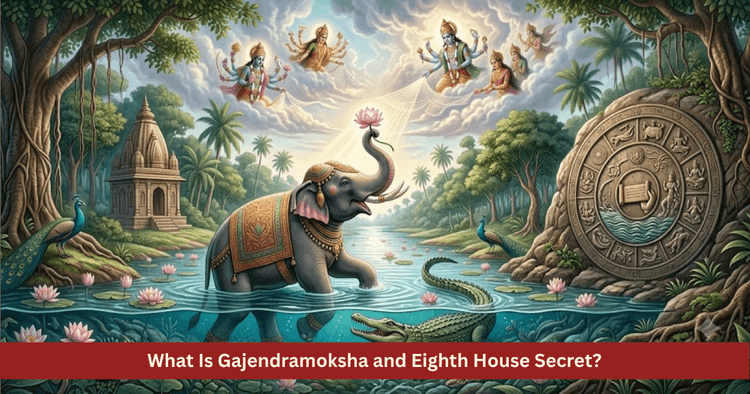
Table of Contents
Gajendramoksha Ritual Timings and Sacred Observance Guidelines
In the sacred Vedic tradition the profoundly compassionate divine manifestation of Supreme Lord Shri Hari Vishnu celebrated as the savior of the elephant sovereign Gajendra represents the absolute zenith of unconditional surrender crisis deliverance and liberation from untimely mortality. Under Vedic astrological principles the worship of Lord Hari in the Gajendramoksha form stands as the supreme remedy to pacify the tribulations of the eighth house governing sudden life crises fatal accidents terminal illnesses prison confinements and Kaal Sarp Dosha. Whenever an individual becomes encircled by catastrophic adversities where financial wealth physical stamina and domestic relations fail completely seeking sanctuary before Gajendramoksha Narayana bestows invincible fearlessness and spiritual salvation. The classical details auspicious timings stellar correspondences and sacred ceremonial components of this divine ritual appear systematically in the structured matrix below.
| Sacred Dimension | Ritual Details and Astrological Significance |
|---|---|
| Sacred Annual Date | Full moon or eleventh lunar day of every month and Wednesdays |
| Daily Worship Time | Auspicious Brahma Muhurta at dawn or evening twilight Pradosha |
| Presiding Form | Four armed Lord Hari mounted upon celestial eagle Garuda holding Sudarshana Chakra |
| Astrological Association | Eighth house twelfth house longevity significator Saturn and nodes Rahu Ketu |
| Core Offerings | Blue or white lotus blossoms yellow sandalwood paste holy Ganga water Tulsi and Panchamrit |
| Primary Vedic Rite | Recitation of Gajendramoksha Stotra from Srimad Bhagavatam and Om Namo Narayanaya |
| Expected Blessings | Preservation from untimely death Kaal Sarp Dosha pacification and legal victory |
The Aquatic Duel in the Sacred Lake of Mount Trikuta
According to the sacred chronicles recorded within the eighth canto of the Srimad Bhagavata Mahapurana upon the divine Mount Trikuta surrounded by the celestial ocean of milk lay an expansive and enchanting forest. Within that valley rested an exquisite sacred lake belonging to the water deity Varuna adorned with radiant golden lotus flowers. In that pristine sanctuary a monumental elephant sovereign named Gajendra ruled over vast herds of wild elephants. Gajendra possessed unparalleled physical strength across the terrestrial globe. Ferocious predators including lions tigers and horned beasts fled in terror upon hearing his thunderous trumpet echoing across the mountain peaks.
During the peak of a scorching summer day exhausted by heat Gajendra entered the sacred lake accompanied by his consorts and offspring. Drawing cool water with his trunk he showered his family while uprooting juicy lotus roots in joyous abandon. Entangled within physical arrogance and the affectionate adoration of his herd Gajendra forgot that no material strength provides immunity against the relentless march of time.
Within the deep waters of that same lake dwelt an extraordinarily colossal crocodile. As Gajendra ventured into deeper currents the aquatic predator struck with lightning velocity seizing the hind leg of the elephant sovereign within its adamantine jaws. In the water the crocodile commanded invincible strength because water was its native elemental realm while an elephant inevitably forfeits terrestrial momentum within deep currents. Gajendra exerted colossal muscular force attempting to wrench his limb free initiating an apocalyptic struggle across the troubled waters.
The Millennium of Struggle and the Cry of Surrender
The fierce duel between the mighty elephant and the relentless crocodile continued not for days or months but across 1000 solar years without pause. Both entities possessed uncommon vitality derived from past life spiritual impressions. The placid lake churned into boiling waves that splashed against the heavens while celestial beings and holy seers observed this unprecedented clash from the skies with profound awe.
As centuries elapsed the physical stamina and spiritual resilience of the crocodile expanded naturally within its aquatic domain. Conversely being a terrestrial creature the muscular vigor blood circulation and Pranic vitality of Gajendra drained steadily. When Gajendra reached the threshold of total exhaustion sinking below the surface his consorts and offspring realized that rescuing their patriarch was impossible. Panicked and weeping in despair the herd abandoned Gajendra to his fate retreating safely to the dry shore.
- Gajendra realized that the family and physical might he cherished had abandoned him in his darkest hour.
- He perceived that worldly relationships endure solely during moments of health and transient prosperity.
- When his bodily limbs grew entirely paralyzed leaving only the tip of his trunk above the surface his worldly pride dissolved completely.
- Awakened by past life spiritual impressions Gajendra suddenly remembered the transcendental majesty of Supreme Lord Shri Hari.
- Plucking a blossoming blue lotus flower with the tip of his trunk he raised it toward the sky crying out with a trembling soul asking Lord Narayana the universal preceptor to deliver him.
Supreme Lord Vishnu reclined within the celestial realm of Vaikuntha. The very instant the selfless and desperate cry of Gajendra reached His divine ears the Lord abandoned His throne in haste. Barefoot and swift He mounted His celestial carrier Garuda arriving at the lake of Mount Trikuta within a fraction of a second. Beholding His devotee on the verge of death Lord Hari commanded His blazing Sudarshana Chakra. Piercing the depths of the turbulent waters the divine discus severed the jaw of the predatory crocodile instantly liberating Gajendra from the clutches of death. Extending His tender hands Lord Hari lifted the exhausted elephant from the waters granting him eternal fearlessness.
The Karmic Curses and Deliverance of Two Souls
According to the Srimad Bhagavatam this confrontation was not merely an ordinary animal struggle but represented the karmic culmination of actions performed across previous lifetimes. In his prior incarnation Gajendra was the righteous and devout monarch Indradyumna who governed the Pandya kingdom as a dedicated devotee of Lord Vishnu. While King Indradyumna sat in secluded meditation observing a vow of silence upon the mountain venerable sage Agastya arrived accompanied by his disciples. Because the king was absorbed in deep samadhi he failed to stand and offer traditional hospitality. Mistaking this absorption for regal arrogance sage Agastya cursed the monarch declaring that because he behaved like a dull witted elephant ignoring a learned ascetic he would take birth in the body of an elephant.
Conversely the predatory crocodile was in his prior life an illustrious celestial Gandharva named Huhu. While sporting playfully with water nymphs in a celestial lake venerable sage Devala was engaged in severe water austerities nearby. In foolish jest Huhu swam underwater pulling the legs of the meditating ascetic. Enraged by this unprovoked disruption sage Devala cursed the Gandharva stating that because he grabbed limbs underwater like a wicked beast he would instantly become a predatory crocodile. When Huhu begged for mercy the sage declared that when Supreme Lord Hari struck him with His divine discus he would regain his celestial form.
Upon receiving the touch of the divine Sudarshana Chakra the crocodile dissolved its reptilian body emerging as an effulgent celestial Gandharva who offered hymns before ascending to heavenly realms. Similarly when Lord Hari stroked the head of Gajendra with His lotus palm the elephant cast off his animal frame assuming a four armed spiritual form adorned in yellow silks and celestial gems achieving Sarupya Moksha to reside eternally beside Lord Vishnu in Vaikuntha.
Astrological Link of the Eighth House and Kaal Sarp Dosha
In the foundational masterpiece of Indian predictive astrology titled Brihat Parashara Hora Shastra venerable sage Parashara expounds upon the delicate balance between longevity and crisis houses. Astrologically the sacred narrative of Gajendramoksha illuminates the deepest mysteries of the eighth house and the karmic entrapment of Kaal Sarp Dosha.
The eighth house designated as the Randhra Bhava or Ayur Bhava governs sudden catastrophes premature mortality hidden aquatic dangers protracted litigation chronic illnesses and existential misery. The predatory crocodile represents the living embodiment of the eighth house lurking concealed within deep waters to seize human vitality unexpectedly dragging consciousness into darkness. The elephant represents physical ego and material attachments. When the eighth house suffers malefic aspects from Rahu Saturn or Mars an individual feels as though an unseen demonic force is dragging life downward into helplessness.
When all seven physical planets are hemmed between the nodal axis of Rahu and Ketu Kaal Sarp Dosha manifests. This planetary entrapment paralyzes personal progress ensnaring an individual in relentless legal battles false accusations and existential anxiety. The Gajendramoksha Stotra acts as the living Sudarshana Chakra capable of severing the jaws of this karmic crocodile. When an afflicted seeker surrenders before Lord Narayana the destructive vibrations of the eighth house dissolve transforming premature danger into robust longevity.
Transcending Untimely Death Through Absolute Surrender
The foundational flaw in human consciousness is relying solely upon mundane resources during moments of acute crisis. As long as an individual depends upon material wealth intellectual cunning and social contacts divine grace remains unmanifest. Gajendra struggled for a thousand years relying upon his muscular trunk and family yet sank deeper into the aquatic abyss. However the singular moment he acknowledged his total helplessness surrendering his heart before God divine preservation manifested instantly.
Within the Srimad Bhagavatam Supreme Lord Vishnu personally promises that any human being who awakens at dawn reciting or listening attentively to the sacred Gajendramoksha Stotra will never encounter horrific nightmares untimely death or insurmountable catastrophes. This hymn represents not mere poetic literature but the acoustic vibration of absolute spiritual surrender. For an individual trapped within severe depression terminal physical afflictions or judicial imprisonment this sacred hymn acts as an infallible divine medicine.
Sacred Vedic Remedies for Eighth House Purification
When an individual undergoes the planetary major period or sub period of an afflicted eighth lord or faces recurring accidents and life threatening trials classical scriptures prescribe potent remedial measures centered upon Lord Gajendramoksha.
- Sit facing eastward every morning after bathing reciting the original Gajendramoksha Stotra from the third chapter of the eighth canto of the Srimad Bhagavata Mahapurana with focused devotion.
- Offer clean water mixed with holy Ganga water to Lord Vishnu presenting a fresh white or blue lotus flower while chanting the sacred mantra Om Namo Bhagavate Gajendramokshapradayine Namah 108 times with a tranquil disposition.
- Feed small balls of pure wheat flour prepared without salt to fish and aquatic creatures in natural reservoirs every Wednesday and Saturday to pacify the water afflictions of the eighth house.
- Pour raw cow milk mixed with black sesame seeds over the sacred Shivling every Monday while meditating upon the Mahamrityunjaya mantra to dispel the dread of untimely death.
- Wear an authentic eight mukhi or ten mukhi Nepalese Rudraksha strung in silver wire around the neck following competent astrological guidance to pacify eighth house afflictions.
- Donate medicines and wholesome food to impoverished patients within charitable hospitals and feed fresh bananas and green fodder respectfully to living elephants.
Essential Guidelines for Gajendramoksha Spiritual Practice
| Recommended Vedic Practices | Harmful Habits to Avoid |
|---|---|
| Remember Lord Hari during the auspicious dawn Brahma Muhurta daily | Never nurture arrogance regarding material wealth or physical strength |
| Maintain absolute humility and pure surrender while chanting the hymn | Avoid forgetting the benevolence of the Divine once trials subside |
| Recite the sacred Vishnu Sahasranama and Narayana Kavacham regularly | Refrain from polluting natural water bodies or harming aquatic life |
| Consume only pure sattvic meals on Wednesdays and Ekadashi days | Strictly avoid consuming alcohol meat and intoxicating substances |
| Worship the Lord with fresh Tulsi leaves white blossoms and ghee lamps | Do not wear inauspicious gemstones without exhaustive birth chart analysis |
Transcendence of Ego and Attainment of Divine Grace
The sacred descent of Lord Gajendramoksha proclaims the eternal truth that no mundane power can liberate the human soul from the jaws of time and death. As long as a human being lives within the false arrogance of personal strength one continues to be dragged into the turbulent waters of material existence by the crocodile of past karma. However the moment a seeker surrenders personal pride offering the pure lotus of the heart before the feet of the Lord the Sudarshana Chakra severs all worldly bonds. Attaining divine grace requires neither extensive scriptural scholarship nor harsh penance rather a sincere selfless cry of surrender is sufficient to draw the Divine. Remembering Lord Gajendramoksha Narayana daily eradicates sudden catastrophes granting radiant health longevity fearlessness and ultimate spiritual liberation.
FAQ
In which scripture is the narrative of Gajendramoksha preserved? The sacred narrative of Gajendramoksha is recorded across the second third and fourth chapters of the eighth canto of the Srimad Bhagavata Mahapurana.
Who were Gajendra and the crocodile in their previous incarnations? Gajendra was King Indradyumna of the Pandya dynasty while the crocodile was the Gandharva Huhu both born as beasts due to ascetic curses.
Which astrological house corresponds to the Gajendramoksha Stotra? The Gajendramoksha Stotra corresponds directly to the eighth house of the horoscope governing sudden crises accidents chronic diseases and longevity.
What did Gajendra offer to Supreme Lord Vishnu during his final struggle? Being physically incapacitated Gajendra plucked a singular blue lotus flower from the lake offering it skyward with his trunk in pure devotion.
What spiritual blessings are attained through the recitation of Gajendramoksha Stotra? Regular recitation dispels the fear of untimely accidental death pacifies Kaal Sarp Dosha dissolves legal entanglements and leads to ultimate liberation.
Get your accurate Kundali
Generate KundaliDid you like it?
Author

Aparna Patni (63)
Experience: 20
Consults About: Family Planning, Career
Clients In: Punjab, Haryana, Delhi
Share this article with friends and family
About ZODIAQ
ZODIAQ is an online Vedic Astrology platform. It connects clients seeking astrological advice to experienced astrologers with deep knowledge. Our users also generate kundali and perform kundali milan for free. ZODIAQ also offers services to the Astrologers. Astrologers utilize various offerings by ZODIAQ to serve their clients effectively.
If you are a User
Consult with experienced astrologers and seek their guidance. You can also order handwritten Janm Patrika report with life prediction prepared by experienced astrologers. Generate accurate Kundali, perform Kundali Matching and check horoscope and muhurat. Utilize our online library for all the necessary astrological and spiritual information.
If you are an Astrologer
Create accurate kundali for your clients and perform Kundali Matching for up to 5 people at a time. Write comprehensive Janm Patrika report for your clients with ZODIAQ. Check client details anytime by saving it in client directory. Become more productive by tracking how many clients you guide every day.
WELCOME TO
ZODIAQ
Right Decisions at the right time with ZODIAQ
