What Is Vedavyasa Avatar Mercury Jupiter Secret?
By Pt. Sanjeev Sharma
Sacred Lore of Sage Veda Vyasa Classification of Vedas and Astrological Secrets of Mercury Jupiter
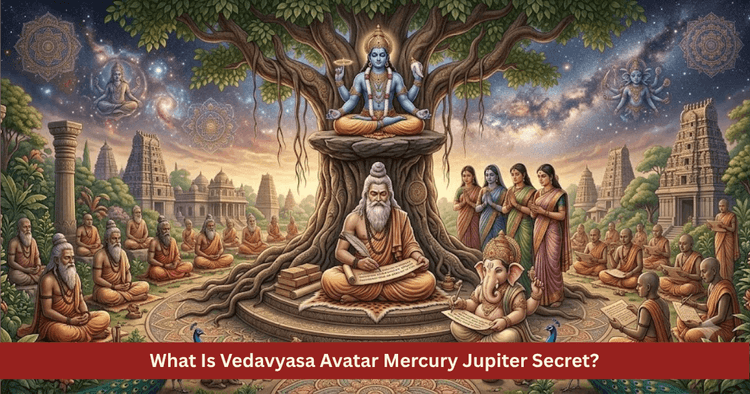
Table of Contents
Vyasa Jayanti Worship Timings and Ritual Guidelines
In the sacred Vedic tradition the seventeenth wisdom manifestation of Supreme Lord Shri Hari Vishnu revered as the primordial preceptor of all classical literature Sage Veda Vyasa represents the absolute pinnacle of analytical intellect philosophical synthesis and scriptural preservation. Under Vedic astrological principles the worship of Lord Veda Vyasa stands as the supreme pathway to harmonize analytical communication ruler Mercury with spiritual preceptor Devaguru Jupiter who governs higher philosophy ethics and transcendental teaching. Whenever Mercury or Jupiter suffers affliction within a personal horoscope causing writer block cognitive fatigue memory debility or recurring obstacles in doctoral research seeking sanctuary before Vyasa Narayana bestows extraordinary intellectual stamina and literary eloquence. The classical details auspicious timings stellar correspondences and sacred ceremonial components of this divine ritual appear systematically in the structured matrix below.
| Sacred Dimension | Ritual Details and Astrological Significance |
|---|---|
| Sacred Annual Date | Full moon day of bright fortnight in Ashadha month Vyasa Purnima and Guru Purnima |
| Daily Worship Time | Auspicious Brahma Muhurta at dawn or sunrise morning hours |
| Presiding Form | Dark complexioned ascetic sage with matted hair holding palm leaf scriptures and stylus |
| Astrological Association | Third house fifth house ninth house tenth house Mercury and Devaguru Jupiter |
| Core Offerings | White sandalwood paste Tulsi leaves yellow blossoms writing stylus scriptures and Panchamrit |
| Primary Vedic Rite | Recitation of Guru Gita Vishnu Sahasranama study and chanting Om Namo Bhagavate Badarayanaya |
| Expected Blessings | Literary accomplishment intellectual brilliance research triumph and pacification of planetary debility |
Sacred Appearance on the Yamuna Island
Toward the closing era of Dvapara Yuga as human consciousness was gradually contracting under approaching temporal shifts the necessity for a divine manifestation capable of organizing cosmic wisdom became essential. According to sacred chronicles recorded in the Mahabharata revered sage Maharishi Parashara one of the foremost masters of celestial mechanics arrived along the banks of river Yamuna while traversing sacred pilgrimage circuits. To cross the river the pious and ascetic daughter of the fisherman chieftain named Satyavati was present operating the ferry. She was also known as Matsyagandha because her body carried the natural aroma of river fish.
Through his profound astrological perception Maharishi Parashara observed that a rare and extraordinary celestial alignment was configured across the firmament. Conceived at that precise planetary moment a divine soul embodying the preservation potency of Supreme Lord Vishnu would manifest to categorize universal knowledge. Maharishi Parashara revealed this transcendental mystery to Satyavati. She hesitated expressing that undertaking such a sacred union in daylight before witnesses was unseemly. Through intense ascetic power Maharishi Parashara generated an impenetrable mist veiling the river island blessing Satyavati that her virginity would remain unblemished while her physical scent would transform into celestial musk radiating across an entire league.
From that holy union upon a secluded island of the Yamuna an extraordinarily radiant and dark complexioned boy took birth. Because He was born upon an island known as Dvaipa in Sanskrit He was named Dvaipayana and due to His dark skin He was called Krishna Dvaipayana. He was no ordinary mortal infant. Immediately upon appearance He consoled His mother declaring that whenever she faced severe adversity she need only remember Him and He would manifest instantly. He then retreated toward the dense forests of Badrikashram to engage in severe penance where meditating beneath Badari jujube trees He became celebrated as Badarayana.
Division of the Four Vedas and Authorship of Puranas
In primordial times Vedic wisdom existed as a single massive continuum of transcendental sound. Observing the onset of Kaliyuga Sage Krishna Dvaipayana recognized that human lifespans would diminish to barely 100 years physical strength would deteriorate and memory retention would weaken severely. Under such limitations no ordinary human being could master the complete undivided Vedic curriculum. Therefore He systematically classified that singular source into four independent compendiums. Because of this monumental and scientific division He became immortalized across world history as Veda Vyasa.
To preserve and propagate this sacred heritage Sage Veda Vyasa entrusted these four compendiums to four of His foremost enlightened disciples.
- To Sage Paila He imparted the Rigveda containing divine hymns and poetic invocations of celestial deities.
- To Sage Vaishampayana He taught the Yajurveda detailing sacrificial fire rituals formulas and liturgical duties.
- To Sage Jaimini He assigned the Samaveda governing sacred music melody and liturgical singing.
- To Sage Sumantu He delivered the Atharvaveda containing botanical medicine sociopolitical sciences and esoteric defense.
- To Romaharshana also known as Suta He assigned the preservation of historical epics and Puranas.
Following the division of the Vedas Sage Vyasa continued His literary preservation. Recognizing that ordinary citizens could not easily penetrate complex Vedic grammar He composed the 18 Mahapuranas and 18 Upapuranas to convey metaphysical truth through engaging narrative histories. Furthermore He authored the monumental Mahabharata consisting of 100000 verses celebrating it as the fifth Veda. For the physical writing of the Mahabharata Lord Ganesha personally served as the divine scribe. Sage Vyasa also authored the profound Brahma Sutras establishing the philosophical foundation of Vedanta philosophy. Finally when His heart remained restless Devarshi Narada advised Him to compose the Srimad Bhagavata Mahapurana celebrating the transcendental pastimes of Lord Krishna which brought supreme peace to His soul.
Confluence of Mercury and Jupiter in Parashara Lore
In the foundational masterpiece of Indian predictive astrology titled Brihat Parashara Hora Shastra venerable sage Parashara explains that cognitive faculties and philosophical discernment operate through planetary channels. Astrologically Sage Veda Vyasa represents the sublime synthesis of planet Mercury and Devaguru Jupiter.
Mercury governs cognitive processing writing documentation editing analytical taxonomy and commercial publication. Organizing complex concepts into structured chapters reflects the innate vibration of Mercury. Devaguru Jupiter governs higher spiritual wisdom Vedanta ethics moral jurisprudence and academic guidance. When Mercury alone is fortified an individual becomes a clever writer or skilled mathematician yet lacks deep spiritual purpose. When Jupiter alone is fortified a native becomes a profound philosopher yet may lack the organizational discipline to document insights into written form.
When Mercury and Jupiter unite within an auspicious quadrant or cast mutual aspects upon each other the rare Saraswati Yoga forms within a birth chart. Sage Veda Vyasa stands as the living embodiment of this royal alignment. Within Him dwelt the organizational classification of Mercury which divided the Vedas into four compendiums alongside the boundless spiritual wisdom of Jupiter which authored the Brahma Sutras. When the third house of writing the fifth house of intellect and the ninth house of higher philosophy interconnect in a horoscope exceptional literary genius blossoms naturally.
Accelerating Careers in Writing Journalism and Academia
In contemporary society communications journalism authorship and academic research have developed into demanding and competitive professions. Numerous authors and researchers experience chronic cognitive stagnation where mental concepts abound yet fail to translate into written words. Modern culture designates this affliction as writer block. From an astrological standpoint this condition manifests when Mercury is combust retrograde or debilitated in Pisces or when the third house suffers afflictions from Saturn or Rahu.
When cognitive focus fractures and an individual struggles to organize thoughts systematically contemplating Sage Veda Vyasa serves as an extraordinary spiritual remedy. Sage Vyasa dictated the entire Mahabharata without interruption while Lord Ganesha transcribed every verse. This divine partnership reveals that Vyasa consciousness provides an uninterrupted flow of inspiration. Students crafting research dissertations authors writing books and journalists upholding integrity discover exceptional clarity and professional honor through Vyasa worship.
Sacred Vedic Remedies for Literary and Intellectual Excellence
When an individual suffers from a weakened Mercury or an afflicted Jupiter causing academic delays memory fatigue or professional writing obstacles classical scriptures prescribe potent remedial measures centered upon Sage Veda Vyasa.
- Sit facing eastward every morning after bathing holding a white flower while meditating upon Sage Veda Vyasa chanting the sacred mantra Om Namo Bhagavate Badarayanaya Namah or Om Vedavyasaya Namah 108 times with a tranquil disposition.
- Prior to commencing daily writing or academic study remember Sage Vyasa and Lord Ganesha mentally inscribing the sacred syllable Om using saffron ink upon parchment or study journals.
- On the full moon day of Ashadha celebrated as Vyasa Purnima and Guru Purnima worship your academic preceptors and donate spiritual scriptures to public libraries or students.
- Feed soaked split chana dal and fresh grass to cows every Wednesday and Thursday while donating books notebooks and writing instruments to impoverished students.
- Wear an authentic four mukhi and five mukhi Nepalese Rudraksha combined in yellow silk cord around the neck following competent astrological counsel to harmonize Mercury and Jupiter.
- Read at least 1 chapter of the Srimad Bhagavata Mahapurana or recite the Vishnu Sahasranama authored by Sage Vyasa daily to calm neural pathways and enhance memory retention.
Essential Guidelines for Vyasa Spiritual Practice
| Recommended Vedic Practices | Harmful Habits to Avoid |
|---|---|
| Dedicate time every morning to contemplative study of sacred literature | Never show disrespect toward books academic materials or writing tools |
| Store academic scriptures and educational volumes in clean elevated places | Avoid reading while lying down or placing reading materials near feet |
| Utilize personal writing and communicative skills for social upliftment | Never utilize your pen to record falsehoods slander or deceit |
| Consume light sattvic meals on Wednesdays and Thursdays | Avoid nurturing vanity regarding personal learning or authorship |
| Adorn the altar with white sandalwood Tulsi leaves and cow ghee lamps | Refrain from misinterpreting spiritual scriptures without study |
Eternal Illumination of Scriptural Wisdom and Universal Truth
The sacred descent of Sage Veda Vyasa is not merely an ancient historical occurrence rather it serves as the foundational backbone of Sanatana culture. Every dimension of classical Vedic heritage we witness today including the Vedas Puranas Upanishads Mahabharata and Bhagavad Gita exists through the pen of Sage Vyasa. Had Sage Vyasa not organized the Vedas and recorded the Puranas this profound spiritual heritage would have dissolved into the darkness of Kaliyuga. The synthesis of analytical classification from Mercury with transcendental truth from Jupiter transforms human life into an immortal scripture. Remembering Sage Veda Vyasa daily awakens dormant spiritual intellect disperses worldly illusions and establishes an individual as an eloquent truthful and revered soul to attain supreme spiritual liberation.
FAQ
Who were the sacred parents of Sage Veda Vyasa? Sage Veda Vyasa was the son of the great sage and master astrologer Maharishi Parashara and the virtuous maiden Satyavati.
Why is Sage Vyasa celebrated as Krishna Dvaipayana? He was named Dvaipayana because He took birth upon an island in the Yamuna and Krishna because His physical complexion was dark.
Into how many divisions did Sage Vyasa classify the singular Veda? Sage Veda Vyasa classified the single Veda into 4 independent compendiums named the Rigveda Yajurveda Samaveda and Atharvaveda.
Which planets correspond to Sage Veda Vyasa in Vedic astrology? Sage Veda Vyasa corresponds directly to the harmonious synthesis of communication ruler Mercury and spiritual preceptor Devaguru Jupiter.
Which mantra is recommended to achieve success in research and writing? Chanting the sacred mantra Om Namo Bhagavate Badarayanaya Namah or Om Vedavyasaya Namah 108 times daily at sunrise is considered supreme for writing success.
Get your accurate Kundali
Generate KundaliDid you like it?
Author

Pt. Sanjeev Sharma (63)
Experience: 20
Consults About: Family Planning, Career
Clients In: Punjab, Haryana, Delhi
Share this article with friends and family
About ZODIAQ
ZODIAQ is an online Vedic Astrology platform. It connects clients seeking astrological advice to experienced astrologers with deep knowledge. Our users also generate kundali and perform kundali milan for free. ZODIAQ also offers services to the Astrologers. Astrologers utilize various offerings by ZODIAQ to serve their clients effectively.
If you are a User
Consult with experienced astrologers and seek their guidance. You can also order handwritten Janm Patrika report with life prediction prepared by experienced astrologers. Generate accurate Kundali, perform Kundali Matching and check horoscope and muhurat. Utilize our online library for all the necessary astrological and spiritual information.
If you are an Astrologer
Create accurate kundali for your clients and perform Kundali Matching for up to 5 people at a time. Write comprehensive Janm Patrika report for your clients with ZODIAQ. Check client details anytime by saving it in client directory. Become more productive by tracking how many clients you guide every day.
WELCOME TO
ZODIAQ
Right Decisions at the right time with ZODIAQ
