The Astonishing Secret of Hanumad Ramayana: When Hanuman Gave Up His Own Creation
By Pt. Nilesh Sharma
The Divine Hanumad Ramayana: A Story of Devotion, Humility, and Renunciation
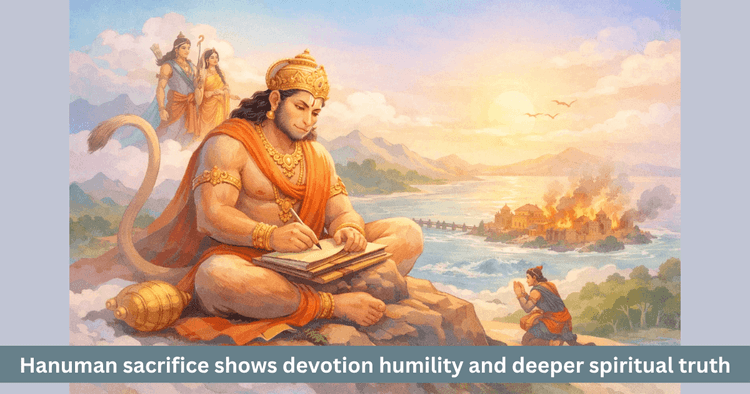
Table of Contents
Ramayana is not merely a narrative. It is a living experience, a field of consciousness that has been seen, felt and expressed through many different visions across time. This is why many forms of Ramayana have emerged through the ages. Yet among them stands one episode that is not often heard, though its depth is extraordinary. This is the story of Hanumad Ramayana, the divine composition said to have been written by Hanuman himself. It is not only the story of a sacred text but the story of humility, devotion, renunciation and creation freed from ego.
After the victory over Lanka, when the work of Shri Rama had been completed, when the fire of war had become still and the outer movement of the divine play had begun to settle, a new feeling arose within Hanuman. He had not merely witnessed Rama’s journey. He had lived it through his own breath. Rama’s exile, Sita’s separation, Lakshmana’s suffering, Vibhishana’s surrender, the crossing of the ocean, the burning of Lanka and finally the triumph of dharma, all these were not just events to Hanuman. They were living truths embedded in his heart. From that fullness arose the inspiration to express the entire lila from his own experience. This was not the literary desire of a poet. It was the outpouring of his heart.
The Heart of the Story at a Glance
| Theme | Deeper Meaning |
|---|---|
| Hanuman’s resolve to write | Devotion expressing itself through lived experience |
| Composition in the Himalayas | Solitude, austerity and inner revelation |
| Arrival of Valmiki | Meeting of two sacred creative streams |
| Experience of greatness | The subtle pain born from comparison |
| Hanuman’s immersion of the text | The highest renunciation without ego |
| Eternal message | Greatness lies not in creation alone but in vision |
Why did Hanuman feel the urge to write Ramayana
The feeling did not arise suddenly. For Hanuman, the story of Rama was not merely the Lord’s lila. It was the very center of his existence. The one who had lived the name of Rama like breath itself, whose life had been wholly devoted to Rama’s work and who saw himself only as a servant, could naturally one day overflow into expression. What Hanuman had seen was not the perspective of an observer. It was the vision of an intimate servant. That vision was unique because it carried bravery along with devotion, nearness along with humility and surrender along with silence.
For this reason, his composition could not have been a simple sequence of events. It would have carried the pulse that only one could know who had borne Rama’s work in the deepest way. This is why tradition says that Hanumad Ramayana did not contain only words. It held the heated truth of direct experience. It was not the result of literary craftsmanship but the spontaneous voice of Rama bhakti.
Where and how did Hanuman write this composition
According to the tradition, Hanuman went toward the Himalayas. The Himalayas are not merely a geographical place. In the Indian spiritual tradition, they symbolize silence, height, austerity and inner dialogue. There, in solitude, Hanuman began to inscribe the story of Rama upon stones with his own nails. The very image is astounding. There was no ink, no pen, no manuscript, no audience, only snow peaks, deep stillness, devotion rising from within and sacred narrative being carved upon stone.
This detail is deeply significant. He did not depend on external instruments to write. Just as his devotion was not based on outer approval, his composition too did not depend on outer arrangements. This itself gives a profound indication that true creation is born from inner fullness, not from abundance of means. One who is inwardly filled can write immortal truth even upon stone.
Why was Hanumad Ramayana considered so extraordinary
Tradition says that this composition possessed such intensity, such emotional fullness and such living immediacy that it stood apart from every other telling of Rama’s story. The reason is not difficult to understand. Valmiki wrote Ramayana through the vision of a sage, through tapas, insight and compassion. It became the Ramayana for the world. But if Hanuman wrote Ramayana, then it was through the eyes of Rama’s most intimate servant. In such a text, battle would not remain merely battle. It would become the protection of the Lord’s purpose. The search for Sita would not remain a narrative episode. It would become the trial of devotion. The leap across the ocean would not remain an act of valor. It would become the flight of faith.
This is why tradition holds that Hanumad Ramayana had extraordinary depth. Its excellence was not competitive or literary in the ordinary sense. It arose from the intensity of lived devotion.
Why did Valmiki come there
When news of this wondrous composition reached Maharishi Valmiki, it was natural that a deep curiosity awakened within him. Valmiki himself is honored as the first poet of Ramayana. Through his tapas, his vision and his compassion, he had created the sacred text that carried Rama’s story across ages. So when he heard that Hanuman too had composed a Ramayana, he desired to see it. He went to the Himalayas and beheld that divine work.
At this point, the story takes a very subtle and deeply human turn. When Valmiki read Hanumad Ramayana, he experienced in it such warmth and such heart born truth that a powerful emotional state arose within him. He felt that Hanuman’s composition was even more living and more deeply moving than his own. Such an experience cannot be easy even for a great sage, because wherever there is creation, there is also a subtle bond between creator and creation.
Why did tears arise in Valmiki’s eyes
The tears in Valmiki’s eyes were not born from simple sorrow. They carried many layers. There was the dignity of his own creation, the pain of comparison and the helpless recognition that another composition was touching the heart even more directly. This is a very deep inner state. Here a person encounters both subtle ego and surrender at the same time.
This episode is great because it does not diminish Valmiki. Rather, it reveals him as even more truthful and profoundly human. A true sage does not hide from the feelings that arise within. Valmiki recognized what was happening inside him and Hanuman immediately recognized it as well.
Why did Hanuman renounce his own composition
When Hanuman understood Valmiki’s inner state, he did not delay. He did not think about how magnificent his composition was, how unique it was or how necessary it might be for the world. He saw only this, that if his creation was causing pain, inadequacy or sorrow in the heart of another great being, then it was not right to hold on to it. This is the moment where Hanuman’s true greatness shines.
Without hesitation, he immersed the entire composition into the ocean. This was not merely the abandonment of a text. It was the renunciation of ownership over creation. It was the renunciation of possible fame. It was the immersion of the ego of authorship. This is the state in which a being says that if even one’s finest work must be surrendered for the sake of peace, harmony or the higher good, then it should be surrendered at once.
The spiritual meanings hidden in this renunciation
This episode should not be left only as an emotional story. It carries profound spiritual meanings. Some of the most important are these.
1. The value of creation is not in possession but in the spirit behind it
Hanuman showed that what is truly born from divine feeling does not need to be clutched.
2. True devotion stands above comparison
If a work causes pain in another heart, the devotee can even renounce its glory.
3. Ego can attach itself subtly even to sacred creation
By giving up his own magnificent work, Hanuman revealed total freedom from that subtle bond.
4. Renunciation is the final test of greatness
One who can create may be great but one who can create and still let go is truly free.
5. Rama’s story is not the possession of one author
It is a living current of consciousness, grace and realization.
What does the story of Hanumad Ramayana teach us
This story teaches that true greatness does not lie only in producing something extraordinary. Greatness also lies in the attitude with which one holds that creation. In an age where creation quickly becomes tied to identity, praise and recognition, the story of Hanuman becomes even more relevant. It teaches that the work may be great but the ego of the doer must not become greater.
Some enduring lessons arise from this story.
1. Offer what you create to the Divine
Then attachment to it will be reduced.
2. Do not let comparison overpower sacred relationships
Greatness grows through compassion, not competition.
3. When renunciation becomes necessary, do not step back
Sometimes letting go is the highest form of spiritual practice.
4. The truest creator is the one who can rise above creation
To become greater than one’s own work is a form of liberation.
5. Humility is the final maturity of knowledge
Where ego disappears, divinity begins to shine.
Was Hanumad Ramayana truly lost
Tradition says that Hanuman immersed his own composition and therefore it did not remain available to the world in written form. Yet the deepest point of the story is this, that even if its words were lost, its essence is still living. In truth, Hanumad Ramayana is greater than a text. It is a state of consciousness. It teaches that when devotion reaches its highest point, it can create and when necessary, it can also surrender that very creation.
In that sense, Hanumad Ramayana is not truly lost. It lives in every heart that approaches Rama’s story not through ownership but through surrender. It lives in every seeker who can offer even the fruit of personal labor back to the Divine. And it lives in every writer who values truth above display.
What is the living heart of this story
In the end, this story takes us to a rare spiritual truth. Hanuman showed that true knowledge, true devotion and true humility are not separate virtues. When these three unite, a being can renounce even the most beautiful work without attachment. This is the secret of Hanumad Ramayana. It is not only the story of a composition. It is the story of rising beyond one’s own creation.
Hanuman’s renunciation reminds us that when ego comes to an end, divinity fully reveals itself. Words may disappear, stones may sink and texts may vanish but the spirit of devotion can never be destroyed. The real Hanumad Ramayana remains alive in that spirit. That is its heart, its light and its eternal message.
Frequently Asked Questions
What was Hanumad Ramayana
Hanumad Ramayana is regarded as the divine composition written by Hanuman from his own lived experience of Rama’s story.
Where did Hanuman write it
According to tradition, he inscribed it in the Himalayas upon stones with his own nails.
Why did Valmiki feel pain after reading it
He experienced such emotional depth and living intensity in Hanuman’s work that subtle comparison and sorrow arose within him.
Why did Hanuman immerse his own composition
Because he did not wish his creation to become the cause of pain or inadequacy in the heart of another great sage.
What is the greatest teaching of this story
Its greatest teaching is that true greatness lies not only in creation but in holding creation with humility and freedom from attachment.
Get your accurate Kundali
Generate KundaliDid you like it?
Author

Pt. Nilesh Sharma (63)
Experience: 20
Consults About: Family Planning, Career
Clients In: Punjab, Haryana, Delhi
Share this article with friends and family
About ZODIAQ
ZODIAQ is an online Vedic Astrology platform. It connects clients seeking astrological advice to experienced astrologers with deep knowledge. Our users also generate kundali and perform kundali milan for free. ZODIAQ also offers services to the Astrologers. Astrologers utilize various offerings by ZODIAQ to serve their clients effectively.
If you are a User
Consult with experienced astrologers and seek their guidance. You can also order handwritten Janm Patrika report with life prediction prepared by experienced astrologers. Generate accurate Kundali, perform Kundali Matching and check horoscope and muhurat. Utilize our online library for all the necessary astrological and spiritual information.
If you are an Astrologer
Create accurate kundali for your clients and perform Kundali Matching for up to 5 people at a time. Write comprehensive Janm Patrika report for your clients with ZODIAQ. Check client details anytime by saving it in client directory. Become more productive by tracking how many clients you guide every day.
WELCOME TO
ZODIAQ
Right Decisions at the right time with ZODIAQ
