The Secret of Hanuman on Arjuna’s Chariot: Did a Single Banner Change the Course of the War
By Pt. Amitabh Sharma
Hanuman’s Subtle Presence on Arjuna’s Chariot and Its Profound Impact
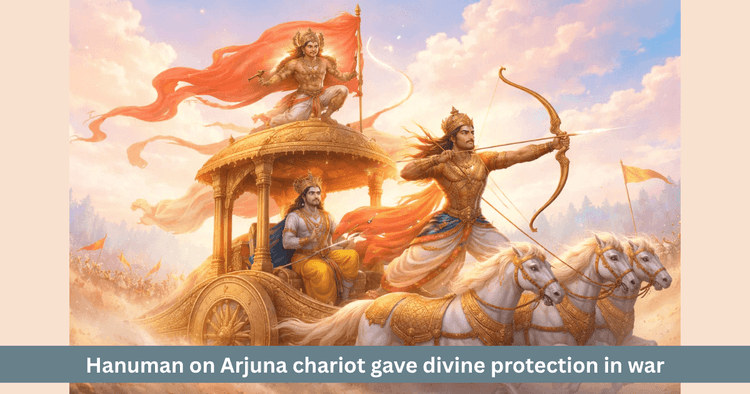
Table of Contents
The war of Kurukshetra was not merely a clash of bows, arrows and divine weapons. It was also a conflict of subtle forces standing invisibly beside each warrior. When Arjuna stood upon his chariot and fought in the field of dharma, he was not accompanied only by Shri Krishna as his charioteer. Upon his chariot there was another presence, outwardly subtle yet vast in effect. That presence was Hanuman, seated upon Arjuna’s banner. If this episode is understood deeply, it no longer remains a symbolic detail. It reveals that battles are not won only through visible skill. Behind victory stand devotion, protection, guidance and divine support.
The presence of Hanuman upon Arjuna’s banner is one of the most subtle and spiritually rich episodes in the Mahabharata tradition. It opens the truth that when the hardest wars of life arrive, a person is not sustained by personal ability alone. Invisible grace, the guidance of the guru and the protection of higher powers matter equally. This is why Arjuna’s chariot remained steady even under the fiercest blows of war.
The Story at a Glance
| Theme | Deeper Meaning |
|---|---|
| Hanuman seated on the banner | Divine protection joined with Arjuna |
| Krishna as charioteer | Right direction and supreme guidance |
| Arjuna’s skill | Human effort and dharmic responsibility |
| Attacks of Bhishma and Karna | Severe trials of life |
| Stability of the chariot | Combined force of devotion, strength and grace |
| Chariot burning after war | True condition revealed after divine protection withdraws |
How was Arjuna’s connection with Hanuman established earlier
The Mahabharata tradition suggests that Arjuna’s connection with Hanuman was formed before Kurukshetra itself. Arjuna was renowned for his mastery of archery, his heroic strength and his unmatched confidence in battle. He was not only a great warrior but also deeply aware of his own excellence. It was in this context that Arjuna met Hanuman and a meaningful exchange took place between them. In that earlier encounter, Hanuman promised that he would remain upon the banner of Arjuna’s chariot.
This promise was not merely an honor. It was also a blessing, a shield of protection and a divine assurance. When a great power promises to stand beside a seeker, warrior or dharmic being, it does not mean only presence. It means that at the necessary time, that power will steady, protect and support the one it accompanies. Hanuman’s presence on Arjuna’s chariot was the result of such a sacred assurance.
What was the spiritual meaning of Hanuman on the banner
A banner is never merely an identifying mark. In ancient sacred warfare, it represented lineage, spiritual foundation, divine association and the dharma of the warrior. Hanuman seated upon Arjuna’s banner signified that behind Arjuna’s war there stood not only personal heroism but also the power of Rama bhakti, the vitality of Vayu, the force of selfless service and the energy of protecting dharma.
Hanuman represents many sacred qualities and these matter deeply here
- unwavering devotion
- immeasurable strength
- selfless service
- steadiness in danger
- power dedicated to dharma
When all these qualities were present upon Arjuna’s banner, the banner was no longer just a sign. It became a living center of divine force within the battlefield.
How did the chariot remain steady under the attacks of Bhishma and Karna
Arjuna was not facing ordinary warriors in Kurukshetra. He stood before Bhishma, Drona, Karna and other masters of celestial weaponry, profound tapas and vast war experience. The attacks of Bhishma and Karna were so powerful that they could shake, drive back or even destroy an ordinary chariot. Yet Arjuna’s chariot remained astonishingly steady. It may have shaken, it may have absorbed fierce impact but it did not collapse.
This stability cannot be explained only through Arjuna’s own skill. Nor can it be attributed solely to Krishna’s role as charioteer. There were three levels of force active behind that steadiness
1. Krishna’s guidance
He held the direction, timing, movement and strategy of the chariot.
2. Arjuna’s effort
Arjuna himself was fully alert, capable and established in battle.
3. Hanuman’s protective presence on the banner
His presence gave the chariot a special spiritual steadiness.
This threefold union made Arjuna’s chariot unlike any ordinary chariot.
Was Hanuman’s weight and energy truly protecting the chariot
Tradition says that Hanuman’s presence was not merely symbolic. His radiance, strength and divine force were truly connected with the chariot. One beautiful way to understand this is that a chariot carrying the presence of Hanuman could not easily be pushed back by any outer assault. Here the idea of weight should not be understood only physically. It also points toward the weight of spiritual force.
This helps us understand a larger truth of life. Stability does not come only from muscle, talent or intellect. Many unseen forces sustain a person. Sometimes it is the grace of the guru, sometimes the fruit of inner discipline, sometimes the power of devotion and sometimes the protection of a higher presence. In the case of Arjuna’s chariot, Hanuman’s place on the banner symbolizes exactly this invisible protection.
What were the three great supports of Arjuna’s chariot
Arjuna’s chariot was not merely a vehicle of war. It was a moving center where several divine forces were acting together. If this episode is to be understood deeply, its three main supports may be seen in this way
1. Krishna as charioteer
Krishna was not merely driving the chariot. He was also guiding the inner chariot of Arjuna’s mind, his confusion, his fear and his moral struggle. The role of the charioteer here means not only outer movement but the direction of consciousness itself.
2. Arjuna’s own skill
Arjuna was himself an unmatched archer. Without his effort, the chariot meant nothing. This episode does not teach that grace alone is enough. It teaches that grace and effort must move together.
3. Hanuman’s presence on the banner
Hanuman represents that force which does not allow a person to break in moments of crisis. His presence upon the banner was a declaration that Arjuna’s battle was not merely personal but part of a larger stream of dharma.
What does the burning of the chariot after the war reveal
At the end of the Mahabharata war, a deeply significant event occurs. After the battle is over, Krishna first asks Arjuna to step down from the chariot. Arjuna comes down. Then Krishna himself leaves the chariot. The moment both have stepped away, the chariot bursts into flames and is reduced to ashes. This is a highly symbolic and profound moment. It does not mean that the chariot suddenly became weak. It means that during the war the chariot had been preserved by the divine powers associated with it and only after those forces withdrew did its true condition become visible.
This can be understood on two levels
- the chariot had already endured such fierce divine weaponry that under ordinary circumstances it should have been destroyed much earlier
- the presence of Krishna and Hanuman had held it together through all those assaults
Once that divine protection withdrew, the accumulated effect of the celestial attacks manifested at once. Thus the burning of the chariot becomes a direct revelation of invisible protection.
What is the psychological and spiritual meaning of this story
This episode is not merely a sacred miracle. It also carries deep psychological and spiritual teaching. Arjuna’s chariot may be seen as a symbol of human life itself. In that chariot
- Krishna represents right guidance
- Arjuna represents the striving human being
- Hanuman represents protective devotion and sacred strength
When right direction, sincere effort and invisible divine support come together in life, a person can remain steady even amidst great pressures. Outer attacks may shake such a life but they do not destroy it. This is the deeper meaning of Arjuna’s chariot.
Did a single banner truly change the direction of the war
If this question is seen only outwardly, the answer would be that it was not the cloth of the banner but the force seated upon it that mattered. Yet inwardly the answer may still be yes, because that banner was not simply an emblem. It was the visible sign of divine presence. It gave Arjuna’s chariot morale, protection and spiritual steadiness. It also revealed that in war, not only visible weapons fight but invisible support fights as well.
Three conclusions may be drawn from this episode
- Symbols become living when real power stands behind them
- Devotion can protect even in the middle of battle
- Invisible grace often changes visible outcomes
What does this story teach for life today
This episode remains as meaningful now as it was in the age of the Mahabharata. Human beings also face many Kurukshetras in life. External conflict, inner confusion, broken relationships, pressure in action and collision with destiny are all forms of war. In such times, personal talent alone is not enough. One needs three things
- right guidance
- personal effort
- a foundation of divine protection
If in life there is Krishna like wisdom, Arjuna like effort and Hanuman like devotional strength, then even the hardest phase may be crossed.
Where does the heart of this story lie
In the end, Hanuman’s presence upon Arjuna’s chariot tells us that when devotion and strength are joined with dharma, they do not offer mere comfort. They offer real protection. This episode is not just a battle detail. It is a profound sign for human life that invisible powers stand with those whose lives are aligned with right purpose, right guidance and true surrender.
Arjuna’s chariot remained unwavering because it carried not only wheels, horses and a warrior. It carried Krishna’s wisdom, Arjuna’s effort and Hanuman’s protection together. This is the heart of the story. This is its deepest message, that when devotion, discernment and strength stand together, even the course of war can truly change.
Frequently Asked Questions
Why was Hanuman on Arjuna’s chariot
Hanuman had given Arjuna a promise in an earlier episode that he would remain upon the banner of his chariot and offer protection.
Was Hanuman’s presence only symbolic
Tradition regards it not as merely symbolic but as a real divine presence of protection and strength.
How did the chariot remain steady during the war
Through the combined force of Krishna’s charioteering, Arjuna’s skill and Hanuman’s protective presence upon the banner.
What does the burning of the chariot after the war mean
It shows that the chariot had remained protected through divine support during the war and its true condition became visible only after that support withdrew.
What is the greatest message of this story
Its greatest message is that right guidance, human effort and divine protection together can change the direction of even the hardest war.
Get your accurate Kundali
Generate KundaliDid you like it?
Author
Pt. Amitabh Sharma (56 Years)
Experience: 20
Consults About: Family Planning, Career
Clients In: Punjab, Haryana, Delhi
Share this article with friends and family
About ZODIAQ
ZODIAQ is an online Vedic Astrology platform. It connects clients seeking astrological advice to experienced astrologers with deep knowledge. Our users also generate kundali and perform kundali milan for free. ZODIAQ also offers services to the Astrologers. Astrologers utilize various offerings by ZODIAQ to serve their clients effectively.
If you are a User
Consult with experienced astrologers and seek their guidance. You can also order handwritten Janm Patrika report with life prediction prepared by experienced astrologers. Generate accurate Kundali, perform Kundali Matching and check horoscope and muhurat. Utilize our online library for all the necessary astrological and spiritual information.
If you are an Astrologer
Create accurate kundali for your clients and perform Kundali Matching for up to 5 people at a time. Write comprehensive Janm Patrika report for your clients with ZODIAQ. Check client details anytime by saving it in client directory. Become more productive by tracking how many clients you guide every day.
WELCOME TO
ZODIAQ
Right Decisions at the right time with ZODIAQ
