Mainak Parvat and Hanuman: When Duty Moved Ahead Even of Rest
By Aparna Patni
The Incredible Tale of Hanuman’s Devotion, Patience, and Steadfastness in Duty
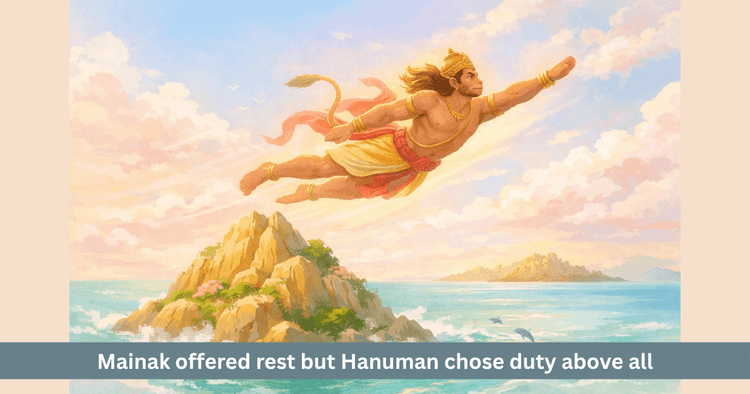
Table of Contents
The episode of crossing the ocean is counted among the most inspiring moments of the Ramkatha. It was not only an extraordinary physical journey but also a spiritual test in which patience, resolve, surrender and devotion to duty were all being examined together. When Hanuman Ji resolved to cross the vast ocean in search of Mata Sita, the challenge before him was not merely distance. Before him stood the gravity of time, the sacredness of the mission and the complete test of his loyalty to Shri Ram. Only one feeling lived in his mind, the work of Ram must be fulfilled at any cost.
From the outer view, this journey was wondrous. From within, it was even deeper. The speed with which he moved through the sky was not merely the result of power. It was the movement of a devotee in whom no second thought remained. When the purpose becomes completely pure and the mind becomes fully established in it, the journey is carried not only by the body but by consciousness itself. Hanuman Ji crossing the ocean is the proof of that divine concentration.
Why did the ocean raise Mainak Parvat
As Hanuman Ji flew above the ocean, even the ocean itself was moved by his extraordinary speed, brilliance and sacred determination. It understood that this journey was not for any ordinary task. It was connected with dharma, compassion and the vow of Shri Ram. In that spirit, the ocean thought that even if it could not directly perform the task, it could at least offer a service.
With this feeling, it gave a signal to Mainak Parvat, who rested within the ocean and was regarded as a friend of the gods. Mainak immediately rose upward and appeared before Hanuman Ji. His appearance was not in the form of an obstacle. There was no deception in him, no opposition and no attempt to hinder. He appeared as a symbol of respect, honor and willingness to help.
What was Mainak Parvat’s proposal
Mainak Parvat, with great humility and affection, requested Hanuman Ji to rest upon him for a short while. He made this request not out of formality but from genuine reverence. He felt that in such a long and difficult journey, a little rest would strengthen Hanuman Ji even more. His offer was filled completely with goodwill.
Mainak’s intention may be understood like this:
• He was not opposing Hanuman Ji’s mission
• He was honoring Hanuman Ji’s journey
• He wished to gain the opportunity to serve
• He offered rest as a form of assistance
That is why the story becomes subtle here. The opportunity that appeared before Hanuman Ji was not bad. It came in the form of affection and respect.
Would accepting rest have been wrong
From an ordinary point of view, Mainak Parvat’s offer was not something that naturally deserved rejection. During a long journey, rest is a normal need. It helps the body recover, sustain energy and continue forward in better balance. If an ordinary traveler had been in that place, he would probably have accepted the offer.
But Hanuman Ji’s situation was not ordinary. This journey was not for a personal purpose. It was connected with the search for Mata Sita, the hope of Shri Ram and the protection of dharma. In such a moment, the question of rest no longer remains merely physical. It begins to ask whether pausing at this point is truly appropriate or not. This is where duty and comfort stand face to face.
Why did Hanuman Ji refuse the offer
Hanuman Ji fully understood Mainak Parvat’s honor, affection and goodwill. He also knew that the offer was not born of deception or illusion. Even then, he did not accept it. The reason was clear. For him, in that moment, the work of Shri Ram stood above everything. Until Mata Sita was found and Ram’s mission moved forward, there was no place for rest.
With deep humility he expressed that until the work was completed, he could not stop. This response was not only a decision. It was the highest form of devotion, where the devotee places even personal comfort, ease and need behind the work of the beloved Lord.
What is the deepest message of this episode
The most beautiful and deepest teaching of this story is that not every distraction comes in the form of an enemy. Some distractions come as comfort, rest, respect and goodwill. They are not bad in themselves but if they are accepted without understanding time and situation, they may pull a person away from the goal.
In this sense, Mainak Parvat becomes the symbol of those opportunities in life that are comfortable, attractive and even appropriate in appearance, yet not suitable at every moment. Hanuman Ji teaches that one should not only ask whether an opportunity is good or not. One must also ask whether it is aligned with the present purpose.
This may be understood simply in the following way:
| Situation | Ordinary view | Hanuman Ji’s view |
|---|---|---|
| Opportunity to rest | A means to gain strength | A possible delay in duty |
| Mainak’s respect | Honor worth accepting | A feeling to acknowledge and move beyond |
| Stopping | A natural choice | An untimely pause before the goal |
Why did Hanuman Ji not insult Mainak
This episode is not only the story of devotion to duty. It is also a profound lesson in humility. Hanuman Ji could have simply moved ahead with his speed and ignored Mainak Parvat’s request. He could even have refused with harshness. But he did not do so.
He respected Mainak Parvat’s intention. He understood his spirit of service. He honored him and then moved forward. This is one of the gentlest aspects of the story. Hanuman Ji shows that while following duty, one must still preserve respect.
From this, some deep life principles arise:
• Not every refusal must be expressed harshly
• One can decline something with dignity and respect
• Staying focused on the goal does not require becoming hard
• Humility and firmness can walk together
Is this only a devotional tale
No. This story applies to every area of life. Whenever a person moves toward a great purpose, many kinds of Mainak appear in life. Sometimes they come as comfort, sometimes as untimely convenience, sometimes as praise and sometimes as a pause that is not yet appropriate.
The great question before a person then is whether they will remember their purpose or stop in temporary ease. Hanuman Ji’s answer is clear. If the purpose is great and the time is crucial, one must discern whether something is truly helpful or merely an invitation to pause.
When duty rises above personal need
For Hanuman Ji, personal fatigue or rest did not matter in that moment. This was not because the body has no limits but because his mind was fully absorbed in the goal. When consciousness becomes completely one pointed, the person’s connection with the work becomes so deep that personal needs move to the background.
It is important to understand that this teaching is not meant to create imbalance in life. It does not mean that rest is always to be rejected. Its real indication is that one must understand the demand of the moment. Where stopping is right, one should stop. Where moving ahead is dharma, one must leave rest behind.
What does Mainak Parvat symbolize in life
If this episode is understood symbolically, then Mainak Parvat represents those opportunities in life that are good, yet not always necessary at every moment. They may appear in forms such as:
• Rest that appears in the middle of a mission
• Comfort that arrives when urgent work is calling
• Ease that slows down surrender
• Pause that attracts before duty is complete
• Gentle delay that interrupts progress
Hanuman Ji’s conduct teaches that wisdom is not only in avoiding evil. It is also in recognizing unnecessary pauses that appear in pleasing form.
Where do duty and surrender meet
The soul of this story is hidden in Hanuman Ji’s response that until the work of Shri Ram was complete, rest had no place for him. This is not only service but the active form of surrender. Here devotion does not become emotional softness alone. It turns into action. Here love does not remain passive. It gives the highest place to the goal.
That is why Hanuman Ji is not only the devotee of Ram but also the complete practitioner of Ram’s work. His devotion does not only make him weep. It makes him move. His loyalty does not only make him bow. It makes him continue forward.
What inspiration does this story offer for life
This episode is deeply meaningful even in modern life. Today, a person faces many opportunities, choices and comforts. Many of them are not bad, yet not everything is right at the right time. If one forgets the larger purpose, smaller comforts may quietly pull the mind away from the true goal.
Some important inspirations emerge from this story:
• Keep your purpose always clear
• It is not necessary to accept every comfort immediately
• What appears good may not always be timely
• Declining with respect is also a virtue
• To keep the mind steady in the time of duty is true surrender
When the goal becomes greater than rest
Ultimately, this episode of Mainak Parvat and Hanuman Ji teaches that when a person becomes completely dedicated to a great purpose, then temporary rest, attraction or comfort cannot stop the journey. The person does not become harsh while declining them, yet also does not become bound by them. That balance is the proof of Hanuman Ji’s greatness.
His journey was not only the story of crossing an ocean. It was the journey of a consciousness in which duty becomes greater than rest, surrender rises above comfort and the goal moves ahead of every attraction. That is the soul of this episode and that is its deepest message.
FAQs
Why did Mainak Parvat stop Hanuman Ji
He did not stop him as an obstacle but with respect and a spirit of service so that Hanuman Ji could rest for a while.
Was Mainak Parvat’s offer wrong
No. His offer was filled with goodwill. It was a symbol of help and honor.
Why did Hanuman Ji not take rest
Because for him, at that moment, the work of Shri Ram was supreme and he did not wish to allow even a small delay.
What is the greatest life lesson of this story
It teaches that even a good opportunity should be accepted only at the right time. If it distracts from the goal, it should be respectfully left behind.
Does this episode also show humility
Yes. Hanuman Ji respected Mainak Parvat’s feeling and declined his offer with honor.
Get your accurate Kundali
Generate KundaliDid you like it?
Author

Aparna Patni (63)
Experience: 20
Consults About: Family Planning, Career
Clients In: Punjab, Haryana, Delhi
Share this article with friends and family
About ZODIAQ
ZODIAQ is an online Vedic Astrology platform. It connects clients seeking astrological advice to experienced astrologers with deep knowledge. Our users also generate kundali and perform kundali milan for free. ZODIAQ also offers services to the Astrologers. Astrologers utilize various offerings by ZODIAQ to serve their clients effectively.
If you are a User
Consult with experienced astrologers and seek their guidance. You can also order handwritten Janm Patrika report with life prediction prepared by experienced astrologers. Generate accurate Kundali, perform Kundali Matching and check horoscope and muhurat. Utilize our online library for all the necessary astrological and spiritual information.
If you are an Astrologer
Create accurate kundali for your clients and perform Kundali Matching for up to 5 people at a time. Write comprehensive Janm Patrika report for your clients with ZODIAQ. Check client details anytime by saving it in client directory. Become more productive by tracking how many clients you guide every day.
WELCOME TO
ZODIAQ
Right Decisions at the right time with ZODIAQ
