The Unique Story of Makardhwaja: Did Hanuman Also Have a Son
By Pt. Suvrat Sharma
Hanuman’s Son Makardhwaja: A Story of Duty, Strength, and Compassion
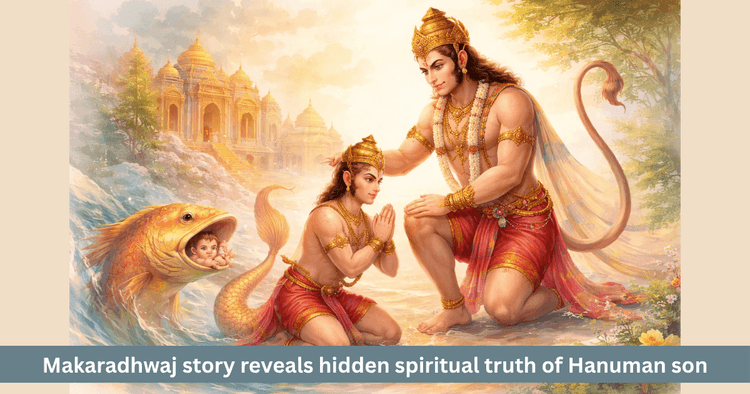
Table of Contents
Hanuman is most often known as the deity of brahmacharya, restraint, devotion, service and complete self control. Every aspect of his life is seen as the symbol of surrender, discipline and sacred strength. In such a context, when the story appears that Hanuman also had a son, it is natural for the mind to question how such a thing could be possible. That very question makes this narrative even more compelling, because its answer does not belong to ordinary logic. It is connected with deep symbolism, sacred energy and hidden dimensions of divine storytelling.
The story of Makardhwaja is of exactly that kind. It is not the account of an ordinary birth. It is the account of a force so powerful that even its touch can reveal the secret of creation. It is also the story of duty, in which a son stands firmly in righteousness without even knowing the identity of his father. And it is a story of compassion, in which victory is followed not by punishment but by recognition, acceptance and a rightful place. This is why the episode is not merely interesting. It is spiritually profound.
The Essence of the Story at a Glance
| Theme | Deeper Meaning |
|---|---|
| Hanuman crossing the sea | Strength, resolve and awakened divine energy |
| The drop of sweat falling | Extraordinary result hidden in an ordinary event |
| Birth of Makardhwaja | An unusual creation born from sacred power |
| His growth in Patala | Strength and loyalty developing in the realm of depth |
| Meeting of father and son | Duty standing before identity |
| Hanuman’s final decision | Balance of victory, compassion and justice |
Where does this story begin
This episode is connected with the time when Hanuman was leaping across the ocean toward Lanka. That was not merely a jump. It was a sacred act of Rama’s service in which his whole power, focus and resolve were shining at once. As he moved across the vast sea, there was not only speed within him but also the fire of purpose. The search for Mother Sita, service to Shri Rama and the protection of dharma formed the heart of that movement.
In such immense effort, the body too was fully engaged. The story says that during this ocean crossing, a drop of sweat from Hanuman’s body fell into the sea. Outwardly, this seems like a very ordinary event. But this is the style of sacred storytelling. It places an extraordinary meaning inside what looks simple. The story of Makardhwaja begins from that point.
Was birth from a single drop really possible
If such narratives are examined only through physical laws, their inner meaning is lost. Here, the drop of sweat does not signify merely a bodily substance. It symbolizes energy, radiance, austerity, force and divine potency. Hanuman was not an ordinary embodied being. He is regarded as an aspect of Shiva, as the son of Vayu and as one whose power far exceeds ordinary limits. therefore even a drop emerging from his body is not understood in merely material terms.
According to the story, the drop entered the mouth of a fish in the sea. Through its influence, that fish gave birth to a child who later came to be known as Makardhwaja. The indication here is that when power is exceedingly pure and intense, its influence extends outward. It does not remain confined to its bearer alone. It can also generate entirely new forms of life and destiny.
What does the fish symbolize in this episode
The fish is not merely a creature in this narrative. It also symbolizes nature receiving and carrying a sacred impulse. The sea itself points toward the unconscious, the hidden depths and the mystery of unmanifest life. When Hanuman’s charged drop enters that watery element and is received by the fish, the story suggests that nature can hold divine contact and bring forth a new expression through it.
A few symbolic meanings of this moment may be understood as follows.
1. Hanuman’s strength was not only outward
It was so potent that even its touch could give rise to life.
2. Creation is not always confined to ordinary rules
In sacred narratives, birth can occur through energy and boon as well.
3. Nature can receive and manifest divine influence
The sea and the fish represent that receptive dimension.
Who was Makardhwaja
Makardhwaja was the result of that unusual birth. He was not an ordinary child. Within him was a portion of the same force linked with Hanuman. Though he did not know the secret of his own origin, qualities such as courage, strength, loyalty and steadfastness were clearly present in his nature. That is why he later received an important position in Patala.
He was raised in Patala loka. This too is a deeply meaningful part of the story. Patala here is not only a location but a symbol of the hidden, mysterious and subterranean levels of existence. To be raised there suggests that divine force may also grow in concealed or shadowed regions. Makardhwaja’s life was outwardly unusual but inwardly purposeful.
What was Makardhwaja’s role in Patala
Makardhwaja eventually became the gatekeeper of Patala loka. This role was not merely military. A gatekeeper is one who protects the threshold, examines the intent of those who arrive and remains absolutely loyal to the domain entrusted to him. This shows that Makardhwaja possessed not only strength but a powerful sense of duty.
His role reveals several important qualities.
1. Unwavering loyalty to responsibility
He stood firmly in the task given to him.
2. Duty above personal advantage
He treated his position as sacred responsibility, not privilege.
3. Courage joined with discipline
These traits reflect the divine force from which he arose.
How did Hanuman and Makardhwaja come face to face
The story reaches its most intense point when Ahiravana takes Rama and Lakshmana to Patala loka. Hanuman then descends there to rescue them. This becomes the first meeting of father and son, though neither is aware of the relationship. Makardhwaja stands at his post, fully committed to his duty. Hanuman arrives for Rama’s work, for the protection of dharma and with the determination that nothing will stop him.
This moment is deeply moving, because on one side stands the son who does not know who faces him and on the other side stands the father who does not yet know that this warrior is his own offspring. Most importantly, neither abandons duty. This is what gives the episode its elevated spiritual power.
What was the significance of their battle
The conflict between Hanuman and Makardhwaja was not merely a test of strength. It was also a test of principle, duty and loyalty. Makardhwaja attempted to stop Hanuman because his role demanded that he guard the entrance. For Hanuman, rescuing Rama and Lakshmana was the highest priority. Thus both stood firmly within their own dharma.
This is what makes the battle special. There was no personal hatred here. It was an encounter between two beings established in duty. In the end Hanuman defeated him but that defeat was not humiliating. It became the moment when a hidden truth came into the light.
When did Hanuman come to know the truth
After the battle, Hanuman came to know that Makardhwaja was in fact born from his own essence. This is an intensely moving moment. Here the narrative turns from heroic action toward compassion. Hanuman would not only have felt surprise but also the realization of how wide the reach of his own sacred power truly was. The warrior standing before him was not merely a guard but the remarkable manifestation of his own energy.
At this point the emotional tone of the story changes. Where there had first been battle, there now arose the mood of recognition and relationship. The episode also suggests that at times a person comes to know new dimensions of personal existence only later. For Hanuman, Makardhwaja was such a revelation.
How did Hanuman treat Makardhwaja
Hanuman did not punish Makardhwaja. Instead, he recognized and honored the latter’s commitment to duty. This is one of the most important aspects of the story. If Hanuman had wished only to display power, he could have destroyed him. But he did not. He saw that this warrior had remained true to responsibility, even in ignorance of the relationship between them. For that reason, Hanuman made him the ruler of Patala loka.
This decision is important on three levels.
1. Justice
One who upheld duty deserved honor.
2. Compassion
Once the relationship became known, affection and acceptance emerged.
3. Restoration of order
After victory, rightful structure was also established.
Here Hanuman appears not merely as a father but as a force of dharma who knows how to balance justice and grace.
Is the meaning of this story only that Hanuman had a son
No, the story is far deeper than that. If it is reduced only to biological curiosity, its spiritual meaning is lost. The real indication of the narrative is that the influence of power does not remain confined to its bearer. It extends outward and at times appears in forms that reveal new truths even to the one from whom it came.
The story also teaches that every power must be joined with purpose, direction and dharma. Makardhwaja’s birth was unusual but his life was not merely a wonder. He was given duty, role, conflict and finally a rightful place within order. That is the true fulfillment of any power.
What spiritual meanings are hidden in this story
This episode carries many subtle meanings. Some of the most important are these.
1. Brahmacharya is not contradicted here
Hanuman’s restraint is not broken by this story. Rather, it shows that his energy was divine, not worldly.
2. Energy can manifest beyond the self
The force within a being does not always remain limited to that being.
3. Duty can stand even before identity
Makardhwaja fulfilled his role without knowing the truth of his parentage.
4. The highest form of victory is dignified recognition
Hanuman chose justice and honor over humiliation.
5. Relationship is not formed only through birth
It is also formed through dharma, loyalty and acceptance.
What does this story teach in present life
Even today this story remains meaningful. It tells us that sometimes the effects of our own actions, energy and presence become visible only later. Our influence does not end with us. It extends into the world. In this sense, the story of Makardhwaja is not only an old sacred tale but also a deep lesson for life.
It also teaches that someone who appears before us as an opponent is not always truly an enemy. It may be that the other stands for duty in a way we do not yet understand. That is why justice requires not only outer strength but also inner insight. Hanuman demonstrated exactly this.
What is the living heart of this story
In the end, the story of Makardhwaja teaches that relationships in life are not formed only through ordinary laws of birth. They are also shaped by energy, duty, loyalty and dharma. This episode is less about marvel and more about the expansion of consciousness. It reveals that the true meaning of great power is not merely force but the ability to give that force right direction. Makardhwaja’s birth was extraordinary but more important than that was the dharmic place given to his life.
This story opens another great dimension of Hanuman’s character. He is not only mighty, not only devoted and not only the servant of Rama. He is also a being of dharma who knows how to give place to even his own manifested energy through justice, compassion and honor. That is the heart of this episode. Its deepest message is that the highest strength is that which can recognize creation, understand conflict through dharma and finally restore balance through grace.
Frequently Asked Questions
Is Makardhwaja really regarded as Hanuman’s son
Yes, in sacred narrative traditions Makardhwaja is regarded as Hanuman’s son born from his divine energy.
How was Makardhwaja born
According to the story, a drop of sweat from Hanuman during his ocean crossing was taken by a fish in the sea, leading to Makardhwaja’s birth.
Where was Makardhwaja raised
He was raised in Patala loka, where he later became a gatekeeper.
Why did Hanuman not punish Makardhwaja
Because Makardhwaja had shown complete loyalty to duty. Hanuman respected that dharmic commitment.
What is the greatest message of this story
The greatest message is that the highest form of power lies not only in creation but in giving creation the right direction through dharma and justice.
Get your accurate Kundali
Generate KundaliDid you like it?
Author

Pt. Suvrat Sharma (63)
Experience: 20
Consults About: Family Planning, Career
Clients In: Punjab, Haryana, Delhi
Share this article with friends and family
About ZODIAQ
ZODIAQ is an online Vedic Astrology platform. It connects clients seeking astrological advice to experienced astrologers with deep knowledge. Our users also generate kundali and perform kundali milan for free. ZODIAQ also offers services to the Astrologers. Astrologers utilize various offerings by ZODIAQ to serve their clients effectively.
If you are a User
Consult with experienced astrologers and seek their guidance. You can also order handwritten Janm Patrika report with life prediction prepared by experienced astrologers. Generate accurate Kundali, perform Kundali Matching and check horoscope and muhurat. Utilize our online library for all the necessary astrological and spiritual information.
If you are an Astrologer
Create accurate kundali for your clients and perform Kundali Matching for up to 5 people at a time. Write comprehensive Janm Patrika report for your clients with ZODIAQ. Check client details anytime by saving it in client directory. Become more productive by tracking how many clients you guide every day.
WELCOME TO
ZODIAQ
Right Decisions at the right time with ZODIAQ
