When Hanuman Stood Before Rama Himself: The Astonishing Union of Devotion and Sacred Restraint
By Aparna Patni
Hanuman’s Profound Example Between Guru’s Command, Dharma, and Devotion
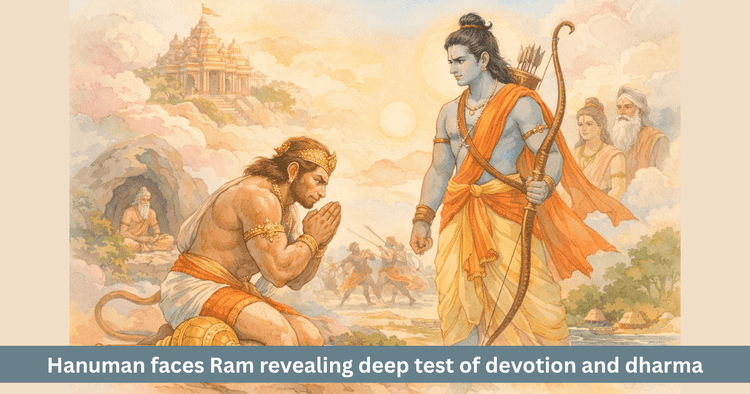
Table of Contents
In the sacred narratives connected with Rama, Hanuman usually appears as the supreme devotee of Shri Rama, one whose every action is an expression of service and surrender. For that reason, when this story appears in which Hanuman himself had to stand before Shri Rama, it naturally fills the mind with wonder. This is not merely the story of a conflict. It reveals that subtle point where devotion, sacred restraint, the command of the guru, the duty of protecting one who has sought refuge and loyalty to truth all stand together.
The beauty of this episode lies in the fact that there is no actual enmity here and yet a profound tension appears. On one side stands Shri Rama, whose life rests upon guru vakya, dharma and maryada. On the other stands Hanuman, whose nature is founded upon protecting the surrendered, honoring the divine name and serving without self interest. Outwardly it appears to be an encounter between two sides. Inwardly it is a meeting of two forms of dharma. That is why this story does not merely surprise. It offers a rare opportunity to understand the true nature of devotion more deeply.
The Story at a Glance
| Theme | Deeper Meaning |
|---|---|
| Vishwamitra’s anger | The seriousness of the guru’s command |
| Rama’s decision | The dharma of maryada and obedience |
| King of Kashi seeking refuge | The sacred duty of protection |
| Hanuman’s assurance | Unshakable responsibility born of devotion |
| Chanting of Rama’s name | The supreme power of the divine name |
| Final forgiveness | Harmonious resolution of dharma and devotion |
How did this episode begin
This story is linked with a time when Rishi Vishwamitra became displeased with the king of Kashi for some reason. Vishwamitra was not only a sage but also a symbol of tapas, resolve and fiery command. In that state of displeasure, he asked Shri Rama that the king of Kashi be given the punishment of death. This was no ordinary request. For Shri Rama, the word of the guru was not merely worthy of respect. It was a duty to be fulfilled. Rama is the very embodiment of maryada and therefore the sanctity of relationships and the fulfillment of vows remain supreme in his life.
From the very beginning, the depth of the episode becomes visible here. The situation before Rama was not simple. He was not acting out of personal anger, preference or rivalry. He was bound by the command of his guru. For him this was a matter of sacred restraint. Thus the story makes clear at the start that what follows will not be driven by hostility from either side. Dharma in different forms will be present on both sides.
Why did the king of Kashi come to Hanuman for refuge
When the king of Kashi came to know that Shri Rama himself had resolved to punish him, fear and helplessness naturally arose within him. He may have considered many ways to save himself but in the end he understood that only the one who embodied devotion, strength and fearless righteousness could truly protect him. Thus he came into the refuge of Hanuman.
Taking refuge is not merely asking for help. In the sacred tradition, sharanagati means placing one’s ego, fear and insecurity completely before a higher force. That is exactly what the king did. Before Hanuman he was no longer merely a ruler. He had become one who had sought refuge. From this point the direction of the story changes, because for Hanuman, protecting one who has come in surrender is not merely an act of kindness. It is an unbreakable dharma.
What kind of dharmic dilemma did Hanuman face
Hanuman’s position in this story is extremely subtle and profound. On one side stands Shri Rama, his chosen Lord, the center of his life and the one for whom he has offered everything. On the other side stands a frightened being who has come to him seeking refuge. If Hanuman does not protect one who has surrendered, then his own dharma is broken. If he stands before Shri Rama, it may outwardly look like opposition. This is the highest spiritual ground of the entire episode.
Hanuman did not make a selfish decision here. He did not choose a side out of ego or emotion. He gave his assurance to the one who had sought refuge. That assurance arose from his very nature. Hanuman cannot abandon the vulnerable, the fearful and one who comes asking for protection. In this way, he stood not against his Lord but in favor of his own dharma.
How could both sides be right in this story
This story is great precisely because no one here represents adharma. Shri Rama is bound to the word of his guru. Hanuman is bound to the dharma of protecting one who has surrendered. Both are true in their own place. This is why the episode does not feel like an ordinary clash. Principles are more active here than weapons. On one side stands maryada and on the other side stands the duty born from devotion. On one side stands obedience to sacred word and on the other stands the protection of the surrendered.
This also reflects a deep truth of life. At times two right principles stand before each other. In such moments outer rules alone are not enough. One needs inner purity, the right intention and the ability to see a higher dharmic resolution. This story reveals exactly such a subtle situation. That is why its solution emerges not through ordinary defeat but through a higher understanding.
What did Hanuman do when Rama came
When Shri Rama came to punish the king of Kashi, Hanuman stood before him. This is one of the most astonishing moments in all sacred storytelling. Yet there is no rebellion in it, no pride and no disrespect. Hanuman’s stance is not the stance of opposition. It is the stance of dharmic firmness. He stands before his Lord, yet does not abandon the one who has sought refuge. Rama stands before his devotee, yet does not move away from the command of the guru. This scene reveals, at once, the two highest ideals of devotion and maryada.
To understand this moment properly, it is important to remember that Hanuman’s love for Rama remained completely untouched. He stood not as an enemy but as a guardian of a sacred obligation. This is the most beautiful dimension of the story. True devotion is not blind. It understands dharma and when needed, it can stand with immense firmness for that dharma.
How did Hanuman face Rama’s weapons
According to the story, Shri Rama used divine weapons, yet Hanuman did not respond with weapons or counter weapons. He simply began chanting Rama’s name. Here lies the deepest secret of the episode. As the weapons moved toward him, they became ineffective before the power of the divine name. This was not merely a miracle. It was the highest revelation of devotion.
Hanuman’s faith was so complete that he had no need for any outward means of protection. He demonstrated that when the heart of the devotee is fully established in the name, the name itself becomes protection. From this episode, the greatness of the divine name may be understood in several ways.
- The name is not only sound but living consciousness
- When chanted with full reverence, it becomes power
- Devotion no longer depends upon outer force
- Rama’s name carries the very force of Rama himself
For this reason, the episode is not merely a story of conflict. It is also a rare revelation of the glory of the divine name.
How did Shri Rama see this situation
When Shri Rama saw that his own weapons were being stilled by the force of the very name that belonged to him, the situation was no longer an outer astonishment alone. It became a deeply spiritual moment. He saw that Hanuman’s faith was not verbal but experiential. The name of Rama for Hanuman was not just a mantra. It was the ground of life itself. That is why the name was proving more powerful than weapons.
This moment became a special revelation even for Shri Rama. The bond between Lord and devotee shines even more radiantly here. Rama understood that this was not a conflict of personal insistence but a testing of dharma and devotion. In the end, he forgave the king of Kashi. Thus the episode did not end in the usual terms of victory and defeat. Here the triumph belonged to devotion, the divine name, dharma and maryada together.
What is the spiritual meaning of this story
This story teaches that true devotion is not mere emotion. It is a force that can keep the seeker steady even in the most difficult circumstances. Hanuman proved that when a person is fully established in the divine name, outer crises cannot break inner strength. The meaning here is not only that Rama’s name is powerful. It is also that the name chanted in complete surrender becomes the means through which dharma is protected.
The story also teaches that the path of dharma is not always easy. Sometimes two duties stand face to face. In such times it is necessary to see the truth hidden beneath outward conflict. Hanuman upheld his duty without wavering in devotion. Shri Rama upheld maryada while allowing compassion and higher understanding to enter the final outcome. This is the profound balance of the episode.
What does this story teach us for life
This narrative remains deeply relevant even today. In human life too, moments come when two right principles stand together. Relationship and principle, compassion and rule, promise and circumstance, all may appear in tension. Such moments are not easy. This story teaches that in those times, inner sincerity and purity of purpose become the real guide.
Some lasting teachings from this episode may be understood in this way.
1. Protecting the surrendered is dharma
One who comes in fear seeking shelter should not be abandoned.
2. Respect for the guru’s word is also sacred maryada
Shri Rama preserves this ideal.
3. The divine name holds immeasurable power
Yet that power manifests only where reverence is complete.
4. Devotion does not create rebellion, it creates higher balance
Hanuman’s stand is not disobedience but dharma.
5. Resolution comes through a higher vision
Where both sides are pure, compassion becomes the final path.
Where does the heart of this story truly lie
In the end, this episode teaches that the relationship between the devotee and the Lord is not merely emotional. It contains love but also dharma. It contains surrender but also insight. It contains humility but also astonishing firmness. By standing before his own Lord, Hanuman demonstrated that true devotion does not create opposition. Whatever appears to happen is only for the sake of a higher truth.
The heart of the story lies in this, that devotion and maryada are never truly opposed. Even if outwardly they seem to stand apart, inwardly they are moving toward a deeper resolution. Hanuman, by taking refuge in Rama’s name, showed that the greatest strength of the devotee lies in inner surrender. Rama, by granting forgiveness, showed that the fullness of maryada flowers in compassion. That is the brightest light of this episode and its eternal message.
Frequently Asked Questions
Why did Hanuman have to stand before Shri Rama
Because the king of Kashi had come to Hanuman seeking refuge and protecting one who has surrendered is Hanuman’s dharma.
Why did Shri Rama wish to punish the king of Kashi
Because he was bound by the command of Guru Vishwamitra and for him this was a matter of sacred obedience and maryada.
How did Hanuman face Rama’s weapons
He did not use weapons of his own. He simply chanted Rama’s name and the divine name made the weapons ineffective.
What is the greatest teaching of this story
The greatest teaching is that true devotion, the power of the divine name and steadfast dharma can transform even the hardest situations.
Is this story about conflict between the Lord and the devotee
No. It is not a story of conflict but of the higher harmony between devotion, sacred restraint and dharma.
Get your accurate Kundali
Generate KundaliDid you like it?
Author

Aparna Patni (63)
Experience: 20
Consults About: Family Planning, Career
Clients In: Punjab, Haryana, Delhi
Share this article with friends and family
About ZODIAQ
ZODIAQ is an online Vedic Astrology platform. It connects clients seeking astrological advice to experienced astrologers with deep knowledge. Our users also generate kundali and perform kundali milan for free. ZODIAQ also offers services to the Astrologers. Astrologers utilize various offerings by ZODIAQ to serve their clients effectively.
If you are a User
Consult with experienced astrologers and seek their guidance. You can also order handwritten Janm Patrika report with life prediction prepared by experienced astrologers. Generate accurate Kundali, perform Kundali Matching and check horoscope and muhurat. Utilize our online library for all the necessary astrological and spiritual information.
If you are an Astrologer
Create accurate kundali for your clients and perform Kundali Matching for up to 5 people at a time. Write comprehensive Janm Patrika report for your clients with ZODIAQ. Check client details anytime by saving it in client directory. Become more productive by tracking how many clients you guide every day.
WELCOME TO
ZODIAQ
Right Decisions at the right time with ZODIAQ
