The Remarkable Episode of Hanuman and Shani Deva: When Devotion Changed Even Planetary Influence
By Pt. Sanjeev Sharma
Hanuman’s Influence on Shani Deva: The Power of Devotion, Dharma, and Courage
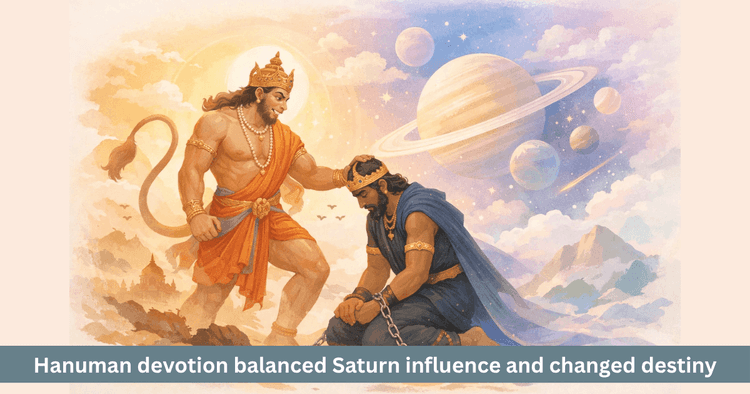
Table of Contents
The Ramayana is not only a story of battle and victory. It is also a story of the subtle forces that shape life, karma and destiny. Sometimes these forces appear in the form of deities and at other times they act through the planets, influencing human experience in deep ways. The episode of Hanuman and Shani Deva brings forward this profound layer of sacred understanding. Here, it is seen that before devotion, dharma and selfless courage, even the harshness of planetary influence can soften and take a different direction.
This story does not merely say that Hanuman freed Shani Deva from captivity. Its meaning is much deeper. It reveals that whenever power is used in the direction of control, arrogance and injustice, the balance of the universe is disturbed. And when a divine servant steps forward in a selfless spirit, that disturbed balance is restored. Hanuman’s action in this episode was not simply an act of strength. It was an act of restoring dharma.
The Essence of the Story at a Glance
| Theme | Deeper Meaning |
|---|---|
| Ravana imprisoning Shani | Challenging the law of karma and justice |
| Hanuman entering Lanka | Moving fearlessly for the work of dharma |
| Liberation of Shani Deva | Restoration of cosmic balance |
| Shani Deva’s joy | Recognition of devotion and selfless service |
| The boon granted | Relief from harsh Saturnine influence through Hanuman devotion |
| Main message | Pure karma and devotion bring balance to life |
Why did Ravana imprison Shani Deva
Ravana’s empire in Lanka was not merely a symbol of material strength or military power. It also represented the extreme state of ego, control and the belief that one’s own will could become absolute. Ravana was not only a king who fought the gods. He also sought to dominate the subtle forces that govern the universe. In that arrogance, he imprisoned Shani Deva.
In the Vedic understanding, Shani is not merely a planet. He represents karmic consequence, justice, discipline, maturity through delay and the hard trials of life. To imprison such a deity was not only an insult to a divine being. It was a challenge to the sacred order through which every being receives the fruit of its actions. That is why this event is not just a mythic detail. It is also a subtle form of the conflict between dharma and adharma.
Why was this imprisonment more than simple captivity
When a deity like Shani, who represents justice, is placed in captivity, the meaning goes far beyond physical confinement. It means that some force has become arrogant enough to think that even the law of karma can be bent by personal desire. This was Ravana’s delusion. He believed that if the planets could be controlled, destiny itself could be brought under his will. But this is the central error of adharma. The order of the universe does not move according to the wish of one being. It moves according to rita, dharma and justice.
Seen from this perspective, the captivity of Shani Deva was actually the captivity of justice itself. It stood against cosmic balance. therefore his liberation was not merely an act of compassion. It was also an act of restoring rightful order. This is why Hanuman’s role rises above ordinary heroism in this episode.
How did Hanuman come to know of this situation
When Hanuman entered Lanka in search of Mother Sita, his purpose was not only to gather information. He had gone for Rama’s work and Rama’s work does not mean carrying a message alone. It also means that wherever adharma is seen, dharma must awaken. In Lanka he did not witness only the strength of the rakshasas. He also perceived the atmosphere of injustice, fear and distorted control that existed there.
In that course, he came to know that Shani Deva had been imprisoned. For Hanuman this was not merely surprising. He would have understood immediately that such a condition stood against dharma and could not be left untouched. This is one of the deepest traits of Hanuman. Wherever he sees injustice, he does not remain a passive observer. He activates dharma at that very point.
How did Hanuman free Shani Deva
When Hanuman reached the place where Shani Deva had been confined, he resolved to free him without delay and without fear. For him, this was not some separate action outside Rama’s mission. It too was part of the greater dharmic work that had brought him to Lanka. No wall, no prison and no barrier created by Ravana could stand before his strength and determination. The episode shows that when power is used not for selfish ambition but for dharma, it becomes invincible.
Here Hanuman appears not only as a warrior but as a protector of sacred order. He does not merely fight. He liberates. He does not merely punish. He restores balance. This is why his strength is always regarded as auspicious and benevolent.
Why was Shani Deva pleased with Hanuman
Shani Deva is known for strict justice and impartial karmic order. He is not easily moved by ordinary displays of power. therefore his joy toward Hanuman is deeply meaningful. In Hanuman he saw not only force but the rare combination of selflessness, devotion and action dedicated entirely to dharma. This is the element that even the stern force of Saturn recognizes and respects.
Shani Deva understood that Hanuman never acts for personal gain. He seeks nothing for himself. Everything in him is offered to the Lord’s work and to the preservation of dharma. It was natural that such a being would receive a special blessing. Thus, Shani Deva granted Hanuman a rare boon.
What boon did Shani Deva grant
Shani Deva declared that anyone who worships Hanuman with sincere heart would find relief from the harshness of Saturnine influence. This blessing should not be understood only in a surface sense, as if it were merely a magical promise of protection. It carries a deep spiritual law within it.
The meaning of this boon is that when a person truly adopts the qualities represented by Hanuman, life itself begins to regain balance. Hanuman stands for
- devotion
- service
- humility
- courage
- disciplined action
- ego free surrender
When these qualities begin to enter life, karma itself becomes purified. And when karma becomes purified, the influence of Shani no longer acts only as punishment. It begins to act as discipline, education and maturity. This is the deeper meaning of the boon.
Is this only a story about relief from Shani dosha
No, reducing this episode only to the idea that Hanuman worship removes Saturn related affliction would make its meaning far too small. The real indication of the story is that devotion transforms life in such a way that even planetary influence is experienced differently. The planets do not stop doing their work but the manner in which their influence is received changes. What once felt only like suffering may, through purified living, courage and surrender, become a means of inner refinement.
In this sense, worship of Hanuman is not merely a remedy. It is a path of character formation. One who turns toward Hanuman gradually rises above fear, becomes steadier in action and grows stronger in times of adversity. That is why this story is spiritually profound.
What does the relationship between Hanuman and Shani teach us
This episode teaches on many levels. First, it shows that strength and justice are not enemies. If strength is aligned with dharma and justice is impartial, then together they create balance in life. Hanuman’s strength serves the restoration of righteousness, while Shani’s justice serves the preservation of karmic order. One removes outer barriers, while the other corrects the inner structure of action.
Second, the story teaches that devotion does not erase destiny but it changes the way destiny is lived. When a person is fearful, lazy, unstable and selfish, difficult planetary periods can break the spirit. But when the same person fills life with devotion, service, discipline and courage, then the difficult phase becomes a means of growth rather than mere pain.
Third, this episode reminds us that dharma is not only a matter of worship. Dharma also means standing fearlessly on the side of justice wherever injustice appears. This is exactly what Hanuman did. He is not only a devotee. He is an active guardian of dharma.
Why does this story remain relevant today
Even today many people connect difficult times of life with the influence of Shani. When delays increase, obstacles repeat, mental burden becomes heavy or life seems to move through one test after another, fear often grows. In such times, this story offers a deep direction. It says do not shrink in fear. Awaken the Hanuman spirit within. Bring devotion, service, strength, patience and right action into life. Then even the difficult period will not remain only painful. It will also become a source of inner power.
This story teaches that worship is not merely ritual. True worship is that which changes the person from within. If Hanuman worship does not bring courage, if it does not increase humility and if it does not purify action, then the worship remains incomplete. This is why the boon of Shani Deva points not only toward outer protection but toward inner transformation.
What is the living heart of this story
In the end, this story teaches that every force in the universe becomes harmonized before dharma and devotion. By liberating Shani Deva, Hanuman did not merely free a deity from captivity. He established the truth that justice cannot be permanently chained by arrogant power. And when a devotee stands in selfless commitment to dharma, even the harshness of planetary influence begins to acquire a new meaning in life.
This episode is not simply praise of Hanuman’s greatness. It also reveals that true devotion purifies karma, purified karma balances life and a balanced life transforms even severe influences into spiritual discipline. This is the heart of the story. This is its greatest message. When a human being becomes inwardly aligned with dharma, even outer obstacles cannot finally stop the path.
Frequently Asked Questions
Why did Ravana imprison Shani Deva
In his arrogance, Ravana wanted to control even the planets and divine forces, so he imprisoned Shani Deva.
How did Hanuman free Shani Deva
Hanuman reached the place of captivity in Lanka and liberated Shani Deva through his strength and unwavering resolve.
What boon did Shani Deva grant to Hanuman
He granted that those who worship Hanuman with sincerity would find relief from the harsh effects of Saturn.
Does this mean Hanuman worship makes Shani completely inactive
No. The deeper meaning is that by adopting Hanuman’s qualities, life and karma become purified, so Saturn’s harshness is experienced in a more balanced way.
What is the greatest message of this story
The greatest message is that before devotion, dharma and selfless action, even severe planetary influence can take a new direction.
Get your accurate Kundali
Generate KundaliDid you like it?
Author

Pt. Sanjeev Sharma (63)
Experience: 20
Consults About: Family Planning, Career
Clients In: Punjab, Haryana, Delhi
Share this article with friends and family
About ZODIAQ
ZODIAQ is an online Vedic Astrology platform. It connects clients seeking astrological advice to experienced astrologers with deep knowledge. Our users also generate kundali and perform kundali milan for free. ZODIAQ also offers services to the Astrologers. Astrologers utilize various offerings by ZODIAQ to serve their clients effectively.
If you are a User
Consult with experienced astrologers and seek their guidance. You can also order handwritten Janm Patrika report with life prediction prepared by experienced astrologers. Generate accurate Kundali, perform Kundali Matching and check horoscope and muhurat. Utilize our online library for all the necessary astrological and spiritual information.
If you are an Astrologer
Create accurate kundali for your clients and perform Kundali Matching for up to 5 people at a time. Write comprehensive Janm Patrika report for your clients with ZODIAQ. Check client details anytime by saving it in client directory. Become more productive by tracking how many clients you guide every day.
WELCOME TO
ZODIAQ
Right Decisions at the right time with ZODIAQ
