The Lamp of Rama’s Name in Lanka: When Hanuman Recognized Vibhishana
By Pt. Nilesh Sharma
Recognition of Dharma and Devotion in Darkness: The Story of Hanuman and Vibhishana
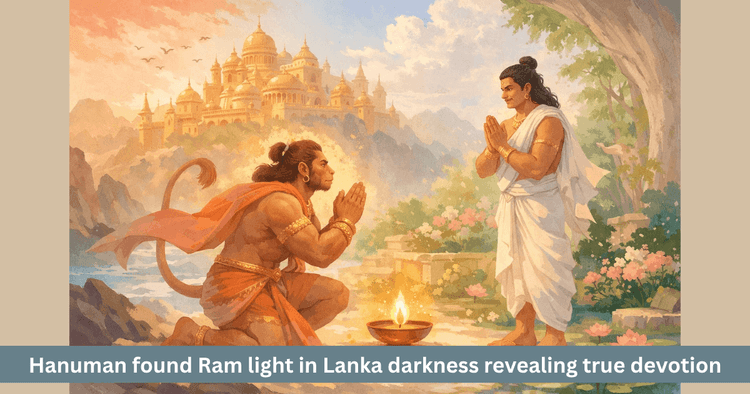
Table of Contents
The moment Lanka is imagined, the mind forms the image of a city built of gold, overflowing with power, splendor and ego. In every direction one sees Ravana’s influence and every being appears to live under his shadow. In such an environment, it becomes difficult even to imagine the presence of devotion, humility or the name of Rama. Yet this is exactly what makes the episode so beautiful. In the deepest region of darkness, a lamp may still remain lit. When Hanuman entered Lanka in search of Mother Sita, he did not see only luxury and fear. He also discovered one place whose atmosphere was completely different. That place was the dwelling of Vibhishana and it was there that Hanuman recognized for the first time that dharma can remain alive even in the midst of adharma.
This is not only a story of search. It is a story of recognition, consciousness, devotion and inner truth. Hanuman did not identify Vibhishana through name, status, appearance or outer signs alone. He recognized him through the subtle aura that arises only from true surrender. That is why this episode is counted among the deepest spiritual moments of the Ramayana tradition. It teaches that when the divine name truly lives within a person, even the place where that person dwells begins to carry a different vibration.
The Story at a Glance
| Theme | Deeper Meaning |
|---|---|
| Hanuman entering Lanka | Entering darkness for the work of dharma |
| Observing the city | Recognizing adharma beneath outer splendor |
| Seeing a different palace | Discovering light hidden within darkness |
| Tulsi and Rama’s name | Living signs of devotion |
| Meeting Vibhishana | The union of two kindred consciousnesses |
| Later role in the war | Inner support for the victory of Rama |
What was Hanuman searching for in Lanka
When Hanuman entered Lanka, only one purpose filled his heart, to find Mother Sita. This journey was far more than a mission of secret observation. It was a sacred duty driven by devotion, one that required vigilance, wisdom, patience and divine inspiration all at once. As he moved through Lanka, he was not merely looking at buildings. He was also reading the inner condition of the city. Wherever his gaze fell, he saw intoxication with power, the force of rakshasa nature, arrogance, control and an atmosphere of fear. It became clear to him that Lanka was not only externally wealthy but inwardly saturated with adharma.
In the course of this search, Hanuman observed everything carefully. It was necessary not only to locate Sita but also to understand who in Lanka could become an ally and who remained bound to darkness. The work of Rama requires not only courage but also the ability to recognize the inner nature of beings. It was this awakened perception that led him eventually to Vibhishana.
Why was the atmosphere of Lanka so different
Lanka is described as a golden city, yet the glow of gold does not always signify purity. At times outer brilliance hides inner emptiness. This was the condition of Ravana’s Lanka. There was order, magnificence and display of force but not the peace that arises from dharma. There was prosperity but not humility. There was control but not compassion. There was splendor but not surrender.
Hanuman perceived this contradiction clearly. This forms the background of the whole episode. When all around carries one single energy and suddenly one place appears different, an awakened vision notices it immediately. The residence of Vibhishana was such a place. Outwardly it belonged to Lanka but inwardly it belonged to another truth.
Why did that palace appear different
As Hanuman searched for Sita, his eyes fell upon a residence unlike the others in Lanka. There was none of the same fierceness there, none of the same pride and none of the same harsh vibration. Its aura was peaceful, as if some deep inner discipline were hidden there. Externally it was a part of the city, yet in consciousness it was distinct from everything around it. This difference could not be recognized by ordinary sight. It could only be seen by one within whom devotion itself was alive.
When Hanuman looked more carefully, he saw a Tulsi plant there and he also saw the name of Rama marked upon that place. For an ordinary observer, this might have been surprising. For Hanuman, it was enough. He immediately understood that someone lived there who had preserved the remembrance of Rama even while surrounded by adharma.
Why were Tulsi and Rama’s name such important signs
The Tulsi plant is never regarded as merely a plant in sacred tradition. It symbolizes purity, surrender, reverence and devotional presence. In the same way, Rama’s name is not merely a written word. It is a force that changes consciousness. Where the name of Rama truly lives, the environment itself begins to transform. The current of thought becomes different, the foundation of life becomes different and even in the midst of fear a subtle peace remains.
From these signs Hanuman understood several things immediately
- this could not be the dwelling of an ordinary rakshasa
- the one who lived here was inwardly connected to dharma
- even if outwardly located in Lanka, the consciousness here was Rama centered
- this was not merely a residence but a place of inner spiritual preservation
This is why the episode teaches that devotion can be recognized, when the vision is pure.
Who was Vibhishana and how was he different in Lanka
Vibhishana was Ravana’s brother, yet inwardly he was completely different from Ravana. The blood relation was the same but consciousness was not. He lived in Lanka, yet Lanka did not live within him. This is his greatest significance. To preserve dharma while surrounded by adharma is not a small achievement. When all around there is fear, vanity and moral distortion, to keep truth, humility and remembrance of the Divine alive within is itself a great spiritual discipline. Vibhishana had lived exactly this discipline.
His personality in this episode appears in three powerful ways
1. Remaining dharmic in the midst of adharma
He did not allow the surrounding atmosphere to enter his soul.
2. Keeping Rama’s name alive
Not merely in thought but in his dwelling and way of life.
3. Waiting for the right moment
He was not an impulsive rebel but one who stood on truth at the proper time.
In this way, Vibhishana is not only a character in the story. He is proof that inner truth may be preserved regardless of outer condition.
Why was the meeting between Hanuman and Vibhishana so important
The meeting between Hanuman and Vibhishana was far more than a meeting of two individuals. It was the meeting of two similar devotional currents, two similar loyalties and two hearts turned in the same direction. Both were devoted to Rama. Both desired the triumph of dharma. Both were preserving that truth in their own way within the hostile atmosphere of Lanka. This is why their meeting was not only natural but spiritually decisive.
This meeting had several great consequences
- Hanuman found a trustworthy ally within Lanka
- Vibhishana found a direct connection to Rama’s work
- The path toward Mother Sita became clearer
- The way opened from within Lanka toward the eventual victory of Shri Rama
Thus this meeting was not only recognition but strategically and spiritually vital.
Does this episode mean only that Vibhishana was a devotee
No, its meaning is far broader than that. Vibhishana is not merely a devotee in this story. He is the symbol of inner dharma. This episode teaches that outer surroundings influence a person but they do not absolutely define a person. If the inner lamp is not allowed to go out, then even in a city of darkness a dwelling of devotion can be created. That is Vibhishana’s greatest teaching.
The deeper meanings of this story may be understood on several levels
1. Devotion does not depend on place
It can remain alive even in Lanka.
2. A single person can hold the lamp of truth
Even when everything around is ruled by adharma.
3. True vision sees beyond outer form
Hanuman recognized Vibhishana not by appearance but by inner feeling.
4. Allies of dharma may appear in unexpected places
Sometimes light hides in the very heart of darkness.
What does the lamp of Rama’s name in Lanka signify
The image of Rama’s name marked in Lanka is intensely symbolic. It teaches that remembrance of the Divine is not limited to temples, hermitages or outwardly sacred places. It may reveal itself even where one would least expect it. This is one of the most beautiful aspects of the episode. Rama’s name here is not merely writing. It is the sign of an inner decision. It says that Vibhishana had already chosen the foundation of his life, even if he still outwardly remained within Ravana’s Lanka.
This lamp may be understood in three ways
-
inner wakefulness
a person knows what the deepest truth is -
continuity of devotion
outer circumstances may change but remembrance does not break -
invitation to divine presence
where the name lives, grace continues to flow
That is why Hanuman understood immediately that someone lived there who was externally in Lanka, yet inwardly belonged to Rama.
What does this story teach for life today
Even today, many people live in surroundings that do not reflect their deepest values. Workplaces, social settings, relationships and pressures of the age often place a person in environments where truth, peace and devotion seem difficult to preserve. In such times, the story of Vibhishana gives great strength. It says that if the inner lamp is not allowed to die, outer darkness cannot become the final reality.
Some important life teachings arise from this story
1. Preserve the truth within
Circumstances may change but the foundation must remain.
2. Devotion does not require outer comfort
It can live even in difficult surroundings.
3. Do not judge people only by external appearance
The truest heart may be found in the least expected place.
4. One person may become a center of light
Vibhishana is the living example of this truth.
Where does the heart of this episode lie
In the end, Vibhishana’s dwelling in Lanka was not merely a house. It was a lamp. It was the proof that even in the strongest atmosphere of adharma, a center of dharma may remain alive. Hanuman recognized Vibhishana because he himself was full of Rama. Only one whose own heart is illumined by devotion can truly recognize devotion in another. This is the gentlest and deepest beauty of the story.
This episode teaches that devotion is not confined by place, city, lineage or circumstance. Wherever there is true surrender, the presence of the Divine reveals itself. The lamp of Rama’s name in Lanka is the symbol of that truth. That is the heart of the story. That is its most beautiful message, that even in the deepest darkness a true name, a Tulsi plant and an awakened heart can alter the whole direction of destiny.
Frequently Asked Questions
How did Hanuman recognize Vibhishana
He saw the Tulsi plant and the sign of Rama’s name at Vibhishana’s residence and understood that the one living there was inwardly devoted to Rama.
How was Vibhishana different while living in Lanka
He lived in Ravana’s household, yet his values, thoughts and inner consciousness remained aligned with dharma and Rama bhakti.
Why were Tulsi and Rama’s name such powerful signs
Because they symbolized living purity, devotion and active remembrance of the Divine.
Why was the meeting between Hanuman and Vibhishana important
It gave Hanuman a dharmic ally within Lanka and that alliance later played a vital role in the victory of Shri Rama.
What is the greatest teaching of this story
The greatest teaching is that no matter how dark the outer world becomes, if Rama’s name remains alive within, dharma remains protected.
Get your accurate Kundali
Generate KundaliDid you like it?
Author

Pt. Nilesh Sharma (63)
Experience: 20
Consults About: Family Planning, Career
Clients In: Punjab, Haryana, Delhi
Share this article with friends and family
About ZODIAQ
ZODIAQ is an online Vedic Astrology platform. It connects clients seeking astrological advice to experienced astrologers with deep knowledge. Our users also generate kundali and perform kundali milan for free. ZODIAQ also offers services to the Astrologers. Astrologers utilize various offerings by ZODIAQ to serve their clients effectively.
If you are a User
Consult with experienced astrologers and seek their guidance. You can also order handwritten Janm Patrika report with life prediction prepared by experienced astrologers. Generate accurate Kundali, perform Kundali Matching and check horoscope and muhurat. Utilize our online library for all the necessary astrological and spiritual information.
If you are an Astrologer
Create accurate kundali for your clients and perform Kundali Matching for up to 5 people at a time. Write comprehensive Janm Patrika report for your clients with ZODIAQ. Check client details anytime by saving it in client directory. Become more productive by tracking how many clients you guide every day.
WELCOME TO
ZODIAQ
Right Decisions at the right time with ZODIAQ
