Kesari’s Valor and the Sign of Hanuman’s Birth: When an Act of Courage Opened the Path to a Divine Blessing
By Pt. Nilesh Sharma
The Tale of Kesari’s Valor, Protection of Dharma, and the Divine Design Behind Hanuman’s Birth
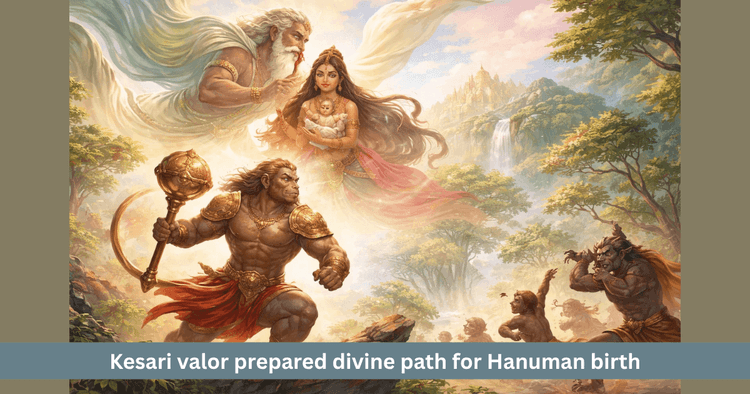
Table of Contents
If one wishes to understand the story of Hanuman ji deeply, it is not enough to know only the event of his birth. It is equally important to understand the circumstances that prepared the ground for that divine birth, the actions that shaped its arrival and the way figures such as Mata Anjana, Vayu Dev and father Kesari became part of that great design. In this context, the name of Kesari is remembered with profound respect. He was not merely a king of the vanara lineage but a symbol of protection of dharma, valor, duty and selfless action and one important deed of his later appeared as a sign connected to Hanuman’s birth.
His valor was not simply the display of personal strength. It carried commitment to dharma, the spirit of protecting the afflicted and the courage not to bow before adharma. That is why his story, though separate in appearance, remains deeply connected with the birth narrative of Hanuman ji. A great soul does not take birth suddenly. Behind such an arrival stand many meritorious actions, many blessings and many subtle preparations. This episode of Kesari is one such important chapter in that divine preparation.
Who Was Father Kesari and Why Is His Importance So Special
To see vanararaj Kesari only as a powerful warrior would be to see only one part of his character. He represented a tradition in which strength was not used merely for victory but for the protection of dharma. He certainly possessed martial skill, yet more important than that was his resolve that sages, ascetics and seekers living in fear should not remain helpless. This quality alone sets him apart from an ordinary hero.
At that time, the rishis and munis living in forests and hermitages were surrounded by constant fear. Their austerities, yajnas and spiritual practices were repeatedly disturbed by wicked beings. This was not only personal suffering. When hermitages lose peace, the flow of dharma itself becomes disturbed. When austerity is interrupted, it is not merely the concentration of one individual that is broken but the sattvic force of an entire region begins to weaken. In such a time, the one who rises in protection performs not only outward help but the restoration of sacred balance. That is exactly what Kesari did.
Why Was the Terror of Shambhasadan Considered So Severe
Traditions speak of a terrifying danava named Shambhasadan. He was not only powerful but also filled with cruelty. His aim was not merely to defeat others. He especially targeted places where rishis and sages lived in peace and performed tapasya and yajna. In this way, his attacks were not only against individuals but directly against the order of dharma.
Some important aspects of Shambhasadan’s terror may be understood in this way:
• He disturbed the peace of sages and ascetics
• Interrupting yajna and tapasya was his central tendency
• By creating fear, he was weakening the path of dharma
• His violence was not only physical but also an assault upon spiritual balance
This is why his death was not merely the destruction of one danava. It was a decisive intervention in the struggle between dharma and adharma.
Why Did Kesari Decide to Enter the Battle
When a region suffers for long under fear, obstruction and injustice, silence itself can become a kind of consent. Kesari did not choose the path of silence. He understood that if dharma was to be protected, then sorrow alone was not enough. One had to stand before adharma. This was the moment when his heroism ceased to be mere strength and became a sacred resolve for dharma.
Kesari’s decision was important for many reasons. He knew that the enemy before him was no ordinary one. Shambhasadan was immensely powerful and merciless. Yet Kesari did not retreat. He accepted the battle not for his own glory but for the peace of those seekers who were never meant to raise weapons themselves. Here the most beautiful aspect of Kesari’s character becomes visible. True valor is that which uses its strength not for the self but for the protection of others.
What Was the Nature of This Battle
The battle between Kesari and Shambhasadan was not an ordinary conflict. On one side stood the cruel force of the danava and on the other stood the unwavering resolve to protect dharma. Shambhasadan fought with all his might, for to him this was not merely resistance but a challenge to the terror he had established. Yet Kesari’s mind did not waver. He was not fighting only with physical power but with the loyalty that refuses to let adharma remain unchallenged for long.
While understanding this battle, it is important to remember that a struggle fought for dharma is not won by outward force alone. It also carries inner strength, awareness of duty and selflessness. All three were present within Kesari. That is why he finally killed Shambhasadan and freed the sages from his fear. This victory was not merely the triumph of a warrior. It was the return of peace that the whole region had longed for.
Why Did the Effect of This Victory Go Beyond a Single Battle
After the death of Shambhasadan, the change that came was much greater than the mere fall of one danava. Peace returned to the hermitages. The rishis and munis were again able to settle into yajna and tapasya. The atmosphere of fear began to fade. The current of dharma began to flow naturally again. This is why Kesari’s act was seen not only as heroism but also as a meritorious deed.
The sages and seers experienced this event very deeply. They saw that Kesari had not acted from selfishness, greed or personal ambition. He had placed his life in danger for the protection of others. Such deeds do not produce ordinary results. Such actions carry the power to shape the future. It was in this feeling of gratitude and reverence that the sages granted Kesari a special blessing.
What Blessing Did the Sages Give
Pleased by Kesari’s valor and steadfastness to dharma, the sages blessed him that a son would be born in his house who would arise from Rudra ansh, a portion of Rudra. This statement was not an ordinary blessing spoken in passing joy. It was a divine indication that the merit of Kesari would not remain limited to ordinary results. The birth that would take place in his house would become an extraordinary pillar of dharma in the future.
The essence of this blessing may be understood in this way:
| Action | Fruit |
|---|---|
| Protection of dharma | Joy of the sages |
| Selfless valor | Accumulation of merit |
| Slaying of the danava | Restoration of peace in the hermitages |
| Blessing of the sages | Sign of a son born from Rudra ansh |
Here it becomes clear that Kesari’s merit is directly connected to the ground of Hanuman’s birth. This is not merely a matter of lineage but of worthiness. Just as the mother’s tapasya is important for a divine birth, the father’s righteous action is equally significant.
What Is the Deeper Message of This Story
The greatest message of this episode is that actions shape the future. A person may become what he thinks toward but true worthiness is established by what he does. Kesari protected dharma. He fought for the frightened sages. He used his strength in a selfless way. These very actions became the foundation for the blessing that later connected with Hanuman’s birth.
This story also shows that divine fruits are not gained by desire alone. Behind them stands the accumulation of merit, sacrifice, patience and steadfastness to dharma. Mata Anjana’s tapasya was important in its own place. The role of Vayu Dev was necessary in its own place. Yet along with them, the righteous valor of father Kesari was also an essential part of this great process. This makes it clear that Hanuman ji’s birth was not an accidental event. It was the result of preparation unfolding across many levels.
Why Was Kesari’s Role Essential in the Preparation for Hanuman’s Birth
When a great soul takes birth, there is never only one reason behind it. The mother’s tapasya, the father’s merit, the blessings of the wise and the design of divine power all work together. Kesari’s role must be understood in this complete preparation. He performed the righteous deed that made his lineage worthy of divine blessing. He showed the courage that awakened reverence in the hearts of the sages. He offered the protection through which the path of dharma could again stand firm.
This many layered process may be seen briefly as follows:
• Mata Anjana’s tapasya purified worthiness
• Vayu Dev’s mediating role connected the divine portion
• Kesari’s righteous action created the worthy foundation for blessing
• The sages’ boon made the sign of birth clear
Through this union, the ground for Hanuman’s birth became complete. That is why Kesari’s valor is not only an old heroic tale but a living and essential part of Hanuman’s story.
When One Act of Courage Changes the Destiny of Future Generations
Ultimately, this episode of Kesari offers a profound vision of life. A selfless act performed for dharma does not remain confined to that single moment. Its influence travels far. At times it removes the suffering of the present and at times it opens the gate to a great future possibility. When Kesari killed Shambhasadan, he perhaps did not know that this very action would become part of the preparation for the divine force that would later take birth in his house. Such is the glory of righteous action. Its fruit is both immediate and far reaching.
The birth of Hanuman ji stands as a beautiful proof of this truth. On one side there was the mother’s spiritual discipline, on another side divine grace and along with them there was the radiant righteous action of father Kesari. This story teaches that when valor, selflessness and dharma stand together, their fruit is not merely victory. It becomes an inspiration for ages to come. Kesari’s valor is the name of that immortal inspiration.
FAQs
Who was Kesari
Kesari was the vanara king and is remembered as a great hero devoted to the protection of dharma.
Who was Shambhasadan
Shambhasadan was a cruel danava who disturbed the austerities and yajnas of the sages.
Why did Kesari kill Shambhasadan
He fought to free sages and saints from the danava’s terror and to protect dharma.
What blessing did the sages give to Kesari
They blessed him that an extraordinary son born from Rudra ansh would take birth in his house.
What is the main message of this story
A selfless act performed for dharma can become so powerful that it forms the basis of divine possibilities in the future.
Get your accurate Kundali
Generate KundaliDid you like it?
Author

Pt. Nilesh Sharma (63)
Experience: 20
Consults About: Family Planning, Career
Clients In: Punjab, Haryana, Delhi
Share this article with friends and family
About ZODIAQ
ZODIAQ is an online Vedic Astrology platform. It connects clients seeking astrological advice to experienced astrologers with deep knowledge. Our users also generate kundali and perform kundali milan for free. ZODIAQ also offers services to the Astrologers. Astrologers utilize various offerings by ZODIAQ to serve their clients effectively.
If you are a User
Consult with experienced astrologers and seek their guidance. You can also order handwritten Janm Patrika report with life prediction prepared by experienced astrologers. Generate accurate Kundali, perform Kundali Matching and check horoscope and muhurat. Utilize our online library for all the necessary astrological and spiritual information.
If you are an Astrologer
Create accurate kundali for your clients and perform Kundali Matching for up to 5 people at a time. Write comprehensive Janm Patrika report for your clients with ZODIAQ. Check client details anytime by saving it in client directory. Become more productive by tracking how many clients you guide every day.
WELCOME TO
ZODIAQ
Right Decisions at the right time with ZODIAQ
