The Secret of Shiva’s Eleventh Rudra Incarnation: Why Hanuman Became an Aspect of Lord Shiva
By Aparna Patni
Lord Shiva’s Hidden Role in the Divine Play of Shri Rama
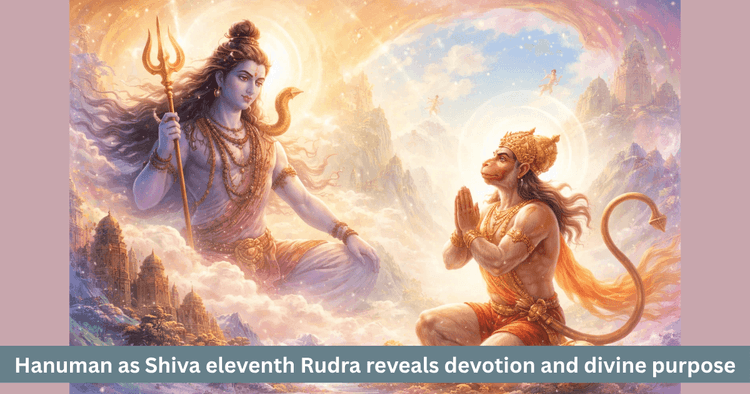
Table of Contents
Whenever the balance of dharma begins to tremble in creation, one divine force alone is not enough. At such times, many sacred streams of power become active together so that the direction of the age may be turned back toward truth. In Tretayuga, when Lord Vishnu decided to incarnate as Shri Rama, it was not merely the story of one avatar. It was a divine design in which many powers had to perform their roles. Within that design, a profoundly important and often unnoticed decision was made. That decision belonged to Lord Shiva, who chose not to remain only a witness to the divine play but to participate in it directly.
Lord Shiva is traditionally understood as detached, inwardly free and untouched by worldly entanglement. He sees the rise and fall of creation, yet does not become bound by it. Even so, during the Rama incarnation, something was different. This was not only about the destruction of adharma. It was about the restoration of maryada, of dharma, of ideal conduct and righteous life. Shiva understood the depth of this divine play and realized that this mission would need more than force. It would require a devotion so pure that it would surrender even its own existence and live only through the will of the Divine. From that realization arose a sacred impulse and Shiva resolved to descend into this lila in the form of a servant.
Key Insight of the Story at a Glance
| Element | Meaning |
|---|---|
| Lord Shiva | Detachment, dissolution, compassion and supreme consciousness |
| Eleventh Rudra aspect | Fierce, dynamic, unshakable and divinely active force |
| Hanuman’s descent | Service, surrender, strength and selfless devotion |
| Role in Rama’s lila | Total dedication to the will of the Divine |
| Deeper spiritual message | Power becomes divine when it turns into service |
Why did Shiva decide to enter this divine play
In the story of Rama, Shri Rama appeared as the living form of dharma and sacred restraint. His life contained battle, compassion, justice and sacrifice. Such a divine play did not require only a warrior. It required a being whose devotion would rise above personal identity and whose every breath would be aligned with the Lord’s purpose. Shiva recognized that this mission required not only strength but a devotion entirely free from selfishness.
This is where the depth of Hanuman’s story begins to open. Shiva did not choose to enter this lila as the great God above all. He chose to enter it as service itself. That is the deepest turning point of this narrative. The deity known as the lord of dissolution chose to appear as the servant of Rama. This is not just a mythic detail. It is a profound spiritual revelation.
What do the eleven Rudra forms of Shiva signify
In Shiva Purana, especially in Shatarudra Samhita, there is mention of the eleven Rudra forms of Shiva. Each Rudra represents a distinct stream of cosmic force. Among these forms is one aspect that is intensely fierce, dynamic, unwavering and deeply active. This force is not merely destructive. It also clears pathways, removes obstacles and gives movement to creation where movement is needed.
It was this eleventh Rudra aspect that Shiva resolved to send to the earthly plane. The purpose was not merely to aid in battle but to serve dharma through divine participation. Hanuman became the living form of that Rudra energy. This is why immense power in him never turned into uncontrolled aggression. It appeared instead as disciplined service.
Why is Hanuman’s birth more than a birth story
The birth of Hanuman was not the result of an ordinary divine event. It was a carefully aligned sacred arrangement. His Vanara form was an outward appearance, yet the consciousness active within him arose from Shiva’s Rudra force itself. His birth through the grace of Vayu Deva is also highly symbolic, because like Vayu, the life wind, Hanuman’s movement was beyond limitation. He could reach where needed, do what was necessary and above all perform every act in complete surrender.
This birth arrangement shows that when divinity wishes to take the form of service, it does not create merely a strong body. It creates a being in whom force, speed, wisdom, steadiness and devotion exist together. That is why Hanuman did not become only a mighty warrior. He became the ideal of service, the highest symbol of devotion and the humble form of divine strength.
What was unique about the eleventh Rudra aspect
The eleventh Rudra aspect of Shiva was not merely a symbol of intensity. It carried qualities that can be clearly seen in Hanuman’s nature.
1. Unshakable strength
This force does not tremble before circumstances. It remains steady for dharma.
2. Movement beyond limitation
Hanuman possessed the speed and reach of Vayu. This is a natural feature of Rudra energy.
3. Strength anchored in obedience
Hanuman never used power to glorify himself. He used it to fulfill Rama’s command.
4. Valor without ego
He possessed immense force but no vanity about it. That is the maturity of Rudra power.
5. Divinity expressed through service
This energy does not act for personal victory but for the protection of cosmic order.
How is Shiva’s burning of Kama connected with Hanuman’s celibacy
There is a deeply subtle spiritual connection here. The Rudra form of Shiva that reduced Kamadeva to ashes should not be understood only as a moment of wrath. Its deeper meaning is that Shiva is the force that can fully master desire, sensual pull and emotional attachment. When that same force appears as Hanuman, it gives rise to a being who becomes the embodiment of restraint, brahmacharya, self mastery and detachment.
Even with immeasurable power within him, Hanuman carried no trace of lust, vanity or personal claim. This is no small matter. Usually, where great strength exists, there is also intense awareness of that strength. Yet in Hanuman, there was not the awareness of personal greatness but only the awareness of Rama’s mission. That is what makes him extraordinary. His power was not his identity. His devotion was his true form.
Why is the relationship between Rama and Hanuman so unique
The relationship between Rama and Hanuman is not only that of Lord and devotee. It symbolizes a spiritual state in which power itself surrenders into service. Hanuman never claimed his identity as an aspect of Shiva. He never displayed his extraordinary capabilities as his personal greatness. He knew only one thing, that he was Rama’s servant. That became his highest glory.
A deep truth is hidden here. Only one who has no pride in strength can use strength in its purest form. Hanuman’s humility is the source of his greatness. He shows that the one who comes closest to the Divine is the one in whom ego dissolves and service awakens.
What spiritual teachings are hidden in this narrative
This story is not merely a mythological event. It is also a symbol of an inner process taking place within human life. Every person carries within a force that can be powerful, fierce and, if left without direction, destructive. That same force, when joined with devotion, discipline and surrender, becomes Hanumanic in nature.
Some of the key teachings hidden in this narrative are the following.
1. The highest form of strength is service
Force alone does not create greatness. Its true value depends on what it is used for.
2. Devotion purifies power
When strength is joined with devotion, it becomes protective rather than destructive.
3. Detachment refines the being
Hanuman’s selflessness shows that renunciation is not weakness but spiritual force.
4. The loss of ego brings nearness to God
Where the sense of self becomes smaller, the Divine becomes more present.
5. Dharma is upheld not only by weapons but by character
Hanuman’s life teaches that character is the true foundation of strength.
Does every person carry a Rudra force within
If this narrative is viewed with contemplation, it becomes clear that every person carries a Rudra energy within. At times it appears as courage, at times as anger, at times as an intense will and at times as an inner fire that wants to break limitation. If this force does not receive direction, it can create imbalance in relationships, thoughts and action.
But when that same force is joined to a higher purpose, its nature changes. Strength becomes discipline. Anger becomes resolve. Ego becomes service. That transformation is the spiritual secret of Hanuman. In this sense, Hanuman is not only a deity outside us. He is also a consciousness that can awaken within us.
Why did Shiva choose the form of a servant
This question stands at the heart of the entire narrative. Shiva could have assisted in any form. He could have descended directly as a fierce dissolving force. Yet he chose the path of service. The reason is profound. Dharma is not restored by force alone. It is restored when power comes under sacred discipline and begins to act from within devotion.
By appearing as Hanuman, Shiva demonstrated that true greatness is not found in occupying the highest seat but in surrendering to the highest center. The form of service may appear humble, yet it is among the greatest expressions of divine power. That is why Hanuman is remembered not merely as a mighty hero but as the supreme servant.
What does Hanuman’s true form teach
Hanuman’s true form presents three great principles together.
1. Strength
Because he arises from Shiva’s Rudra essence.
2. Devotion
Because every one of his actions belongs to Rama.
3. Humility
Because he never turned his strength into personal glory.
The union of these three makes him incomparable. This is why Hanuman is worshipped not only as the remover of difficulties but also as the ideal of inner power, restraint, faith and surrender.
What is the living heart of this story
In the deepest sense, Hanuman is not only an aspect of Shiva. He represents the divine ideal where strength, devotion and humility unite. By manifesting his eleventh Rudra aspect as Hanuman, Shiva revealed that greatness does not depend merely on how much power one possesses. Real greatness depends on the purpose and spirit with which that power is used.
When power becomes service, it reaches divinity. When devotion dissolves ego, one comes closest to the Lord. And when surrender becomes complete, divinity no longer remains only an object of worship. It becomes a way of life. This is the living heart of the story, this is the mystery of Hanuman and this is the deepest message of Shiva’s eleventh Rudra incarnation.
Frequently Asked Questions
Is Hanuman truly regarded as the eleventh Rudra of Lord Shiva
Yes, in many sacred traditions and especially through references associated with Shiva Purana and Shatarudra Samhita, Hanuman is regarded as a Rudra aspect of Shiva.
Why did Shiva choose to become a servant in the form of Hanuman
Because the Rama incarnation required not only strength but selfless service and absolute devotion.
How is Hanuman’s celibacy connected with Shiva
Shiva’s power that burned Kama represents mastery over desire. In Hanuman, that same force appears as brahmacharya and self control.
Does this story also hold an inner spiritual meaning
Yes, it teaches that when the fierce energy within a person is joined with devotion and surrender, it transforms into Hanuman consciousness.
What is the greatest teaching of this story
Its greatest teaching is that the highest form of strength is service and the highest form of devotion is the dissolution of ego.
Get your accurate Kundali
Generate KundaliDid you like it?
Author

Aparna Patni (63)
Experience: 20
Consults About: Family Planning, Career
Clients In: Punjab, Haryana, Delhi
Share this article with friends and family
About ZODIAQ
ZODIAQ is an online Vedic Astrology platform. It connects clients seeking astrological advice to experienced astrologers with deep knowledge. Our users also generate kundali and perform kundali milan for free. ZODIAQ also offers services to the Astrologers. Astrologers utilize various offerings by ZODIAQ to serve their clients effectively.
If you are a User
Consult with experienced astrologers and seek their guidance. You can also order handwritten Janm Patrika report with life prediction prepared by experienced astrologers. Generate accurate Kundali, perform Kundali Matching and check horoscope and muhurat. Utilize our online library for all the necessary astrological and spiritual information.
If you are an Astrologer
Create accurate kundali for your clients and perform Kundali Matching for up to 5 people at a time. Write comprehensive Janm Patrika report for your clients with ZODIAQ. Check client details anytime by saving it in client directory. Become more productive by tracking how many clients you guide every day.
WELCOME TO
ZODIAQ
Right Decisions at the right time with ZODIAQ
