The Secret of Brahma Padartha and Jagannath Discipline
By Aparna Patni
A profound mystery and spiritual discipline associated with the transfer of Brahma Padartha in the Jagannath temple tradition
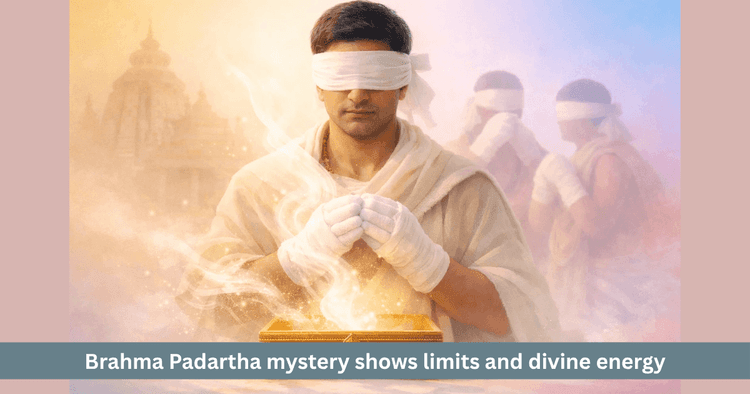
Table of Contents
In Indian temple traditions, there are certain rituals about which the more one hears, the more humble the mind becomes. They are not merely religious actions. They are connected with reverence, sacred discipline, divine awe, silence and the experience of an unseen power. In the tradition of Lord Jagannath, when the Brahma Padartha is transferred from the old idol to the new one, many details associated with that act leave the ordinary mind in wonder. Among the most widely discussed and deeply serious beliefs is that the priests who perform this sacred act have their eyes blindfolded, their hands covered and are not permitted to look directly upon that element themselves.
This episode is not meant merely to create secrecy. It reveals a spiritual discipline in which some realities are considered holier when they are honored without being exposed. In the Jagannath tradition, there is a very deep understanding that not everything sacred is meant to be seen, not every mystery is meant to be explained and not every divine element is made available to the ordinary human gaze. This is why the episode of Brahma Padartha becomes not only a temple ritual but also a great teaching about limit and reverence.
In the oral tradition of the temple priests, it is spoken with great seriousness that the one who directly sees this Brahma Padartha does not survive. This statement should not be dismissed merely as something meant to create fear. In Indian spiritual traditions, such sayings often carry both literal reverence and deep symbolic meaning. therefore to understand this episode properly, one must hold together the levels of faith, symbolism, tradition and experience.
What is Brahma Padartha and why is it considered so mysterious
In the tradition connected with the sacred forms of Lord Jagannath, Balabhadra and Subhadra, the ritual of Nabakalebara holds great importance. According to a specific sacred cycle, when new idols are prepared, an extremely holy element from the old idols is transferred into the new ones. This element is commonly referred to as Brahma Padartha. What exactly it is is not publicly described in detail by the tradition. That itself is one of the main reasons for its gravity and mystery.
It is important to note that Brahma Padartha is not regarded merely as a physical object. It is reverentially understood as something connected with the Lord’s living principle, divine presence, spiritual center or sacred continuity. For this reason, its transfer is never treated like an ordinary ritual procedure. It is one of the most inward, silent and highly restricted acts in the whole life of the temple.
That is why so little is openly spoken about it. At a time when the world wants to uncover, document and explain everything, this tradition teaches that some realities are preserved through protection, not through exposure. From this perspective, the mystery of Brahma Padartha does not arise from lack of knowledge but from a consciously protected sacred boundary.
Why are the priest’s eyes blindfolded
This is the question most often asked and it is natural. If such a holy act is being performed, why is the priest not allowed to see what is being handled. The traditional understanding behind this is very deep. The blindfold is not merely a cloth over the eyes. It is a symbol of a divinely imposed limit upon human sight. Its meaning is that some realities may be served but not claimed through a possessing gaze.
The tradition of blindfolding the eyes indicates
- the divine element stands above ordinary curiosity
- the servant’s duty is to perform the act in surrender, not to inspect it
- where the sacred remains unfathomable, reverence is greater than visual knowledge
- silent service can be holier than direct observation
Thus, the covered eyes symbolize not ignorance but a restrained and humble way of seeing. It is as though the tradition is saying that what is most sacred is not always meant to become an object of sight.
What is the meaning of covered hands or gloves
Along with the blindfold, it is also said that the hands of the priest are specially covered. This too has both an outer and an inner meaning. Outwardly, it suggests that Brahma Padartha is kept separate from ordinary physical contact. Inwardly, it means that human touch itself must remain restrained and sanctified. The touch here is not one of possession or curiosity. It is one of service alone.
In Indian worship traditions, touch carries great significance. How something is touched, with what attitude and under what discipline are all treated as spiritually important. In the case of Brahma Padartha, this sacred caution becomes even more intense. Covered hands seem to declare that what is being done is not personal handling but an act performed entirely within divine instruction and ritual discipline.
| Ritual element | Deeper indication |
|---|---|
| Blindfolded eyes | The limit of sight before divine mystery |
| Covered hands | The sacred boundary of touch |
| Silent atmosphere | Preservation of holy secrecy |
| Restricted priestly access | Worthiness and continuity of tradition |
This table shows that the whole ritual is not based on one isolated rule. It creates an entire sacred atmosphere in which the human being steps back and the divine remains central.
Does the one who sees it truly not survive
This is the statement that creates the greatest wonder. It may be understood at two levels. The first is the level of devotional literal faith. In the devotional tradition, it is received seriously as a warning that an ordinary human gaze cannot bear such a holy reality. The second level is symbolic meaning. Here, the statement that one who sees it does not survive may also mean that the old structure of ego ordinary perception or limited consciousness cannot remain unchanged before such a sacred reality.
In Indian spiritual language, death does not always refer only to bodily death. It can also indicate the death of ego, the breaking of old awareness or the inability of ordinary consciousness to contain overwhelming sacred force. therefore it would be incomplete either to dismiss this saying as superstition or to read it only in crude physical terms. A deeper approach would be to understand that the tradition wishes to express the unfathomable holiness and immense sanctity of the divine element.
Why is this secret not made public
In the present age there is a strong tendency to uncover, display, record and explain everything. But the Jagannath tradition presents a different spiritual culture. Not everything is made public because some realities remain alive precisely when they are protected. The purpose of secrecy here is not confusion but the preservation of a sacred distance.
If every divine process were turned into a spectacle, its inner gravity could gradually be lost. Sometimes tradition keeps something hidden not because it lacks an answer but because the answer is so profound that it must remain within worthiness and reverence. The episode of Brahma Padartha belongs to that category.
The relationship between Nabakalebara and Brahma Padartha
This entire episode is generally understood in relation to Nabakalebara. The word itself means taking on a new body. Here the changing of the idols is not merely a replacement of wood. It is regarded as a profound spiritual act in which the sacred principle is transferred from the old form to the new one. In this way, Brahma Padartha becomes the center of the whole tradition.
Nabakalebara also teaches that the form may change, yet the principle remains. The body may become new but the inward stream of sacred continuity remains unbroken. This same principle is repeatedly found in Indian philosophy. In that sense, Brahma Padartha is not only a temple secret. It also becomes a symbol of the relationship between body and essence, form and truth, mortality and continuity.
What is the psychological meaning of this episode
Seen psychologically, this narrative illuminates one of the great weaknesses of the human mind, which is the restless urge to know everything immediately. Human beings often feel that if there is a mystery, it must be opened. If there is a limit, it must be crossed. If something is hidden, it must be made visible. But this episode teaches that in life there are realities before which humble unknowing is the right attitude.
This is an important psychological lesson. Knowing everything is not maturity. Sometimes maturity means recognizing where one must stop, where one must bow and where silence itself is the truest response. The episode of Brahma Padartha strengthens precisely this sense of boundary.
Does this story teach fear alone or also reverence
This is a very necessary question. If the episode is presented only through fear, half its meaning is lost. There is indeed an element of sacred fear here but it is not the fear of terror. It is the fear born of reverence, the humility before what is supremely holy and the awareness not to cross a sacred limit. In Indian devotion, this kind of feeling often accompanies bhakti.
Reverence is the more essential element here. The priests do not wear blindfolds only because they are afraid. They do so because they know that what they are serving is greater than their personal right to see. In that space, curiosity is less important than ritual humility.
The importance of the oral tradition of the temple priests
This episode is mainly associated with the oral tradition of the temple priests. That means it is not merely a matter of written text but part of the living memory, discipline and transmitted sanctity of those who have served the temple for generations. In Indian culture oral tradition cannot be lightly dismissed. Many times it is precisely oral tradition that protects sacred matters which cannot be fully captured in written form.
The strength of oral tradition lies in the fact that it does not transmit information alone. It also transmits feeling, seriousness and the inner soul of the ritual. That is why the matter of Brahma Padartha is associated more with silence and reverence than with open explanation.
What does this episode teach in today’s world
This narrative is deeply important for modern people. Today there is a vast spread of information but not always an equal spread of reverence. People want to know everything but do not always want to bow before anything. In such a time, this episode teaches the following
- Not every mystery needs to be broken open
- Knowledge without worthiness can become a burden
- Humility is necessary before sacred realities
- Some experiences are truer with closed eyes than with open ones
- Silence can sometimes be more truthful than words
For this reason, the episode becomes not only a Jagannath tradition but also a spiritual lesson for the modern human mind.
The final radiance of this episode
The transfer of Brahma Padartha from the old idol to the new one may be regarded as one of the most sacred and serious mysteries of Indian temple tradition. The priest’s blindfolded eyes, the covered hands, the restricted access and the oral warning that one who sees it does not survive all point in one direction. That direction is humility before divine sanctity.
This story teaches that God is not always encountered by seeing. Sometimes the Divine is most truly received in reverent unseeing. Not every sacred reality exists to satisfy the eyes. Some exist to make the soul bow. Brahma Padartha belongs to that order of mystery. It teaches that where human curiosity reaches its limit, the truest beginning of devotion may in fact begin.
Frequently Asked Questions
What is Brahma Padartha believed to be
It is regarded in the Jagannath tradition as a supremely sacred divine element transferred from the old idol to the new one.
Why are the priest’s eyes blindfolded
So that the divine element is not directly seen and the ritual remains protected in complete reverence and discipline.
What is the meaning of covered hands
They signify the sacred limit of touch, ritual purity and humility in handling the divine element.
Does the one who sees it truly not survive
The oral tradition speaks of this belief with great seriousness and it is understood both literally in reverence and symbolically in spiritual interpretation.
What is the main source of this episode
It is mainly associated with the oral tradition of the temple priests.
Get your accurate Kundali
Generate KundaliDid you like it?
Author

Aparna Patni (63)
Experience: 20
Consults About: Family Planning, Career
Clients In: Punjab, Haryana, Delhi
Share this article with friends and family
About ZODIAQ
ZODIAQ is an online Vedic Astrology platform. It connects clients seeking astrological advice to experienced astrologers with deep knowledge. Our users also generate kundali and perform kundali milan for free. ZODIAQ also offers services to the Astrologers. Astrologers utilize various offerings by ZODIAQ to serve their clients effectively.
If you are a User
Consult with experienced astrologers and seek their guidance. You can also order handwritten Janm Patrika report with life prediction prepared by experienced astrologers. Generate accurate Kundali, perform Kundali Matching and check horoscope and muhurat. Utilize our online library for all the necessary astrological and spiritual information.
If you are an Astrologer
Create accurate kundali for your clients and perform Kundali Matching for up to 5 people at a time. Write comprehensive Janm Patrika report for your clients with ZODIAQ. Check client details anytime by saving it in client directory. Become more productive by tracking how many clients you guide every day.
WELCOME TO
ZODIAQ
Right Decisions at the right time with ZODIAQ
