Chhera Pahara: When the Gajapati King Sweeps and Teaches the Meaning of Humility
By Pt. Nilesh Sharma
This ritual by the Gajapati King during Ratha Yatra conveys a profound message of equality, devotion, and humility
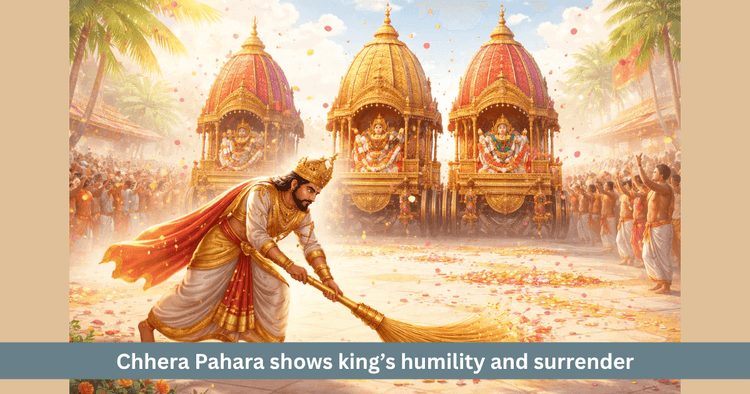
Table of Contents
In Indian spiritual tradition, some rituals appear simple outwardly, yet inwardly they carry deep teachings about dharma, power, devotion, humility and social equality. The ritual of Chhera Pahara, associated with the great Ratha Yatra of Puri, is one such extraordinary example. In this sacred act, the Gajapati King of Puri personally sweeps the area before the chariots of Lord Jagannath, Balabhadra and Subhadra with a golden broom. This is not merely a ceremonial act of cleanliness. It is a living proclamation of the truth that before God, king and pauper stand alike.
The king, who in worldly terms represents the highest authority of the state, takes up the broom before the Lord’s chariot and performs service. In that moment he is not merely cleaning the path. He is laying down before the Divine his power, grandeur, authority and royal identity. This is why Chhera Pahara is not considered only a formal part of the festival. It may rightly be seen as a living philosophy of humility. It reminds every devotee that in the presence of the Lord there is no final superiority of rank. There, the king and the commoner become equal.
In the traditions preserved through Rajavanshavali and Madala Panji, this act is remembered not only as history but as a sacred discipline. To understand Chhera Pahara is therefore to understand the heart of the Puri Ratha Yatra itself.
What is Chhera Pahara and why is it considered so important
During the Ratha Yatra, when the Lord comes out and ascends the great chariots, countless devotees gather for darshan. At this majestic moment, the Gajapati King arrives and with deep humility sweeps before the chariots. The broom used is not ordinary. According to tradition, it is a golden broom, with which the path is sanctified. The sight itself carries a profound contrast. The one who possesses royal power becomes a servant.
That is the very soul of this ritual. Chhera Pahara teaches that
- the highest beauty of power lies in service
- the loftiest form of royal dignity is humility
- before the Lord, outward rank has no final supremacy
- the one who can bow most deeply becomes truly great
For this reason, the ritual is not merely a tradition. It is a living expression of social and spiritual teaching.
Why does the Gajapati King himself perform this service
It is natural to ask why this act is not performed by temple servants, priests or attendants and why the king himself must do it. The answer lies in the spiritual political tradition of Puri. The Gajapati King has never been understood merely as a political ruler. He is also seen as the servant of Lord Jagannath. His kingship is not above the Lord. It exists under the Lord.
therefore when the Gajapati King performs Chhera Pahara, he publicly declares that his kingdom, his authority and his position gain meaning only through the grace of the Lord. He establishes himself as the foremost servant of Jagannath. This reflects a very high form of Indian rajadharma, where the ruler is not seen as the final owner of power but as a responsible representative under divine order.
What is the symbolic meaning of the golden broom
If the purpose were only to clean the path, then an ordinary broom would be enough. Yet here a golden broom is used. Its meaning is far deeper than display of royal wealth. Gold usually symbolizes sovereignty, dignity and prosperity. When that same gold becomes a broom in service before the Lord, the message becomes clear that wealth and power reach their highest value only in service.
The golden broom may be understood at three levels
| Element | Deeper meaning |
|---|---|
| Gold | Royal wealth and worldly grandeur |
| Broom | Service, cleansing and humble action |
| King using it | Offering royal dignity into divine service |
This table makes it clear that Chhera Pahara is not simply an outward act. It is the living embodiment of the idea that even the finest worldly resources should be offered in service to the Divine.
The message of equality within Chhera Pahara
One of the greatest beauties of this ritual is that it communicates a profound truth without any formal sermon. Where society is often divided by class, position, status and power, Chhera Pahara shows in one visible moment that before God every human being ultimately stands in one condition.
The king’s act of sweeping does not mean that kingship has no honor. Rather, it means that before the Lord, true honor is founded not upon rank but upon devotion and humility. That is why the ritual is also socially significant. It helps human beings understand that spirituality is not confined to temple walls. It also appears in the consciousness of human equality.
Is this only a religious rite or also a social teaching
One of the most beautiful aspects of Chhera Pahara is that it forms a bridge between religion and society. On one side it is an essential sacred act in the Jagannath tradition. On the other side it teaches society that no position is so high that it can be placed above service. It confirms the Indian ideal in which leadership means responsibility, not privilege.
In the modern world this lesson becomes even more valuable. Public status often overshadows the spirit of service. Chhera Pahara reminds us that the greater a person is, the more humility that person should cultivate. That is the true test of leadership.
The place of Chhera Pahara within the Ratha Yatra
The Ratha Yatra is not merely a public procession of the Lord. It reveals the mood in which the Lord comes out of the sanctum and moves among the people. God himself goes toward the devotees. In such a moment, the Gajapati King sweeping the path signifies that the highest function of worldly authority is to make the way clear for divine movement.
A profoundly beautiful spiritual image emerges here. The Lord is moving. The devotees are waiting. The king has become a servant. This is the inclusive greatness of Jagannath culture. No single human role dominates the scene. Each stands in place but the center belongs only to the Lord.
How do Rajavanshavali and Madala Panji preserve this tradition
In the tradition of Puri, both Rajavanshavali and Madala Panji are highly significant. They are not merely historical records. They are carriers of living sacred memory. Through them it becomes clear that Chhera Pahara is not a recently added festival act but an accepted and preserved part of the Jagannath tradition over a long span of time.
These traditional sources are important because they show that the relationship between kingship and Jagannath devotion was never merely administrative. It was deeply connected with spiritual responsibility. The Gajapati King’s identity as a servant of the Lord is repeatedly affirmed within this lineage of memory.
The psychological meaning of Chhera Pahara
If this ritual is viewed psychologically, it strikes at one of the central weaknesses of the human mind, which is ego. The one who thinks too highly of oneself finds it hard to bow. The one who defines oneself only through rank may consider service beneath one’s status. But Chhera Pahara teaches that true inner maturity is shown through the ability to bow.
The sight of the king sweeping silently places questions before every observer
- Do I truly honor service
- Am I greater than my position or has my position become greater than my humility
- Can I also bow before a truth higher than myself
In this way, Chhera Pahara moves beyond outer ritual and becomes a cause for self reflection.
Is there only humility in this ritual or also the height of devotion
Yes, there is humility but not humility alone. There is also the height of devotion. For true devotion is present where one can reduce the centrality of oneself and make the Lord the center. That is the deepest spiritual beauty of this act. The Gajapati King is not saying that he is not a king. He is saying that even his kingship becomes an instrument of service before the Lord.
This is the heart of Indian bhakti. Whether one is king, saint, householder, servant or ordinary devotee, the highest identity is formed through surrender at the feet of the Lord. Chhera Pahara gives this surrender a visible and unforgettable form.
What does this tradition teach in the modern age
In today’s world, power, image, influence and status are highly valued. In such a time, the tradition of Chhera Pahara offers an urgently needed reminder. It teaches that
- leadership means service
- humility is not weakness but spiritual height
- before God all are equal
- the truly great are those who know how to bow
If this spirit were to move beyond temple spaces and enter public life, institutions, family life and personal conduct, society would become far more balanced and dignified.
The final radiance of this episode
Chhera Pahara is not merely an attractive moment in the Ratha Yatra. It is one of the most beautiful proclamations of Indian spirituality. The Gajapati King bowing, the golden broom entering service, the path before the Lord being swept and the people witnessing all this together, all deepen one truth that before the Lord there is neither high nor low.
Preserved through Rajavanshavali and Madala Panji, this tradition teaches that the highest honor of a human being does not lie in position but in surrender. Before Lord Jagannath, even the king becomes a servant. That is the great spiritual beauty of this ritual. The broom that clears the path does not remove only dust. It also removes the layers of ego hidden within the human heart. That is the real secret and timeless message of Chhera Pahara.
Frequently Asked Questions
What is Chhera Pahara
It is the sacred tradition during the Ratha Yatra in which the Gajapati King sweeps before the chariots of the Lord with a golden broom.
Who performs this ritual
The Gajapati King of Puri performs this ritual with humility and traditional reverence.
What does the golden broom symbolize
It symbolizes the offering of royal wealth and dignity into the service of the Lord.
What is the central message of this tradition
Before God, king and commoner are equal. True greatness lies in service and humility.
What are the traditional sources associated with this episode
This tradition is associated with Rajavanshavali and Madala Panji.
Get your accurate Kundali
Generate KundaliDid you like it?
Author
Pt. Nilesh Sharma (63)
Experience: 20
Consults About: Family Planning, Career
Clients In: Punjab, Haryana, Delhi
Share this article with friends and family
About ZODIAQ
ZODIAQ is an online Vedic Astrology platform. It connects clients seeking astrological advice to experienced astrologers with deep knowledge. Our users also generate kundali and perform kundali milan for free. ZODIAQ also offers services to the Astrologers. Astrologers utilize various offerings by ZODIAQ to serve their clients effectively.
If you are a User
Consult with experienced astrologers and seek their guidance. You can also order handwritten Janm Patrika report with life prediction prepared by experienced astrologers. Generate accurate Kundali, perform Kundali Matching and check horoscope and muhurat. Utilize our online library for all the necessary astrological and spiritual information.
If you are an Astrologer
Create accurate kundali for your clients and perform Kundali Matching for up to 5 people at a time. Write comprehensive Janm Patrika report for your clients with ZODIAQ. Check client details anytime by saving it in client directory. Become more productive by tracking how many clients you guide every day.
WELCOME TO
ZODIAQ
Right Decisions at the right time with ZODIAQ
