The Anger of Mahalakshmi in Hera Panchami: Love, Dignity and Human Tenderness in Jagannath Tradition
By Pt. Suvrat Sharma
When divine anger reflects love, rightful closeness and the emotional depth of sacred relationships
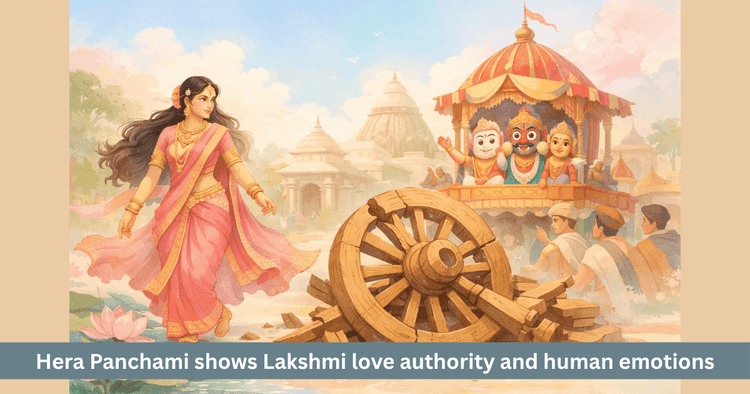
Table of Contents
One of the most remarkable features of the Jagannath tradition is that Bhagavan is not worshipped only as a distant deity but experienced as a living member of a sacred family. This tradition is not limited to grand rituals, towering chariots and public celebration. It is also filled with relationship, affection, longing, dignity, emotional exchange and domestic warmth. For this reason, many episodes in the Jagannath tradition appear at first glance to be simple and even household like, yet inwardly they express deep truths of devotion and philosophy. The episode of Hera Panchami is one such profound sacred moment, in which the anger of Mahalakshmi, the journey of Bhagavan Jagannath with his brother Balabhadra and sister Subhadra and the breaking of the chariot wheel, together become a deeply human and spiritual drama.
According to the traditional account preserved in the Madala Panji, when Bhagavan Jagannath travels to the Gundicha Temple, lovingly understood as the house of his maternal aunt, along with Balabhadra and Subhadra, Maa Lakshmi becomes displeased because he does not take her along. This displeasure is not merely an expression of domestic irritation. It is the sacred manifestation of a relationship that includes affection, rightful closeness, emotional dignity and divine intimacy. On Hera Panchami, the Goddess comes out from her temple, approaches Bhagavan and symbolically damages the wheel of his chariot. This event does not remain a simple gesture of anger. It becomes a visible revelation of the emotional depth of divine relationship.
What Does Hera Panchami Mean
Hera Panchami is not merely a festival. It is that special moment after the beginning of the Ratha Yatra when the absence of Bhagavan gives rise to longing, dignified displeasure and the sacred truth of intimate relationship. Here Lakshmi is not seen merely as the goddess of wealth. She is also the guardian of the household, the embodiment of abundance and the principle of beauty order, prosperity and nearness within the divine order.
The word Hera is often associated with the act of looking, seeking or coming to behold. In that sense, Hera Panchami becomes the day when Lakshmi herself comes to see where Jagannath is, in what condition he is and why he did not take her with him. This question alone gives great depth to the entire lila.
Why Is the Anger of Mahalakshmi So Important
In Indian devotional culture, the anger of the Goddess is never ordinary anger. It is often another form of love. Where there is closeness, there is also expectation. Where there is intimacy, there is also emotional dignity. Maa Lakshmi’s displeasure arises from this nearness. If there were no living relationship, such anger would not arise. Thus this episode actually reveals the living bond between Lakshmi and Jagannath.
Within her anger, many emotions work together:
- Intimacy, because she is deeply affected by the departure of the beloved
- Rightful closeness, because she is not merely a devotee but the divine consort
- Dignified hurt, because she was not included in the journey
- Sacred play, because all of this unfolds to awaken devotion and understanding
That is why the breaking of the chariot wheel is not mere rage. It is a dramatic expression of love.
Why Is Gundicha Temple Called the House of the Maternal Aunt
One of the greatest beauties of the Jagannath tradition is that it brings the Divine into the language of family. The Gundicha Temple is lovingly called the house of the maternal aunt for this very reason. Bhagavan Jagannath is not kept in a distant celestial abstraction. He is experienced as a member of the family, who travels, visits relatives, stays for some days and then returns home.
This human closeness gives the devotee something profound. It allows God to be not merely a subject of darshan but a subject of relationship. Bhagavan is so near that one may speak of home, relatives, departure and return in relation to him. This is one of the sweetest aspects of Jagannath devotion.
What Is the Deeper Meaning of Breaking the Chariot Wheel
The most discussed event of Hera Panchami is the symbolic breaking of the chariot wheel by Maa Lakshmi. Outwardly, it appears dramatic. Inwardly, its meaning is very deep. The chariot is not only a vehicle. It is the symbol of Bhagavan’s movement, journey and sacred decision. When Lakshmi breaks the wheel, the meaning is that no journey is truly complete without the participation of the principle that sustains the home, preserves balance and carries prosperity.
The act of breaking the wheel may be understood through the following meanings:
| Symbol | Deeper Meaning |
|---|---|
| Chariot | The movement and sacred journey of Bhagavan |
| Wheel | The force that carries relationship and destiny forward |
| Breaking the wheel | A dramatic call for attention through dignified displeasure |
| Lakshmi’s intervention | The insistence of prosperity and domestic balance |
This table shows clearly that the episode is not merely theatrical. It teaches that movement must remain joined with balance.
Is This Also a Spiritual Interpretation of Divine Conjugal Relationship
Yes, very deeply. In Indian thought, the relationship between deity and goddess is never only a social image of husband and wife. It also expresses the relationship between power and motion, prosperity and activity, home and journey, stability and expansion. Bhagavan Jagannath departing with brother and sister while Lakshmi remains behind shows that every movement in life must still remain accountable to relational and domestic harmony.
Lakshmi here is not merely the wife of the Lord. She is the representative of that principle which grants auspiciousness, prosperity and sustaining grace to any order. Her displeasure becomes a teaching that movement without the participation of inner balance ultimately comes to a pause.
How Does Hera Panchami Express Loving Distance and Reconciliation
One of the most beautiful features of bhakti is sacred displeasure born of love. Where love is deep, dignified hurt is also natural. Maa Lakshmi’s anger is one expression of that. Yet this displeasure does not create permanent separation. Its purpose is to reawaken remembrance, dialogue and renewed closeness. Hera Panchami turns this emotional truth into a sacred celebration.
In this episode, devotees experience that even in the divine world, relationships are not merely formal. There is longing, absence, hurt and then the movement toward reunion. In this way, the story places the most human emotions upon a sacred plane.
Major emotions present in this lila
- Longing, because Lakshmi is not taken along
- Dignified displeasure, because she feels left out
- Anger, because the intimacy of the bond has been disturbed
- Appeasement, because the relationship is not meant to break
- Preparation for reunion, because this very displeasure makes reunion more meaningful
Why Does the Jagannath Tradition Make Bhagavan So Human
This is a very important question. The heart of the Puri tradition lies in experiencing God not only as majestic and transcendent but as inwardly close. Therefore Bhagavan here bathes, falls ill, rests, goes on journeys and enters into intimate relational episodes with loved ones. This humanity does not diminish God. It brings him nearer to the heart of the devotee.
Hera Panchami shows that divine greatness lies not only in transcendence but also in nearness. When the devotee sees Lakshmi expressing displeasure and Jagannath remaining within that relational framework, it becomes clear that the Lord is not outside life. He is deeply within it.
Is There Also a Teaching Here for Household Life
Certainly. Indian tradition never treated household life as spiritually insignificant. It regarded it as one of the core foundations of dharma. Hera Panchami points toward that same truth. Bhagavan may go on journey, celebrate public festivals and move into wider sacred space, yet the dignity of the household and the presence of Lakshmi remain equally important. therefore one subtle teaching of this episode is that no matter how grand the journey, one must not neglect the relationships that sustain one’s inner life.
This may also be connected to modern life. Outer achievement matters but if the inner home becomes unbalanced, the journey loses completeness.
What Is the Cultural Importance of This Episode
Hera Panchami is not only a religious tale. It is a living cultural memory of Puri. Within the vast public celebration of the Ratha Yatra, it brings to the foreground the voice of feminine dignity, household grace, goddess power and emotional justice. In this way, the Jagannath tradition shows that culture is not only spectacle. It is also made of dialogue, dignified emotion, relationship and inner fairness.
That is why Hera Panchami is not merely an event to witness. It is also a cultural reminder that intimate bonds should never be neglected, however grand the outer journey may be.
What Can the Modern Person Learn From This Lila
Modern life is deeply absorbed in movement, targets, performance, expansion and outward accomplishment. Yet in this rush, people often leave their closest relationships behind. Hera Panchami offers a gentle yet very clear teaching that what is nearest must be honored just as much as what is outwardly grand. The anger of Lakshmi reminds us that neglected intimacy never remains silent. It expresses itself in one form or another.
This episode offers beautiful lessons for the present age:
- Before outer journeys, remember inner relationships
- In love, learn to understand dignity, not merely words
- What gives balance and home must always be honored
- Do not treat relationships as secondary, because they are the deepest form of true wealth
The Final Illumination of This Lila
The episode of Hera Panchami preserved in the Madala Panji is one of the great sacred moments of the Jagannath tradition, where dharma, culture, relationship and philosophy appear together. Bhagavan Jagannath’s journey to Gundicha Temple, Maa Lakshmi’s displeasure and the breaking of the chariot wheel are not merely outward events. They celebrate the truth that journey, knowledge, festival and movement must remain joined with domestic harmony, relational dignity and the intimacy of love.
therefore it may be said that Hera Panchami is not merely a story of Mahalakshmi’s anger. It is the story of love’s rightful claim, which turns distance into dialogue. It is the reminder that even the world of Bhagavan is woven of relationships and where there are relationships, there will also be longing, dignity, appeasement and reunion. That is the most beautiful and living meaning of this sacred episode.
Frequently Asked Questions
What is Hera Panchami
Hera Panchami is the special observance in which Maa Lakshmi expresses her displeasure when Bhagavan Jagannath goes to Gundicha Temple.
Why does Maa Lakshmi break the chariot wheel
It is understood as a symbolic expression of her dignified anger, emotional closeness and relational claim.
Why is Gundicha Temple called the house of the maternal aunt
In the Jagannath tradition, Bhagavan is experienced in a deeply familial and intimate way, so the Gundicha Temple is lovingly called the house of the maternal aunt.
Is this only a folk tale
No, it is a living sacred and cultural lila of the Jagannath tradition, mentioned in the Madala Panji.
What is the main teaching of this episode
It teaches that every journey in life must also honor relationship, balance and emotional intimacy.
Get your accurate Kundali
Generate KundaliDid you like it?
Author
Pt. Suvrat Sharma (63)
Experience: 20
Consults About: Family Planning, Career
Clients In: Punjab, Haryana, Delhi
Share this article with friends and family
About ZODIAQ
ZODIAQ is an online Vedic Astrology platform. It connects clients seeking astrological advice to experienced astrologers with deep knowledge. Our users also generate kundali and perform kundali milan for free. ZODIAQ also offers services to the Astrologers. Astrologers utilize various offerings by ZODIAQ to serve their clients effectively.
If you are a User
Consult with experienced astrologers and seek their guidance. You can also order handwritten Janm Patrika report with life prediction prepared by experienced astrologers. Generate accurate Kundali, perform Kundali Matching and check horoscope and muhurat. Utilize our online library for all the necessary astrological and spiritual information.
If you are an Astrologer
Create accurate kundali for your clients and perform Kundali Matching for up to 5 people at a time. Write comprehensive Janm Patrika report for your clients with ZODIAQ. Check client details anytime by saving it in client directory. Become more productive by tracking how many clients you guide every day.
WELCOME TO
ZODIAQ
Right Decisions at the right time with ZODIAQ
