The Illness of Bhagavan Jagannath: The Deeper Meaning of Anasara
By Pt. Narendra Sharma
The Emotion of divine intimacy during Anasara when Bhagavan rests after Snana Purnima and withdraws from public darshan
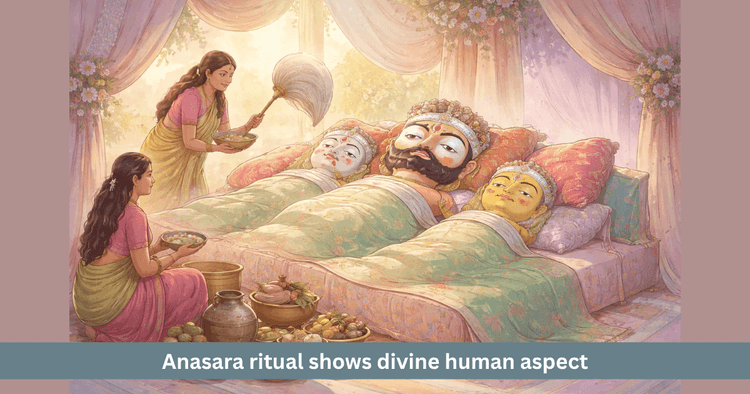
Table of Contents
One of the most remarkable and tender aspects of the Jagannath tradition is that Bhagavan is not experienced merely as a distant deity to be worshipped but as a living presence. He is not confined to the sanctum as an abstract divine form. He is loved as a Lord who bathes, rests, travels, assumes a new body and even falls ill. This is one of the reasons why the Jagannath tradition occupies such a unique place within Indian devotional culture. In this tradition, the distance between God and devotee becomes smaller and Bhagavan appears in a form that invites not only reverence but also affection, service and participation.
It is described in Niladri Mahodaya that before the great Ratha Yatra, on the sacred day of Snana Purnima, Bhagavan Jagannath, Bhagavan Balabhadra, Maa Subhadra and Shri Sudarshana are ceremonially bathed with great solemnity. This bathing is no ordinary act. Water from many sanctified vessels is offered in a grand public ritual and after this sacred bathing it is believed that Bhagavan develops a fever. Thereafter, he remains in seclusion for nearly fifteen days. This period is known as Anasara. During this time Bhagavan does not give public darshan and he is believed to be given a special restorative preparation, including herbal decoction and light nourishing offerings. This is not mere ritual detail. It is part of a devotional world in which Bhagavan is understood as fully alive, responsive and intimately near to the devotee.
What Does Anasara Mean
Anasara is not simply a symbolic description of divine illness. It creates a sacred situation in which Bhagavan comes closer to human experience. Retreating into seclusion after bathing, withdrawing from public darshan, receiving herbal care and taking rest, all reveal a deeply human dimension of the divine. It allows the devotee to feel that the Lord is not only worthy of worship but also capable of being cared for and emotionally felt.
The deeper meaning of Anasara may be understood on three levels:
| Dimension | Meaning |
|---|---|
| Devotional | Bhagavan enters the most intimate range of human feeling |
| Symbolic | Rest and inward renewal after the intensity of ritual bathing |
| Philosophical | The Divine accepts human states within sacred play |
Thus, Anasara is not merely a condition of illness. It becomes a sign of Bhagavan’s nearness, simplicity and living immediacy.
Why Is Snana Purnima So Important
Snana Purnima is one of the most significant observances in the annual cycle of the Jagannath tradition. On this day Bhagavan is brought to the bathing platform and ceremonially bathed in public view with sanctified water. This is not merely an act of purification but also a sacred preparation for the great Ratha Yatra. The fact that Bhagavan is then believed to fall ill makes the entire event even more emotionally rich. It gives rise to the feeling that after such extensive bathing and ritual exposure, the Lord now requires rest.
In this moment devotees are no longer passive observers. They become emotionally involved in the divine condition itself. Snana Purnima becomes especially moving because immediately after this glorious public bathing, Bhagavan enters Anasara and devotees are deprived of his direct darshan for some time. Thus the festival becomes not only a celebration but also a center of union and separation.
Major spiritual meanings of Snana Purnima
- Public revelation of Bhagavan’s greatness through sacred bathing
- Bhagavan’s acceptance of fever after the excessive bathing
- A period of rest and inward preparation before the Ratha Yatra
- The awakening of longing and separation in the hearts of devotees
Why Does Bhagavan Fall Ill
This is a natural question. If Bhagavan is all powerful, how can he fall ill. Within this question lies one of the deepest beauties of the tradition. Indian devotional culture repeatedly shows that the Divine does not come only as transcendent power. God also enters human experience so that the devotee may be touched at the deepest level of the heart. Bhagavan Krishna weeps in childhood, Rama enters exile, Shiva expresses both wrath and compassion and Jagannath falls ill. This does not mean the Lord is helpless. It means he allows himself to be experienced through human conditions so that the devotee may feel greater intimacy.
The divine illness carries several meanings for the devotee:
- God is not only an object of formal reverence but may be felt like a member of the family
- The spirit of service awakens
- Longing and waiting deepen devotion
- The Divine may express itself through deeply human conditions within sacred play
What Does the Period of Seclusion Represent
During Anasara, Bhagavan remains in seclusion and is not available for public darshan. This seclusion is not merely a sign of physical rest. It also suggests an inner withdrawal. Snana Purnima is a moment of public manifestation, while Anasara is the hidden silence that follows that manifestation. Just as intense human experience is often followed by a need to return inwardly, so too this divine rhythm is expressed through seclusion.
Within this seclusion, several meanings are hidden:
- Inner rest after a great public ritual
- Hidden healing after open darshan
- A spiritual discipline of patience and longing for the devotee
- Preparation for Bhagavan’s next great public movement, the Ratha Yatra
That is why Anasara is not mere absence. It is a period of hidden presence.
What Is the Meaning of Giving Herbal Decoction to Bhagavan
One of the most tender features of the Jagannath tradition is that during Anasara Bhagavan is not only allowed to rest but is also offered a special medicinal preparation. The offering of herbal decoction shows that the relationship of the devotee to Bhagavan is not limited to worship alone. It is also a relationship of care and healing. This reflects one of the highest possibilities of bhakti, where God is not only the receiver of ritual but also the center of loving concern.
The decoction here is not merely a medicinal drink. It becomes a symbol of the devotee’s concern, affection and desire for divine well being. When devotees hear that Bhagavan is unwell and is being given herbal care, a tender and deeply personal feeling rises within them. It is this tenderness that gives devotion its sweetness.
Is Anasara Only Symbolic
This is an important question. From the devotional perspective, it is a living and real sacred tradition. Devotees receive it with complete faith as the actual illness bearing of the Lord. From a philosophical perspective, it may also be understood symbolically. These two readings do not oppose one another. Symbolically, the process may suggest that after great external ritual contact there must be rest and renewal. Devotionally, it expresses that Bhagavan himself accepts rest, care and loving treatment from his devotees.
Thus, Anasara may be understood in more than one way:
| Perspective | Meaning |
|---|---|
| Devotional | Bhagavan truly takes on fever and receives healing care |
| Symbolic | A period of inward restoration after public sacred exposure |
| Cultural | A living familial bond between Bhagavan and devotee |
| Philosophical | Human conditions are included within divine play |
Why Does This Pause Come Before Ratha Yatra
This arrangement is especially beautiful. Anasara comes just before the great Ratha Yatra. It is as if Bhagavan first withdraws, rests and recovers and then emerges once again to travel among the people. This sequence is not only ritualistic. It expresses a profound law of life that before great manifestation there must often be inward retreat. Ratha Yatra is the great public festival of movement and Anasara is the inward gathering that precedes it.
This sequence teaches:
- Every great outward revelation is often preceded by a silent inward phase
- Rest is not weakness but part of sacred preparation
- Without inner stillness, outer movement remains incomplete
- Divine play also unfolds in rhythm and order, not in disorder
Why Is This Period So Emotional for Devotees
For devotees, Anasara is not merely a period on the ritual calendar. It is a time of separation. Bhagavan, who had been visible in daily darshan, suddenly withdraws into seclusion. His doors are closed and devotees know only that their Lord is resting and recovering. This deepens devotion in a way that easy availability cannot. Often longing and separation awaken a more profound form of love than constant nearness.
During this period, several emotions arise in the devotee:
- Concern for the health of Bhagavan
- Separation due to the absence of darshan
- Eager anticipation of seeing Bhagavan again during Ratha Yatra
- A deepened sense of intimacy with the Lord
This is why, when Anasara ends and the time of Ratha Yatra arrives, the devotional emotion of the devotees becomes even more intense.
Does This Lila Make Bhagavan More Human
Yes and that is one of its greatest strengths. In the Jagannath tradition, the human dimension of the Divine is exceptionally visible. Bhagavan is not only the Lord of Vaikuntha. He is also the king of Puri, the beloved of the city and almost a member of the devotee’s own household. He eats, rests, bathes, falls ill and then recovers to come out for the great journey. This humanity does not diminish the Lord. It brings him closer to the devotee’s heart.
A profound spiritual message is hidden here. Divinity does not mean only distance, awe and transcendence. It also means that God may become so near that human beings can feel him within the textures of life itself.
What Can This Tradition Teach Today
Modern life is full of exhaustion, public exposure, constant activity and inner depletion. The lila of Anasara offers a remarkable teaching that rest itself is sacred. After intense activity, silence and seclusion are necessary. It also teaches that love is expressed not only in celebration but in care during illness. The act of offering herbal decoction to Bhagavan shows that spirituality is not limited to chanting or ritual alone. It also includes caregiving.
For the present day, this tradition teaches us:
- Rest should not be seen as weakness
- Solitude may become a time of inner renewal
- True love expresses itself through service
- God may be experienced not only in majesty but also in tenderness
The Final Illumination
The tradition of Anasara is one of the most beautiful dimensions of Jagannath devotion, where the relationship between Bhagavan and devotee opens in a deeply intimate way. The teaching described in Niladri Mahodaya, that after Snana Purnima Bhagavan Jagannath takes on fever, remains in seclusion for fifteen days and is offered herbal decoction, is not merely a ritual narrative. It is a living dimension of bhakti in which the bond between God and devotee becomes profoundly human, tender and personal.
therefore it may be said that the lila of Anasara teaches that divine nearness is not felt only through miracles but also through illness, rest, service, separation and reunion. That is the most beautiful and moving truth of this sacred tradition.
Frequently Asked Questions
What is Anasara
Anasara is the period after Snana Purnima when Bhagavan Jagannath is believed to take on fever and remain in seclusion.
How long does Bhagavan remain in Anasara
Traditionally, this period is understood to last for about fifteen days.
Why does Bhagavan fall ill after Snana Purnima
The tradition holds that after the grand ceremonial bathing, Bhagavan takes on fever, expressing his living and intimate nature.
What is offered to Bhagavan during Anasara
During this period, Bhagavan is offered herbal decoction and light restorative preparations.
What is the deeper meaning of this tradition
It reveals the divine relationship of service, tenderness, rest and loving separation between Bhagavan and the devotee.
Get your accurate Kundali
Generate KundaliDid you like it?
Author

Pt. Narendra Sharma (63)
Experience: 20
Consults About: Family Planning, Career
Clients In: Punjab, Haryana, Delhi
Share this article with friends and family
About ZODIAQ
ZODIAQ is an online Vedic Astrology platform. It connects clients seeking astrological advice to experienced astrologers with deep knowledge. Our users also generate kundali and perform kundali milan for free. ZODIAQ also offers services to the Astrologers. Astrologers utilize various offerings by ZODIAQ to serve their clients effectively.
If you are a User
Consult with experienced astrologers and seek their guidance. You can also order handwritten Janm Patrika report with life prediction prepared by experienced astrologers. Generate accurate Kundali, perform Kundali Matching and check horoscope and muhurat. Utilize our online library for all the necessary astrological and spiritual information.
If you are an Astrologer
Create accurate kundali for your clients and perform Kundali Matching for up to 5 people at a time. Write comprehensive Janm Patrika report for your clients with ZODIAQ. Check client details anytime by saving it in client directory. Become more productive by tracking how many clients you guide every day.
WELCOME TO
ZODIAQ
Right Decisions at the right time with ZODIAQ
