Jagannath Ashtakam and the Vision of Daru Brahma: When Adi Shankaracharya Saw Brahman in Wood
By Pt. Sanjeev Sharma
How Jagannath Ashtakam reveals the divine form as Daru Brahma and expresses the vision of non-dual reality
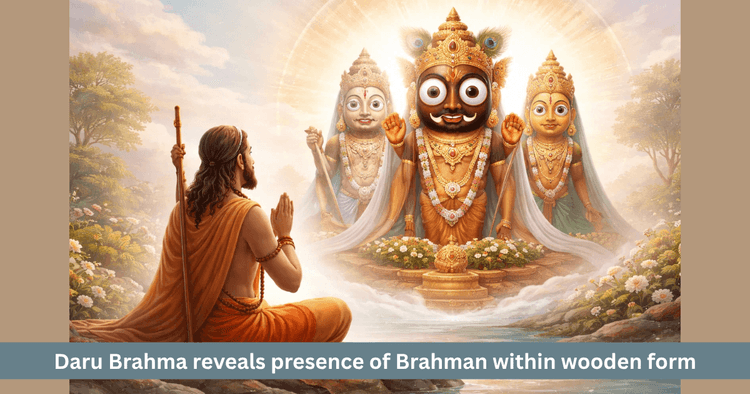
Table of Contents
In the Indian spiritual tradition, certain hymns are not merely acts of praise. They become living gateways into philosophical experience. They appear outwardly as devotion, yet inwardly they open a profound field of realization. Jagannath Ashtakam is one such extraordinary composition. It does not merely glorify Bhagavan Jagannath. It reveals the deeper truth of a divine form in which God does not remain confined to a conventional, royal or classically sculpted image. He may appear in wood, he may descend into the vision of the devotee and he may reveal himself in that very place where the ordinary eye sees only form, while the awakened heart perceives Brahman.
The arrival of Adi Shankaracharya in Puri is regarded as a deeply meaningful moment in Indian spiritual history. He was not only a philosopher. He was also a pilgrim, a worshipper and an acharya who saw a profound non dual truth shining through the many divine traditions of India. Tradition holds that when he beheld Bhagavan Jagannath in Puri, the composition of Jagannath Ashtakam arose from within him. In this hymn, he does not see Bhagavan merely as the deity of a sacred temple. He experiences him as a living supreme reality that transforms the devotee’s vision, feeling and understanding all at once. It is within this sacred field of realization that Bhagavan Jagannath is called Daru Brahma, meaning Brahman manifest in wood.
Why Is Jagannath Ashtakam So Important
Jagannath Ashtakam is not merely a hymn of eight verses. It is the record of a profound meeting between Advaita Vedanta, devotion, pilgrimage experience and the living presence of a beloved divine form. People often remember Adi Shankaracharya only as the great teacher of non dual philosophy. Yet his hymns make it clear that there was within him not only the subtlety of philosophical inquiry but also the sweetness of devotion.
The significance of Jagannath Ashtakam is especially great because Shankaracharya is not speaking here in the dry language of abstraction. He stands before a visible, living, compassionate Lord. He experiences the temple of Puri, the Lord’s public journey, the sweetness of his darshan and the uniqueness of his form. For this reason, the hymn removes any artificial distance between philosophical vision and devotional love.
Key points that reveal the uniqueness of Jagannath Ashtakam
- It is a remarkable union of philosophical vision and devotion
- Bhagavan Jagannath is experienced not merely as an image but as realized Brahman
- Adi Shankaracharya appears here not only as an acharya but also as a devotee
- The composition links the Jagannath tradition with the wider spiritual consciousness of India
What Does Daru Brahma Mean
One of the deepest expressions in the Jagannath tradition is Daru Brahma. Daru means wood and Brahma or Brahman means the supreme reality that is infinite, all pervading and fundamental. When these two words are brought together, a subtle spiritual vision opens. It suggests that Brahman may be present not only in the formless but also in visible matter. More than that, it suggests that even a material as ordinary as wood may become the bearer of the highest divine presence.
This idea is spiritually profound. The ordinary mind will see only wood. The awakened mind will perceive the Divine in that same material. This is the true beauty of Daru Brahma. It is not merely a defense of image worship. It is the revelation of a larger Indian insight that God is not separate from existence. When perception becomes pure, the very substance of the world may reveal itself as an expression of Brahman.
Is the Idea of Daru Brahma Connected With Advaita
Yes, very deeply. Advaita Vedanta teaches that Brahman alone is the ultimate reality and that everything rests in that same truth. If this is so, then the Divine cannot remain limited only to an abstract formlessness. God may also appear in form, in name, in mantra and in wood. The concept of Jagannath as Daru Brahma is a devotional manifestation of that non dual truth.
A very important philosophical point must be understood here. Advaita does not say that form is false and only the formless is real. It says that the basis of form is also the same supreme reality. When Shankaracharya accepts Jagannath as Daru Brahma, he shows that one who has known Brahman does not fear form. He is able to perceive that very truth in form as well.
Why Is Adi Shankaracharya’s Relationship With Puri So Important
Adi Shankaracharya established sacred centers in the four directions of India. Puri is counted among the great places where his presence gave not only philosophical strength but also broader recognition to a living devotional tradition. During his pilgrimage to Puri, his response to Bhagavan Jagannath was not merely respectful. It was also filled with wonder, reverence and spiritual recognition.
When a teacher of Advaita stands before Jagannath and composes a hymn, the meaning becomes very great. It shows that Jagannath is not merely a local or regional deity. He is fully worthy of Vedantic recognition. He belongs not only to one devotional stream but to the spiritual consciousness of India as a whole. That is why Jagannath Ashtakam is not just a hymn. It is also a cultural and philosophical bridge.
What Is There in the Form of Jagannath That May Have Moved Shankaracharya
The form of Bhagavan Jagannath differs from many conventional sacred images. The large eyes, the incomplete looking arms, the unusual body, the wooden form and the strongly living folk devotional character, all make this form unlike classical sculptural ideals. Yet this very difference is what makes the form so powerful. Here God is not confined to formal beauty according to strict visual rules. He appears directly as presence, feeling and sacred experience.
It is possible that this is precisely what moved Shankaracharya so deeply. In this form he may have perceived a striking expression of Brahman beyond conceptual limitation. Where outer perfection appears reduced, inner essence often shines more clearly. The form of Jagannath seems to declare that to recognize the Divine, one needs not merely eyesight but spiritual vision.
Some deeper features of the Jagannath form
| Element | Spiritual Indication |
|---|---|
| Wooden body | The imperishable present in the perishable |
| Large eyes | All seeing compassion and awakened presence |
| Unconventional form | Divinity beyond formal limitation |
| Daru Brahma principle | The formless dwelling within form |
Is Jagannath Ashtakam Only Praise or Also a Spiritual Practice
This is a very important question. In the Indian hymn tradition, many compositions are not merely recited but inwardly lived. Jagannath Ashtakam belongs to that category. When a devotee recites it, one is not merely repeating the words of Shankaracharya. One is entering into his experience. In this way the hymn becomes a practice of sacred seeing.
The recitation or contemplation of this Ashtakam may awaken several transformations within the devotee:
- A deeper emotional bond with Bhagavan Jagannath
- The ability to feel the murti not merely as an image but as a living presence
- Recognition of divinity even within material form
- The softening of artificial separation between philosophical knowledge and devotional love
That is why this hymn is not merely literature. It is a path of devotion united with non dual understanding.
What Does the Idea of Daru Brahma Teach the Modern Mind
The modern person often either reduces spirituality to abstraction or confines it only to outward ritual form. The idea of Daru Brahma offers a beautiful balance between these two tendencies. It says do not dismiss matter as insignificant and do not mistake form for the whole truth. Learn to perceive the deeper principle within form. That is spiritual vision.
For present life, this concept is meaningful in many ways:
- It teaches that the extraordinary may dwell within the ordinary
- It shows that the Divine may appear not only in transcendence but also in substance
- It purifies perception by reminding us that the world is not merely an object of use but may also be an expression of Brahman
- It encourages a new relationship between inner awareness and outer reality
Does Jagannath Ashtakam Offer a Beautiful Balance Between Devotion and Advaita
Yes, this is one of its greatest strengths. On one side, Shankaracharya stands in loving surrender before Bhagavan. On the other side, he recognizes the supreme truth present in Jagannath. Thus the hymn contains neither dry philosophy alone nor emotional devotion alone. It holds feeling, insight, humility and metaphysical recognition together.
This balance gives a great teaching to all seekers. Spiritual life need not be divided into opposing camps. Knowledge without devotion can become dry and devotion without deeper understanding may remain limited. Jagannath Ashtakam turns both into a divine meeting.
What Is the Cultural Importance of This Hymn for Puri and the Jagannath Tradition
Jagannath Ashtakam gave the tradition of Puri a profound philosophical articulation. When a revered acharya like Shankaracharya honored Bhagavan Jagannath in such a hymn, it established that this was not only a local devotional form but a treasure of the wider Indian spiritual world. In this way, Jagannath Ashtakam became a cultural bridge.
Its cultural importance may be understood in the following way:
- It helped establish Puri as a shared center of Vedanta and devotion
- It gave philosophical dignity and wider recognition to the form of Jagannath
- It united folk devotion and classical spiritual thought
- It assured the devotee that beloved Jagannath is not only the center of emotion but also a manifestation of Brahman
What Is the Deepest Message of This Episode
Jagannath Ashtakam and the principle of Daru Brahma teach that outer standards alone are never enough to recognize God. Sometimes the form that appears simple carries the greatest depth. Sometimes the material that appears ordinary becomes the seat of the highest reality. And sometimes the hymn that seems to be only praise reveals itself as living non dual realization.
This episode also teaches that when vision becomes purified, wood becomes Brahman, pilgrimage becomes practice and praise becomes realization. This is perhaps the greatest gift Shankaracharya offers through his devotion to Jagannath.
Final Reflection
The Jagannath Ashtakam attributed to Adi Shankaracharya is one of those extraordinary compositions in Indian spiritual literature where experience, philosophy and devotion blossom together. To call Bhagavan Jagannath Daru Brahma is not merely a poetic expression. It is the declaration of a profound realization in which God becomes fully present as Brahman even in a wooden form. Here matter and the Absolute, murti and Brahman, devotion and knowledge, all meet in one sacred point.
therefore it may be said that Jagannath Ashtakam is not only a hymn. It is a transformation of perception. It teaches the devotee that where the ordinary mind sees wood, the awakened heart sees Bhagavan. That is the deepest and most beautiful truth of this sacred composition.
Frequently Asked Questions
Who composed Jagannath Ashtakam
Tradition holds that it was composed by Adi Shankaracharya during his pilgrimage to Puri.
What does Daru Brahma mean
Daru Brahma means Brahman manifest in wood or the experience of divine presence in what appears to be ordinary material.
Is this concept connected to Advaita
Yes, it is deeply connected with the non dual vision that Brahman is present everywhere.
Why is Jagannath Ashtakam important
It is a remarkable union of devotion, philosophy and the spiritual interpretation of the Jagannath form.
What does this hymn teach
It teaches that divinity may be experienced not only in the formless but also in visible and seemingly ordinary forms.
Get your accurate Kundali
Generate KundaliDid you like it?
Author

Pt. Sanjeev Sharma (63)
Experience: 20
Consults About: Family Planning, Career
Clients In: Punjab, Haryana, Delhi
Share this article with friends and family
About ZODIAQ
ZODIAQ is an online Vedic Astrology platform. It connects clients seeking astrological advice to experienced astrologers with deep knowledge. Our users also generate kundali and perform kundali milan for free. ZODIAQ also offers services to the Astrologers. Astrologers utilize various offerings by ZODIAQ to serve their clients effectively.
If you are a User
Consult with experienced astrologers and seek their guidance. You can also order handwritten Janm Patrika report with life prediction prepared by experienced astrologers. Generate accurate Kundali, perform Kundali Matching and check horoscope and muhurat. Utilize our online library for all the necessary astrological and spiritual information.
If you are an Astrologer
Create accurate kundali for your clients and perform Kundali Matching for up to 5 people at a time. Write comprehensive Janm Patrika report for your clients with ZODIAQ. Check client details anytime by saving it in client directory. Become more productive by tracking how many clients you guide every day.
WELCOME TO
ZODIAQ
Right Decisions at the right time with ZODIAQ
