Jagannath and Chaitanya Mahaprabhu: Merging into the Lord Through Kirtan
By Pt. Narendra Sharma
How Chaitanya Mahaprabhu’s life became a symbol of devotion, love and complete union with Lord Jagannath
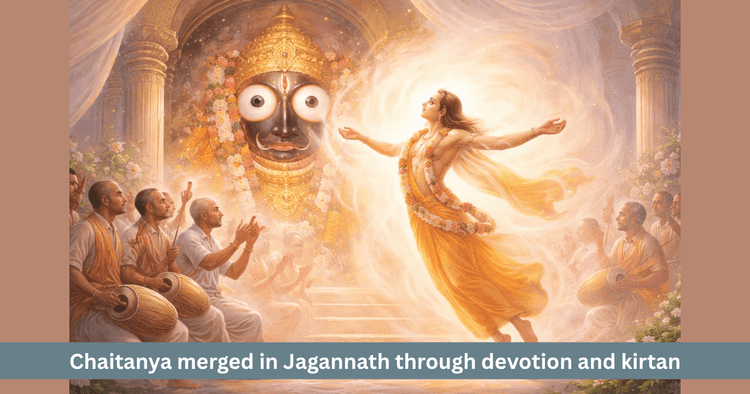
Table of Contents
In the sacred traditions of Puri, some episodes cannot be separated and placed merely under the labels of history, legend or devotional memory. They belong to such a deep current of bhakti that their meaning grows even wider with time. The bond between Chaitanya Mahaprabhu and Lord Jagannath is one such incomparable spiritual relationship. It was not merely a connection between a saint and his chosen deity. It became a living expression of love, longing, darshan, kirtan and complete self surrender. From this relationship arises the profound belief that Chaitanya Mahaprabhu did not die in the ordinary sense but while immersed in kirtan, he merged into the very image of Lord Jagannath.
When heard for the first time, this statement sounds extraordinary. Yet within the bhakti tradition, it is not received only as a miraculous claim. A deeper thought becomes important here. Why should the end of a saint who had already dissolved inwardly into the Lord remain ordinary in outer form. The whole life of Chaitanya Mahaprabhu flowed in one direction alone. His heart, his chanting, his dancing, his tears, his longing and his ecstasy were all centered in Lord Krishna and in Jagannath of Puri. therefore when the tradition says that he merged into the deity, it feels less like an isolated tale and more like the final spiritual completion of his life.
The traditions associated with Chaitanya Charitamrita receive this episode with great devotional seriousness. Here there is no dry historical note. There is a living memory of bhakti in which the end of the saint is not considered separate from the Lord he adored. That is the deepest strength of this narrative.
Why was the bond between Chaitanya Mahaprabhu and Jagannath so deep
Without understanding Chaitanya Mahaprabhu, the depth of this episode cannot be understood. He was not merely a philosopher, monk or social reformer. He was a form of premabhakti, divine love, in which the holy name of God became the very pulse of life. For him, the Lord was not only a deity to be worshipped. He was the Beloved, the Master, the center of existence and the sole foundation of the heart.
After coming to Puri, this inner state became even more intense. In the darshan of Shri Jagannath, Chaitanya Mahaprabhu did not merely behold an idol. He directly experienced his Krishna there. For this reason, the Jagannath temple became for him not only a place of worship but a field of divine absorption. At times he would become motionless in darshan. At times he would weep during kirtan. At times he would lose outer awareness in ecstatic dance. At times he would burn in longing. His devotion held both union and separation, darshan and intense yearning, together.
This depth forms the true background of the episode. When a saint cannot imagine life apart from the Lord, the tradition that he finally merged into the deity no longer appears like a simple folk invention. It begins to feel like the natural expression of his whole spiritual journey.
Is this only a story or also a symbol of devotion
The answer to this question is both simple and subtle. In bhakti tradition, such narratives are not preserved only for historical verification. They are also told in order to express spiritual truth. That truth does not necessarily oppose history but it often extends beyond historical detail. When it is said that Chaitanya Mahaprabhu merged into the image of Jagannath, one level of meaning is devotional faith and another is symbolic bhakti.
This belief suggests the following
- The distance between devotee and Lord came to an end
- Kirtan remained no longer merely a practice but became the path of total union
- In the highest state of devotion, the individual self loses separate identity
- Chaitanya’s life ended in the very center where it had always dwelt inwardly
Thus this episode becomes less a narrative of death and more a narrative of spiritual absorption.
What does it mean to merge while performing kirtan
The greatest foundation of Chaitanya Mahaprabhu’s devotion was nama sankirtan, the chanting of the divine name. For him, kirtan was not a musical performance. It was a living path to the Lord. Within it, bodily boundaries loosened, mental identity dissolved and the soul flowed wholly into the name. When it is said that a saint merged into the Lord while singing kirtan, it means that the final moment did not remain within ordinary worldly consciousness but within the highest state of divine remembrance.
Here kirtan may be understood in three dimensions
| Level of kirtan | Deeper meaning |
|---|---|
| Voice | Chanting of the divine name |
| Body | Dance and outward expression of devotion |
| Soul | Dissolution of ego and surrender into the Beloved |
The life of Chaitanya Mahaprabhu was kirtan on all these three levels. therefore his merging into the deity is understood as the highest culmination of that state in which name, form and divine love become one.
What is the philosophical meaning of merging into the image
In Indian devotional literature, the deity image is not considered mere stone or wood. Once consecrated, it is regarded as a living center of divine presence. From this perspective, if a saint merges into the deity, it does not mean entry into an inert object. It means union with a living center of divine consciousness.
Philosophically, this episode teaches several things
- In the highest state of devotion, the devotee loses separate identity
- The divine form is not only for seeing but also for dissolving into
- The life and the end of a saint may both become inseparable from the chosen deity
- The deity image in bhakti can become a doorway of direct experience, not only symbolism
For this reason, reducing this narrative to a sentimental legend would not do justice to devotional philosophy. It holds a very deep spiritual vision.
The viraha of Chaitanya Mahaprabhu and this final tradition
The devotion of Chaitanya Mahaprabhu was not only ecstatic joy. It was also marked by intense viraha bhava, the feeling of divine separation. He did not merely praise the Lord. He also broke open in longing for him. Many traditions see him as one who experienced Krishna through the inward mood of Radha. Because of this, his whole life seems to move between union and separation.
Seen in that light, the belief that he finally merged into the image of Jagannath becomes the last answer to his longing. The one who lived in separation was finally absorbed in union. This idea carries immense consolation within bhakti. It assures the devotee that true love is never wasted. The one who calls throughout life does at last arrive in the Beloved.
Does this episode value devotional feeling more than outer history
Yes and this is very important to understand. Bhakti tradition does not always try to bind every sacred event within the hard language of external history alone. Often emotional truth or bhava satya, becomes more important. This does not mean the event is false. It means that its inner significance may be greater than its outward detail.
In this episode, the devotional truth is that
- Chaitanya Mahaprabhu’s life was centered in Jagannath
- His spiritual practice was wholly immersed in nama sankirtan
- His heart never stood apart from the Lord
- His final remembrance was preserved in the form of complete union
Thus the story does not only say what happened. It also says how far devotion can go.
How does the tradition of Chaitanya Charitamrita keep this memory alive
The devotional memory associated with Chaitanya Charitamrita does not preserve Chaitanya Mahaprabhu only as a historical figure. It presents him as a living current of divine love. In that tradition, his kirtan, tears, Radha bhava, love for Jagannath and spiritual ecstasy are not merely episodes. They are among the highest points of devotional life. therefore when this tradition says that he merged into the deity, it does not read like the final chapter of a biography. It feels like the last blossom of his bhakti.
The importance of the source lies in the way it preserves this not as a cold statement but as a living devotional remembrance. That is why one does not merely think while hearing this tradition. One also feels inwardly moved.
What does this episode teach a spiritual seeker
This sacred tradition of Chaitanya Mahaprabhu and Jagannath gives the seeker a very deep teaching. It does not merely glorify a saint. It also points toward the goal of spiritual practice.
Main teachings of this episode
- Nama sankirtan can become not only a ritual but a path of self dissolution
- In the highest form of devotion, the distance between devotee and Lord diminishes
- True love ultimately moves toward union
- The one who lives in God throughout life is remembered as entering God at the end
Because of these teachings, this episode remains not just a story but a mirror for spiritual life even today.
What significance does this hold for modern people
Modern human life is full of fragmentation. Relationships break, attention scatters and the heart often lives without a center. In such a world, the episode of Chaitanya Mahaprabhu teaches that if the heart becomes truly connected to a divine center, the whole direction of life can change. Bhakti here does not become escape. It becomes the center of existence itself.
This tradition invites the modern seeker to reflect whether there is any such center in life where mind, speech and soul can be offered together. Chaitanya’s answer is clear. That center can only be divine love.
The final radiance of this episode
The relationship between Jagannath and Chaitanya Mahaprabhu is one of the most tender, most intense and most profound relationships in the whole bhakti tradition of India. It is not merely a relationship of darshan. It is a relationship of total inward surrender. therefore the belief that Chaitanya Mahaprabhu did not die in the ordinary way but while singing kirtan merged into the image of Jagannath, is not merely an extraordinary tale. It is the final expression of a love in which no distance remains between devotee and Lord.
The sacred memory preserved through Chaitanya Charitamrita teaches that the final meaning of devotion is not outer accomplishment but divine absorption. The one who calls upon the Beloved through a whole lifetime ultimately finds rest in that very presence. This is the most beautiful meaning of the episode and the immortal identity of Chaitanya Mahaprabhu’s devotion.
Frequently Asked Questions
Why is the relationship between Chaitanya Mahaprabhu and Jagannath considered so special
Because Chaitanya Mahaprabhu’s heart is understood as being completely immersed in Jagannath love and Krishna devotion.
What does the belief of merging into the deity mean
It is regarded as a symbol of final union, self dissolution and complete surrender between the devotee and the Lord.
Is this episode only a devotional legend
In the bhakti tradition it is received with deep reverence and devotional truth, not merely as an ordinary tale.
What is considered the main source of this tradition
The principal source associated with this belief is the devotional tradition of Chaitanya Charitamrita.
What can a seeker learn from this narrative
A seeker may learn that through the divine name, kirtan and complete surrender, devotion can bring one profoundly close to the Beloved.
Get your accurate Kundali
Generate KundaliDid you like it?
Author
Pt. Narendra Sharma (63)
Experience: 20
Consults About: Family Planning, Career
Clients In: Punjab, Haryana, Delhi
Share this article with friends and family
About ZODIAQ
ZODIAQ is an online Vedic Astrology platform. It connects clients seeking astrological advice to experienced astrologers with deep knowledge. Our users also generate kundali and perform kundali milan for free. ZODIAQ also offers services to the Astrologers. Astrologers utilize various offerings by ZODIAQ to serve their clients effectively.
If you are a User
Consult with experienced astrologers and seek their guidance. You can also order handwritten Janm Patrika report with life prediction prepared by experienced astrologers. Generate accurate Kundali, perform Kundali Matching and check horoscope and muhurat. Utilize our online library for all the necessary astrological and spiritual information.
If you are an Astrologer
Create accurate kundali for your clients and perform Kundali Matching for up to 5 people at a time. Write comprehensive Janm Patrika report for your clients with ZODIAQ. Check client details anytime by saving it in client directory. Become more productive by tracking how many clients you guide every day.
WELCOME TO
ZODIAQ
Right Decisions at the right time with ZODIAQ
