The Construction of Jagannath Chariots: Astrology, Craft and Sacred Discipline
By Pt. Amitabh Sharma
How astrology, sacred craft and ritual discipline come together in the divine tradition of chariot construction
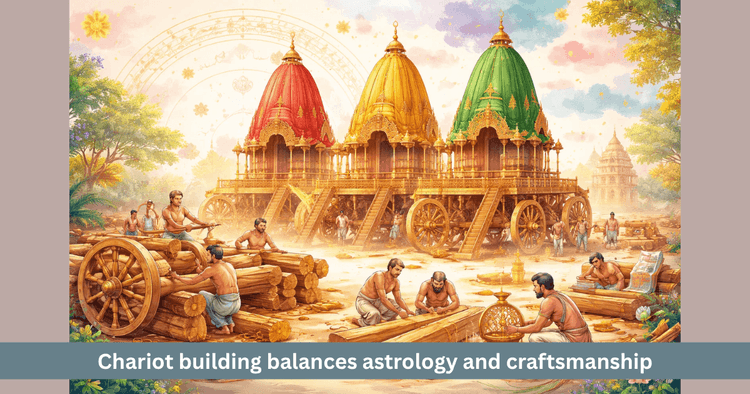
Table of Contents
Anyone who witnesses the Ratha Yatra of Puri is first overwhelmed by its grandeur. The massive chariots, towering canopies, ropes pulled by hundreds of hands and the majestic movement of Bhagavan through the city create an atmosphere that feels like more than a festival. It feels like a living spiritual experience. Yet behind this magnificent public event stands a deeply disciplined and subtle tradition. The chariots of Bhagavan Jagannath, Bhagavan Balabhadra and Maa Subhadra are not merely large wooden structures. Their construction belongs to a sacred system in which astrological calculation, traditional craft science, ritual purity and sacred material selection all come together.
In traditions associated with Shilpa Shastra, it is understood that the number of wheels on each chariot, the height of the structure, the arrangement of its parts and the selection of wood are not determined by convenience or availability alone. They are governed by inherited religious principles, symbolic order and auspicious calculation. That is why the making of the chariots is not viewed as a merely technical task. It may be understood as a form of ritual craftsmanship. The artisans involved are not just builders. They become participants in a sacred service where every piece of wood, every joint, every measurement and every direction carries special meaning.
Why Is Chariot Construction Considered So Sacred
In the Jagannath tradition, the chariot is not an ordinary vehicle. It is the sacred medium through which Bhagavan comes out of the temple and moves among the people. For this reason, the making of the chariot is not simply a matter of building a structure. It is understood as the making of Bhagavan’s vehicle of divine movement. Just as the creation of a murti follows sacred rules, so too the making of the chariot is bound by traditional discipline.
The sacredness of the chariot may be understood in the following ways:
- It supports the moving presence of Bhagavan
- It transforms the stillness of the temple into sacred journey and public contact
- Its construction is meant not merely for function but for service and offering
- A new chariot is built each year, revealing a tradition of continuous renewal
For this reason every stage of chariot construction is treated with deep seriousness.
Why Is the Number of Wheels Understood in an Astrological Way
The three chariots of the Ratha Yatra do not all have the same number of wheels. The chariots of Jagannath, Balabhadra and Subhadra differ in structure and their wheels are also traditionally assigned differently. This difference is not only for visual distinction. Tradition holds that each chariot is built according to the divine nature, symbolic energy and sacred direction associated with the deity it carries. Therefore the number of wheels is also treated as meaningful.
The astrological and symbolic thinking behind this may be understood in several ways:
1. The symbolism of number
In Indian tradition, numbers are not only used for counting. They are also connected to power order and meaning.
2. Balance of direction and movement
The chariot is not merely an object that moves forward. It is a center of balance, direction and collective force. The number of wheels relates to this inner order.
3. Difference of divine form
Jagannath, Balabhadra and Subhadra represent distinct sacred energies. Therefore the design of their chariots also differs.
Here astrology is not limited to planetary charts alone. It includes the larger science of number, direction, rhythm and auspicious arrangement.
Why Is the Selection of Wood So Special
The wood used in the construction of the chariots is not chosen casually. Traditionally, it is held that the wood for the chariots must possess not only strength but also ritual suitability and sacred appropriateness. Therefore the selection of wood itself becomes part of a religious process. Which kind of wood will be used for which section, which part will bear greater weight and how each section will be balanced, all of this follows inherited knowledge.
The choice of wood is guided by several important elements:
| Element | Deeper Meaning |
|---|---|
| Type of tree | Each wood carries a distinct quality and use |
| Scriptural suitability | Certain woods are regarded as more fitting for specific parts |
| Ritual purity | The material must be not only useful but also worthy of sacred service |
| Load and balance | The structure must remain stable during movement |
This makes it clear that wood selection is not merely a technical decision. It is the result of scriptural discernment and devotional purpose together.
Is Chariot Construction Only a Matter of Engineering
If one were to describe this process only as engineering, one would understand only a part of it. There is certainly extraordinary technical intelligence involved. These giant chariots must carry enormous weight, remain balanced in motion, support ropes and public pulling and withstand the strains of movement. This itself reflects a highly developed tradition of structural craftsmanship. Yet at the same time, it is also a form of sacred applied knowledge, because each stage of the process is shaped by ritual consciousness.
It is therefore best understood on three levels:
- Craft, because it involves high construction skill
- Astrological order, because number, timing and arrangement are treated as sacred
- Devotion, because the final purpose is service to Bhagavan
It is this threefold union that makes the chariot tradition so unique.
Why Is Not a Single Iron Nail Used
This is one of the most astonishing aspects of the Jagannath chariot tradition. In modern construction, iron is seen as a symbol of strength. Yet in the traditional making of the chariots, iron nails are not used. This is not merely a matter of preserving antiquity. It is part of a deeper craft logic. The various wooden parts of the chariot are joined through traditional techniques in such a way that they support, fit and hold the structure together without reliance upon iron nails.
Several deeper meanings may be seen behind this feature:
1. Self sufficiency of traditional craftsmanship
It demonstrates that ancient Indian artisans possessed the skill to create vast mobile structures without metal fasteners.
2. Respect for the living nature of wood
Wood expands and contracts subtly according to heat, humidity and weight. Traditional joints often work in greater harmony with this natural quality.
3. Ritual purity of material use
Certain devotional traditions preserve the preference for natural and inherited methods in sacred construction.
4. Temporary yet dignified sacred structure
The chariots are not meant as permanent monuments. They are sacred annual constructions renewed again and again.
Thus the absence of iron is not a sign of weakness. It is regarded as evidence of refined traditional mastery.
How Deep Is the Role of Shilpa Shastra
Shilpa Shastra in the Indian tradition is not merely a handbook of building. It contains deeper principles of proportion, direction, material, sacred symbolism and ritual suitability. In the making of the Jagannath chariots, its influence is regarded as central. Every part of the chariot is not only useful but meaningful. Height, width, wheels, canopy, flag, cloth decoration and structural detail all carry both ritual and symbolic value.
This teaches us that in the Indian sacred world, beauty, utility and spiritual significance were never separate domains. They were integrated expressions of one larger vision.
Does the Fact That the Chariots Are Newly Built Every Year Also Carry Meaning
Yes, very much so. The yearly rebuilding of the chariots reflects the principle of continual sacred renewal. Bhagavan remains the same but the vehicle is made new. This creates the feeling that while the divine remains constant, the form of service must continually be renewed. This is connected in spirit to broader traditions of renewal in the Jagannath world, where transformation is seen not as loss but as a sign of living continuity.
The yearly rebuilding teaches devotees that:
- Each year calls for new service
- Tradition remains alive only when it is recreated with devotion
- Bhagavan’s movement is not static but dynamic
- What is sacred must be rebuilt again and again through fresh dedication
What Is the Cultural Importance of This Tradition
The making of the chariots is not only a religious act. It is a living center of community and sacred culture. Artisans, temple servitors, ritual specialists, hereditary practitioners and the larger public all participate directly or indirectly in the process. It shows that dharma is not confined only to the sanctum. It also lives in the hands that select wood, in the craftsmen who measure and shape the parts, in the labor that forms the wheels and in the community that pulls the ropes.
That is why the chariot of Jagannath becomes not only the vehicle of God but also the visible form of the combined labor of devotion and society.
What Does This Tradition Teach the Modern World
Modern life moves quickly through convenience, machinery and immediacy. In such a time, the tradition of Jagannath chariot construction offers a powerful reminder that certain great works are completed not only by material strength but by intention, discipline and reverence for inherited wisdom. It teaches that technique matters but vision matters more. Construction matters but purpose matters above all.
For life today, this tradition offers several important lessons:
- It is not enough merely to build something strong. One must also make it meaningful
- Number and structure too can carry symbol and consciousness
- Tradition is not the enemy of progress. It may be the carrier of deeper intelligence
- When work is done in the spirit of service, it rises beyond ordinary craft
The Final Reflection
The construction of the Jagannath chariots stands as a profound example of the maturity of Indian sacred culture, where astrology, craftsmanship, devotion and collective effort all converge in one act. The number of wheels, the selection of wood, the auspicious timing, the arrangement of structure and the absence of iron nails are not merely technical details. They belong to a tradition that holds that the vehicle of Bhagavan’s sacred journey must itself be as meaningful as the journey it serves.
therefore it may be said that the Jagannath chariot is not merely a giant festive wooden structure. It is a moving union of calculation, discipline, symbolism, devotion and divine service. That is the deepest and most beautiful meaning of this sacred tradition.
Frequently Asked Questions
Why do the Jagannath chariots have different numbers of wheels
This is linked to traditional and astrological understanding, where each deity’s chariot is arranged according to sacred symbolism.
How is the wood for the chariots selected
The wood is selected according to scriptural suitability, structural need and sacred traditional practice.
Is it true that iron nails are not used
The traditional understanding is that iron nails are not used and special joining methods are employed instead.
Why is chariot construction considered sacred service
Because it is the preparation of Bhagavan’s vehicle of movement, it is seen not merely as craft but as service and ritual offering.
What does this tradition teach us
It teaches that true construction becomes complete only when skill is joined with devotion, purpose and discipline.
Get your accurate Kundali
Generate KundaliDid you like it?
Author
Pt. Amitabh Sharma (56 Years)
Experience: 20
Consults About: Family Planning, Career
Clients In: Punjab, Haryana, Delhi
Share this article with friends and family
About ZODIAQ
ZODIAQ is an online Vedic Astrology platform. It connects clients seeking astrological advice to experienced astrologers with deep knowledge. Our users also generate kundali and perform kundali milan for free. ZODIAQ also offers services to the Astrologers. Astrologers utilize various offerings by ZODIAQ to serve their clients effectively.
If you are a User
Consult with experienced astrologers and seek their guidance. You can also order handwritten Janm Patrika report with life prediction prepared by experienced astrologers. Generate accurate Kundali, perform Kundali Matching and check horoscope and muhurat. Utilize our online library for all the necessary astrological and spiritual information.
If you are an Astrologer
Create accurate kundali for your clients and perform Kundali Matching for up to 5 people at a time. Write comprehensive Janm Patrika report for your clients with ZODIAQ. Check client details anytime by saving it in client directory. Become more productive by tracking how many clients you guide every day.
WELCOME TO
ZODIAQ
Right Decisions at the right time with ZODIAQ
