Jagannath’s Colors: The Trinity of Power
By Pt. Suvrat Sharma
How the colors of the Jagannath triad reveal the deeper philosophical meanings of emptiness, consciousness and divine power
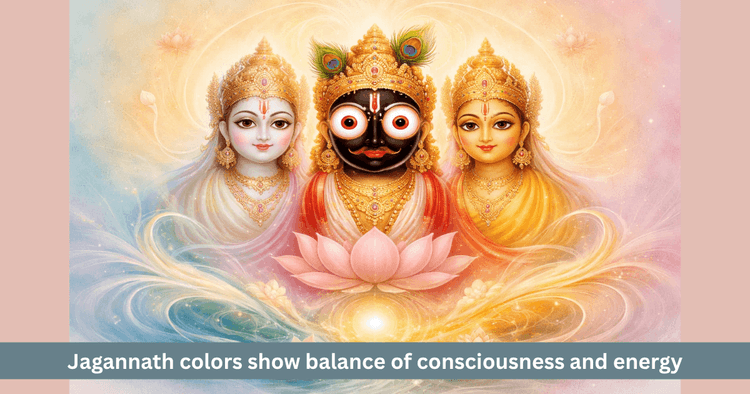
Table of Contents
One of the most remarkable features of Shri Jagannath Dham in Puri is not only the form of the deities but also the profound spiritual language carried by their colors. At first glance, one may simply observe that Lord Jagannath is dark, Balabhadra is white and Subhadra is yellow. But Indian philosophical traditions never treat color merely as outer visual beauty. They often read it as a sign of principle, consciousness, energy, cosmic truth and inner realization. For this reason, to understand the colors of the Jagannath triad is not only to understand temple imagery but also to enter a deeper spiritual vision.
From the perspective of Sankhya thought and Tantric interpretation, these three colors carry a highly subtle meaning. The dark color of Lord Jagannath is taken as a symbol of shunyata, sacred emptiness. The white color of Balabhadra is understood as the sign of consciousness. The yellow color of Subhadra is regarded as the expression of shakti, divine power. When these three are seen together, they no longer remain merely three deities. They become three great dimensions of existence itself. On one side is the infinite ground into which all dissolves. On another is the awareness that illuminates all. On the third is the dynamic power that sets creation into motion.
That is why in the Jagannath temple one does not only receive darshan. One also receives a silent teaching through color. If the devotee pauses for a few moments before this mystery, it may be felt that this triad is not only an object of worship but also a set of three great signs concerning life, the cosmos and the soul.
Why are colors so important here
In Indian spiritual traditions, colors are often given deeply symbolic meanings. A color is not merely an outer surface. It can be a medium of mood, energy, principle and philosophical indication. In temples, yantras, mandalas, deity forms and Tantric traditions, the use of color is never considered accidental.
The importance of color becomes even greater in the Jagannath triad because the three forms stand together. If there were only one form, its meaning might remain more limited. But when the three colors are seen together, they seem to reveal a complete formula of creation itself. This visual arrangement is not ordinary. It can take the devotee from outer worship into inner contemplation.
Why is Jagannath’s black color regarded as a symbol of emptiness
At first glance, black may seem only a symbol of depth, gravity or sacred seriousness. But here its meaning is much more subtle. In Sankhya and Tantric interpretation, the dark form of Lord Jagannath is regarded as the sign of shunyata, sacred emptiness. Here emptiness does not mean absence or lifeless void. It means the infinite ground within which all can dissolve and from which all can also arise.
In the visible world, black often appears as the state in which all colors are absorbed. In the same way, sacred emptiness is that state in which names, forms, ego, divisions and limitations dissolve. The dark form of Jagannath suggests that one aspect of the Divine cannot be confined within one form, one definition or one limit. It is vast, immeasurable and able to contain all.
This emptiness is not negative. It is fullness hidden within sacred vastness. It is like the silence from which music is born. It is like the sky within which all things take place. Jagannath’s dark color teaches that the Divine is present not only in visible light but also in that boundless depth where the mind becomes still and leaves behind all boundaries.
How does Balabhadra’s white color become a symbol of consciousness
If Jagannath’s dark form represents sacred emptiness, then Balabhadra’s white form is seen as the sign of consciousness arising within that vast ground. In Indian symbolism, white is associated with purity, clarity, light, balance and awakened awareness. When connected with Balabhadra, it allows his form to be understood not only as that of an elder brother or a deity of strength but also as luminous awareness.
Consciousness does not mean mere wakefulness. It means seeing, knowing, understanding and remaining present. Balabhadra’s white color suggests that existence is not only infinite emptiness. It also contains the light that makes experience possible. If emptiness is the ground, consciousness is its awakened expression.
The white of Balabhadra also conveys inner steadiness. There is a quiet clarity within it. It is as though the color says that the one established in awareness can stand a little apart from confusion. The one rooted in consciousness can look at life more clearly. In this way, Balabhadra becomes not only a symbol of strength and protection but also of radiant awareness.
Why does Subhadra’s yellow color represent power
The yellow form of Subhadra, placed at the center of the Jagannath triad, is especially meaningful. In Indian spiritual symbolism, yellow often represents energy, fertility, life, abundance, mediation and creative movement. In Tantric interpretation, Subhadra is seen as a representation of shakti and this makes her yellow form deeply appropriate.
Shakti does not simply mean force. It is the dynamic principle that manifests creation between emptiness and consciousness. If Jagannath is the ground and Balabhadra is awakened awareness, then Subhadra is the divine energy that activates all. Yellow expresses this activity in a very beautiful way. It carries warmth, life, invocation and vibrant movement.
Subhadra’s form also teaches that creation does not move through static principles alone. It needs an energy that manifests, connects and flows. Thus shakti here becomes not only a goddess principle but the living pulse of the cosmos itself.
How should the three colors be understood together
When these colors are seen separately, each offers its own sign. But when they are seen together, a larger teaching emerges. The triad visually presents a complete spiritual formula of existence.
| Form | Color | Symbolic meaning |
|---|---|---|
| Jagannath | Black | Emptiness, infinite ground, unmanifest depth |
| Balabhadra | White | Consciousness, light, awakened presence |
| Subhadra | Yellow | Power, creation, dynamic energy |
This table does not merely list symbols. It also suggests a spiritual order. First there is the infinite ground. Then within it awakened awareness. Then from that, the active flow of creation. This is why the Jagannath triad may be seen as deeply rich from a philosophical perspective.
What does this color mystery suggest from the perspective of Sankhya philosophy
Sankhya philosophy is concerned with principles, the relation of prakriti and purusha and the structure of manifested existence. Although this color symbolism is not presented in the style of a single formal Sutra, it becomes highly meaningful when read through a Sankhya lens. Sacred emptiness may be viewed as the immeasurable basis before differentiation. Consciousness may be viewed as the witnessing light that makes experience possible. Power may be seen as the principle of nature that activates and manifests creation into many forms.
In this sense, the color symbolism teaches that life is not merely matter, not merely witness and not merely movement. Life is shaped through the subtle relation between all three. This is what makes the Jagannath triad a philosophical temple as much as a devotional one.
What is its special significance in Tantric interpretation
Tantric traditions often read symbols not in purely outward terms but in the language of energy. From this perspective, black may represent the infinite womb, the unfathomable void and the unmanifest principle. White may represent awakened light, pure awareness and serene consciousness. Yellow may represent active shakti, creativity and manifesting power.
This triad becomes especially significant in Tantric interpretation because here the emphasis is not only on theory but on experience. When the devotee contemplates these forms, one does not merely see colors on idols. One may also begin to recognize these three dimensions within oneself
- there is a deep inner emptiness
- there is a witnessing consciousness
- there is also an active energy within
In this way, the color mystery of the Jagannath triad becomes not only a matter of outer worship but also of inner spiritual practice.
Does this color symbolism also relate to human life
Yes and very deeply. If this episode is treated only as philosophical symbolism, then only half its beauty is understood. In truth, every human being also carries these three states inwardly in one way or another.
Within the human being there is
- a silent, deep and vast dimension
- a conscious, aware and witnessing dimension
- an active dimension of feeling, action and creative force
For this reason, the Jagannath triad is not only meant to be worshipped outside. It may also be recognized inwardly. This is one of the most beautiful aspects of the teaching. The triad that stands in the temple is also present in subtle form within the seeker.
What does this teaching of color give to the devotee
This mystery does not only offer philosophical insight. It offers vision. The devotee begins to understand that God is not confined to one form or one emotional relation. The Divine may be infinite emptiness, awakened consciousness and flowing power all at once. This deepens devotion, because the seeker can begin to experience the Lord in many dimensions.
This episode can enrich the devotee in several ways
- one learns to see color also as a spiritual language
- one connects deity darshan with deeper contemplation
- one may recognize emptiness, consciousness and power within oneself
- devotion can grow from outer ritual into inward practice
Why is this interpretation important in the modern age
Today people see much but often do not know how to read symbols. Even after visiting temples, many return only with visual impressions. At such a time, this interpretation of the Jagannath triad reminds us that Indian deity traditions are not merely objects of worship. They are also teachings of consciousness.
This becomes especially relevant because modern people often feel inwardly fragmented. They seek peace, clarity and energy. Jagannath’s black color offers the sign of rest in sacred emptiness. Balabhadra’s white color offers the call toward clarity in consciousness. Subhadra’s yellow color inspires connection with the living force of life. In this way, the color mystery remains living and deeply relevant even now.
The final light of this episode
The colors of Jagannath, Balabhadra and Subhadra are not merely a matter of religious beauty. They are a profound language of Indian spirituality. At the level of Sankhya philosophy and Tantric interpretation, black, white and yellow together offer a great formula of existence. Emptiness, consciousness and power are not separate. Together they make life, spiritual practice and creation complete.
That is why the darshan of the Jagannath triad becomes more than the viewing of sacred forms. It becomes a spiritual contemplation. The devotee who sees this mystery deeply may no longer perceive only three colors in the temple. One may feel that the whole cosmos is revealing itself through three silent signs. That is the true beauty and enduring teaching of this episode.
Frequently Asked Questions
What does Jagannath’s black color symbolize
It is regarded as a symbol of sacred emptiness, infinite ground and unmanifest depth.
What is the meaning of Balabhadra’s white color
It symbolizes consciousness, light, clarity and awakened presence.
What does Subhadra’s yellow color represent
It represents power, creation, life energy and dynamic movement.
What is considered the source of this interpretation
It is associated with symbolic readings found in Sankhya philosophy and Tantric tradition.
What should be understood by seeing all three colors together
They should be understood as the balance of emptiness, consciousness and power that forms the basis of both life and creation.
Get your accurate Kundali
Generate KundaliDid you like it?
Author

Pt. Suvrat Sharma (63)
Experience: 20
Consults About: Family Planning, Career
Clients In: Punjab, Haryana, Delhi
Share this article with friends and family
About ZODIAQ
ZODIAQ is an online Vedic Astrology platform. It connects clients seeking astrological advice to experienced astrologers with deep knowledge. Our users also generate kundali and perform kundali milan for free. ZODIAQ also offers services to the Astrologers. Astrologers utilize various offerings by ZODIAQ to serve their clients effectively.
If you are a User
Consult with experienced astrologers and seek their guidance. You can also order handwritten Janm Patrika report with life prediction prepared by experienced astrologers. Generate accurate Kundali, perform Kundali Matching and check horoscope and muhurat. Utilize our online library for all the necessary astrological and spiritual information.
If you are an Astrologer
Create accurate kundali for your clients and perform Kundali Matching for up to 5 people at a time. Write comprehensive Janm Patrika report for your clients with ZODIAQ. Check client details anytime by saving it in client directory. Become more productive by tracking how many clients you guide every day.
WELCOME TO
ZODIAQ
Right Decisions at the right time with ZODIAQ
