Why Jagannath Idols Are Incomplete: Vishvakarma’s Divine Condition
By Pt. Abhishek Sharma
A spiritual story of imperfection, faith and divine will in Jagannath tradition
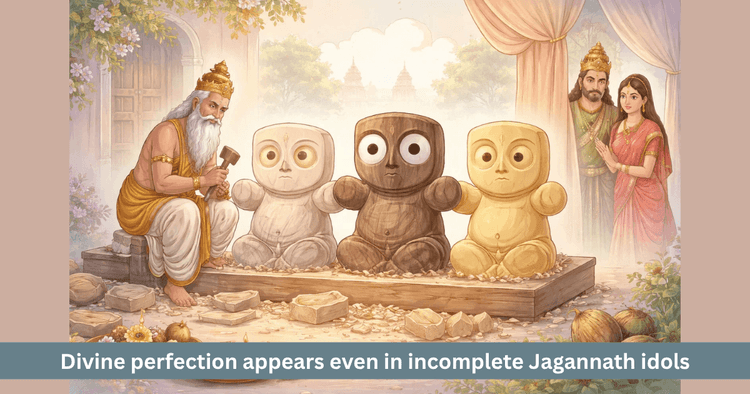
Table of Contents
In Indian spiritual tradition, there are certain stories that seem simple on the surface, yet inwardly they reveal profound truths about human impatience, curiosity, surrender, faith and divine will. The story connected with the incomplete form of the idols of Lord Jagannath belongs to this category. At first glance, a natural question arises. If the sacred idols of the Lord were being made, why were they not completed. And if they remained unfinished, why were they accepted and worshipped in that very form. This question is what makes the story so spiritually powerful.
In the tradition of Niladri Mahodaya, this episode is not merely about craftsmanship or temple construction. It points toward the deeper truth that while human beings define perfection according to symmetry, completion and visual beauty, the Divine may choose to reveal itself in a form that the world considers incomplete. In this narrative, Vishvakarma’s condition, Queen Gundicha’s curiosity, the closed door and the emergence of unfinished idols all come together to reveal a spiritual mystery that belongs not to outer form but to inner vision.
This is why the forms of Lord Jagannath, Balabhadra and Subhadra are never viewed only from the perspective of sculpture. Their appearance teaches that divine completeness may be entirely different from what human beings call complete. Where the human mind seeks form, proportion and polished perfection, the Lord may choose to manifest in a form that appears unfinished yet is spiritually full.
Why is this story considered so unique
The form of Lord Jagannath is different from most other sacred images. His hands do not appear in the usual sculptural way, his feet are not shaped in conventional completeness and the entire structure of the image seems different from classical ideals of sacred sculpture. This uniqueness draws devotion and raises questions at the same time. The story is understood as an answer to that question.
According to the tradition of Niladri Mahodaya, Lord Vishvakarma himself agreed to make the idols but he placed a condition. He said that he would remain within a closed chamber for a fixed period and complete the work and until he emerged on his own, no one should open the door. This condition was not ordinary. Within it lay the principles of trust, patience and non interference in divine process.
But human nature is often drawn more toward curiosity than waiting. That becomes the turning point of the story. Queen Gundicha became restless with concern and eagerness. She wondered what was happening inside, whether the work had stopped or whether something had gone wrong. This is the moment where the human mind and divine order stand face to face.
What was the deeper meaning of Vishvakarma’s condition
Vishvakarma is not merely the celestial architect. He is associated with divine design, sacred construction, cosmic order and the hidden process of manifestation. When he says that the door must remain closed for a period, its meaning is not limited to secrecy of workmanship. It carries a profound symbolic meaning.
The closed door may be understood at several levels
- Divine work requires time
- Every true creation is fulfilled through patience, not impatience
- Human beings are not meant to control every process
- Where trust is broken, the outcome may change
His condition also teaches that many divine processes cannot be opened, interrupted or examined midway. To let them unfold in their own time is itself an act of faith. Vishvakarma’s condition was therefore also a test of human patience.
Why did Queen Gundicha open the door
The role of Queen Gundicha is deeply human. To reduce her simply to a mistake would weaken the beauty of the story. Opening the door was not merely a failure of restraint. It carried concern, curiosity and perhaps the restless human desire to know what is happening inside the mystery.
Human beings often find it difficult to wait. They want results quickly. They struggle to trust the unseen process. They want to know what is taking shape even before the time comes. Queen Gundicha becomes the symbol of this very human impatience.
Her act of opening the door suggests
| Episode | Symbolic meaning |
|---|---|
| The queen’s curiosity | Human restlessness and impatience |
| The closed chamber | Divine process and trust |
| Opening the door too soon | Interference in sacred unfolding |
| The unfinished idols | Human limitation before divine will |
This table makes it clear that the event is not merely a royal incident but also a symbol of tendencies within the human mind.
Why were the idols left incomplete
When the door was opened before the appointed time, the sacred images were not yet complete. Vishvakarma left the work unfinished. That is the outer event of the story. But the deeper spiritual question is not only why they remained incomplete. It is why the Lord accepted that very form.
Here the story rises to its highest meaning. In ordinary human thinking, unfinished idols would be considered unfit, perhaps rejected, perhaps rebuilt. But the tradition says that the Lord accepted that very unfinished form as his divine form. This means that where human beings saw incompleteness, the Divine revealed inner completeness.
The episode teaches that the presence of God does not depend upon outer perfection of shape. The Lord can be fully present even in a form that the world considers unfinished. This is the greatest spiritual message hidden in the story.
Why did the Lord accept the unfinished form
This is the most important question and the entire mystery of the story rests here. The acceptance of the unfinished form shows that divine manifestation does not depend on human standards of symmetry and completion. The Lord can reveal fullness within apparent imperfection.
Several deep meanings lie in this divine acceptance.
1. God is greater than form
The image is a medium, not a limit. Even if the outer form appears incomplete, the divine presence within it may still be complete.
2. Imperfection too can become worthy of grace
Human beings themselves are incomplete in many ways. If the Lord accepted only outward perfection, humanity would remain forever distant. By accepting the unfinished form, the Lord reveals that the incomplete are also his own.
3. Divine will is greater than human design
The sculpture remained unfinished but the lila became complete. What appears to human beings as interruption may in fact hold divine intention.
What does the Jagannath form teach about imperfection
The apparently unfinished form of Lord Jagannath is not merely an old temple tradition. It is also a continuing spiritual teaching. His large eyes, simplified structure and unconventional form move the heart beyond ordinary ideas of beauty. They take one past aesthetic expectation and into spiritual perception.
Within the Jagannath form, many deep meanings are seen
- He sees all equally
- He is beyond limitations of form and social identity
- He is a universal Lord beyond fixed artistic norms
- He teaches that God is the refuge not only of the perfect but also of the unfinished
That is why Jagannath is called the Lord of all. His form itself becomes a proclamation that the Divine is not confined within one aesthetic ideal or cultural expectation.
Does this story apply to human life as well
Completely. This is one of the most living aspects of the story. Every human being feels some form of incompleteness. One may feel unfinished in patience, another in confidence, another in relationships, another in spiritual clarity. If the Divine accepted only completed forms, then hope would disappear.
But the form of Jagannath says
- Your incompleteness does not make you unworthy of God
- Your brokenness too can become a place of grace
- What is not yet complete can still be sacred
- The Lord accepts you even in the middle of your becoming
Thus this story moves beyond an idol and becomes a teaching about self understanding. It says that what feels unfinished in life must not always be viewed with despair. Divine possibility may be hidden within it.
The psychological meaning of imperfection in this story
Human beings often suffer deeply because of the demand to be perfect. They want perfect appearance, perfect success, perfect relationships, perfect spirituality and perfect self control. In this struggle they keep rejecting themselves. The story of Jagannath’s unfinished idols becomes a profound consolation for such a mind.
It teaches that
- To be unfinished is not to be unworthy
- Every process requires its time
- Do not break open what is still becoming
- Acceptance too is a necessary part of spiritual life
If Queen Gundicha’s action symbolizes impatience, then the Lord’s acceptance of the unfinished form symbolizes compassion and gracious acceptance. This is the psychological balance of the story.
The importance of Niladri Mahodaya in this tradition
The source of this episode is traditionally regarded as Niladri Mahodaya, a text associated with the glory, sacred tradition and divine narrative of Lord Jagannath. Its importance lies not merely in preserving a story but in preserving the deeper meaning behind Jagannath’s unusual form.
When viewed in the light of Niladri Mahodaya, the episode is not treated as an accidental event. It is revered as the divinely accepted form of the Lord himself. Therefore the significance of the story is not only historical. It belongs equally to devotional theology and sacred worship.
Major lessons that arise from this episode
Faith does not mean control
It is not necessary to know every divine process immediately. Sometimes faith means waiting.
Impatience can alter outcomes
Premature interference can change what was moving toward completion.
Imperfection is not always a flaw
Sometimes it becomes the very mark of divine grace.
Divine acceptance goes beyond human standards
The Lord may reveal himself even where the world sees only lack.
The final radiance of this story
The story of the unfinished idols and Vishvakarma’s condition does not merely explain the origin of Lord Jagannath’s form. It also teaches a profound spiritual principle. It shows that impatience belongs to human beings but acceptance belongs to God. It reveals that divine completeness can be very different from human ideas of completion. Where we see defect, the Lord may reveal meaning. Where we see interruption, the Lord may establish a timeless symbol of his own presence.
This is the true mystery of the episode. The unfinished appearance of Lord Jagannath reminds us that the Lord is also the refuge of those who feel broken, partial, unfinished or unformed within. He does not make things divine only after they are perfected. He often makes them divine through acceptance. That is the greatest tenderness of the story and its most enduring message.
Frequently Asked Questions
What condition did Vishvakarma place before making the idols
He said that he would remain in a closed chamber for 21 days and no one should open the door before he emerged.
Why did Queen Gundicha open the door
She opened it because of curiosity, concern and the impatient desire to know what was happening inside.
Why were the idols left unfinished
When the chamber was opened too early, Vishvakarma stopped his work before completion.
Why did the Lord accept the unfinished idols
Tradition says the Lord accepted that very form to reveal that divine completeness does not depend upon outward perfection.
What is the main source of this story
The main traditional source of this episode is regarded as Niladri Mahodaya.
Get your accurate Kundali
Generate KundaliDid you like it?
Author

Pt. Abhishek Sharma (63)
Experience: 20
Consults About: Family Planning, Career
Clients In: Punjab, Haryana, Delhi
Share this article with friends and family
About ZODIAQ
ZODIAQ is an online Vedic Astrology platform. It connects clients seeking astrological advice to experienced astrologers with deep knowledge. Our users also generate kundali and perform kundali milan for free. ZODIAQ also offers services to the Astrologers. Astrologers utilize various offerings by ZODIAQ to serve their clients effectively.
If you are a User
Consult with experienced astrologers and seek their guidance. You can also order handwritten Janm Patrika report with life prediction prepared by experienced astrologers. Generate accurate Kundali, perform Kundali Matching and check horoscope and muhurat. Utilize our online library for all the necessary astrological and spiritual information.
If you are an Astrologer
Create accurate kundali for your clients and perform Kundali Matching for up to 5 people at a time. Write comprehensive Janm Patrika report for your clients with ZODIAQ. Check client details anytime by saving it in client directory. Become more productive by tracking how many clients you guide every day.
WELCOME TO
ZODIAQ
Right Decisions at the right time with ZODIAQ
