Why Does the Mahaprasad of Jagannath Never Fall Short
By Aparna Patni
How devotion, sacred order and divine grace together create the endless experience of Jagannath Mahaprasad
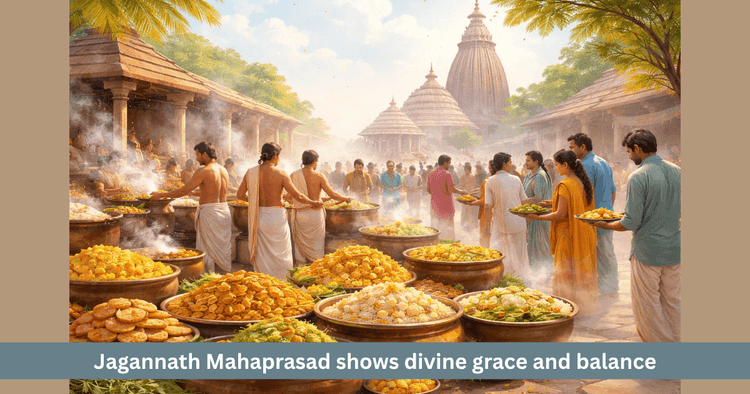
Table of Contents
Among the most beautiful beliefs associated with the sacred dham of Puri is the belief that the Mahaprasad of Lord Jagannath never falls short. Every day thousands of devotees come to the temple, offerings are made, Mahaprasad is distributed, people receive it, carry it with them and yet the feeling remains that it neither runs into scarcity nor ends in waste. This is not seen merely as a matter of food management. It is understood as a living expression of the Lord’s grace, the ancient temple order and the continuing power of sacred service.
The most beautiful part of this tradition is that devotion and order seem to move together within it. On one side, devotees experience it as Jagannath’s grace through food. On the other, the temple kitchen and distribution system sustain it with remarkable balance. That is why this experience of Mahaprasad is not only a matter of religious emotion. It is a sacred tradition in which service, discipline, lived experience and trust in the divine stand together.
Why is Mahaprasad held in such high reverence
In the Jagannath temple, the offering is not regarded as ordinary food. Once it is offered to the Lord, it becomes Mahaprasad and for this reason its dignity is held to be far greater than common food. Devotees do not receive it only for taste or bodily satisfaction. They receive it as grace, blessing and sacred participation. The feeling attached to Mahaprasad is that the Lord has first accepted it and therefore by the time it reaches the devotee, it no longer remains mere food. It becomes a carrier of spiritual touch.
One of the unique features of the Jagannath tradition is that the reverence for Mahaprasad is very wide and inclusive. It does not remain confined to one class or a narrow ritual circle. In temple tradition, Mahaprasad becomes a living medium of folk life, pilgrimage feeling and shared sacredness. That is why when it is said that it never falls short, the statement points not only to quantity but also to a sense of limitless grace.
What is the central meaning of the belief that Mahaprasad never falls short
This belief, rooted in local experience and temple order, suggests that in the Puri temple, even with the daily arrival of countless people, the distribution of Mahaprasad continues in a striking balance. It reaches those who come. Yet in the end it does not seem to fall into lack. In the same way, what is prepared does not appear to go to waste. This balance leaves a deep impression on the devotee.
Devotees connect this experience with the gracious presence of Lord Jagannath, in whose temple food is not treated merely as a material thing but as a flow of divine blessing. Fear of lack becomes less intense there, because the inner faith remains that Jagannath does not abandon those who come in devotion. This is why the belief has become an important part of the spiritual identity of the temple.
Main indications of this belief
• Mahaprasad is understood as food in the form of grace.
• Even when thousands arrive, there is no feeling of scarcity.
• In the end the offering is also believed not to go to waste.
• Devotees connect this balance with the nourishing grace of the Lord.
Is this only religious faith or also a remarkable system of order
The temple tradition gives a very beautiful answer to this question. It is not only the language of marvel that is present here. There is also the discipline of service. The temple kitchen, the traditions of preparation, the order of offering, the way of distribution and the reverence people have for Mahaprasad together create a system in which waste is minimized and participation is maximized. That is why this tradition becomes not only a sacred wonder but also an example of deeply mature service structure.
Yet for the devotee, efficient arrangement alone is not the final answer. The devotee feels that where food is prepared for the Lord and where it is treated not merely as a commodity but as sacred offering, the meaning of quantity itself changes. That is why the belief that Mahaprasad never falls short becomes both the success of service order and the grace of the Lord.
Why is the idea that Mahaprasad never goes to waste so profound
In the present age, the wastage of food has become an ordinary and painful sight. In such a setting, the belief associated with the Puri temple, that Mahaprasad neither falls short nor goes to waste, offers a deep cultural and spiritual teaching. Here food is not treated only as an object of consumption. It is treated as food touched by the divine. Once a thing is understood to bear the touch of the Lord, carelessness around it begins to diminish naturally.
There is another beautiful side to this belief. It shows sufficiency and restraint moving together. That what is needed is made available and what is made available is received with reverence, this is the ideal of any sacred food culture. Seen this way, the tradition of Mahaprasad is not only a religious experience. It also teaches a civilized and compassionate attitude toward food itself.
Why is the relation between Lord Jagannath and food considered so special
In the worship of Lord Jagannath, food, offering and prasada hold a place of tremendous significance. In his dham, food is not only one aspect of ritual offering. It is one of the living centers of devotion. It appears as though in the Jagannath tradition, the Lord is not only a deity to be worshipped but also a Lord who enters into a relationship through food with his devotees. This relationship is intimate and close to daily life.
For this reason, the experience of Mahaprasad also teaches the devotee that divine grace is present not only in sacred vision but even in the most basic needs of life. Hunger being quieted, people sitting together to receive the offering, sharing it and receiving it with respect, all this ceases to be mere religious action. It becomes a sign of the nearness between God and life.
Deep teachings offered by the Mahaprasad tradition
• Food must be seen as grace.
• What is sacred should not be treated with wastefulness.
• Shared prasada awakens the feeling of community and equality.
• In the Lord’s abode, nourishment is not only of the body but also of the heart.
How does local experience strengthen this belief
Many beliefs of Puri dham live not only through scripture but through experience based memory. The belief that Mahaprasad never falls short belongs to that stream. Those who repeatedly witness this tradition experience that despite the great number of people, the offering moves through a remarkable balance. Such repeated experience gradually takes the form of living faith.
In Indian pilgrimage traditions, local experience carries great importance. It does not merely create stories. It conveys the soul of a sacred place to people. The continuity of Mahaprasad in Jagannath temple belongs to the same kind of living experience, one that pilgrims do not merely hear about but often carry back as part of their own sacred memory.
How does temple order make this balance possible
From the point of view of temple order, this tradition is sustained through alert service, discipline and inherited practice. The quantity prepared, the sequence of cooking, the timing of offering, the rhythm of distribution and the social culture of receiving Mahaprasad together make possible a structure in which balance remains even among thousands. For this reason, local experience sees this not merely as administrative skill but as the perfection of service.
Here order and devotion are not opposites. Order without devotion would become mechanical and devotion without order would become unstable. The glory of Puri lies in the way both are seen moving together. From this union arises the assurance that Mahaprasad will neither run short nor go to waste.
Can this also be understood as a sign of the Annapurna spirit
Yes, this belief may also be understood through the spirit of Annapurna, meaning the divine principle of nourishment. Wherever the devotee leaves the Lord’s abode fulfilled, wherever food is treated with reverence and wherever fear of lack gives way to trust, food does not remain only a material thing. It becomes a symbol of divine nurture, sustaining care and sacred abundance. Many devotees feel this nourishing tenderness in the Mahaprasad of Lord Jagannath.
Thus the belief that Mahaprasad never falls short is not only a marvel of quantity. It is also a sign that the Lord’s house does not send the hungry away empty. That is why this tradition awakens consolation, trust and a sense of sacred abundance within people.
A simple table to understand this theme
| Element | Spiritual and cultural meaning |
|---|---|
| Mahaprasad | Food transformed into grace through offering |
| Never falling short | Sign of divine sufficiency and trust |
| Not going to waste | Reverence toward food and disciplined restraint |
| Temple order | Disciplined service and balanced distribution |
| Local experience | Living belief and pilgrimage memory |
Why is this tradition inspiring in the present age
In a world where there is excess consumption on one side and unequal food access on the other, this tradition of Puri dham offers a powerful lesson. It teaches that if food is understood not merely as an object but as a sacred responsibility, then its use can become more balanced, more compassionate and more meaningful. For this reason, the belief connected with Mahaprasad remains deeply relevant even today.
It also teaches that abundance does not mean only greater quantity. It means right use, shared participation and a culture that resists waste. The Mahaprasad of the Puri temple therefore becomes not only a religious subject but also an ideal for living.
Food of grace, the message of fulfillment
In the end, this belief associated with the Mahaprasad of Lord Jagannath conveys a very tender and profound truth. Where there is the Lord’s food, the fear of lack can lessen. And where food is received as prasada, waste can also lessen. That is why this tradition awakens not only wonder but also a calm trust within the heart.
The belief that Mahaprasad never falls short and never goes to waste becomes a symbol of the fact that when grace, service and restraint stand together, sufficiency becomes possible in life. This is the most beautiful and lasting teaching of this sacred tradition of Jagannath dham.
Frequently asked questions
What is the famous belief about the Mahaprasad of the Puri temple
The famous belief is that the Mahaprasad there never falls short and never goes to waste.
Is this only a matter of religious faith
No. Along with divine grace, the balanced temple service order is also considered important in sustaining this tradition.
Why is Mahaprasad regarded as so sacred
Because it first reaches the Lord as an offering and then comes to devotees, it is understood as food in the form of grace.
What does the belief that Mahaprasad never goes to waste teach
It teaches reverence toward food, disciplined use and restraint.
On what basis is this belief widely known
It is generally understood as a living belief rooted in local experience and temple order.
Get your accurate Kundali
Generate KundaliDid you like it?
Author

Aparna Patni (63)
Experience: 20
Consults About: Family Planning, Career
Clients In: Punjab, Haryana, Delhi
Share this article with friends and family
About ZODIAQ
ZODIAQ is an online Vedic Astrology platform. It connects clients seeking astrological advice to experienced astrologers with deep knowledge. Our users also generate kundali and perform kundali milan for free. ZODIAQ also offers services to the Astrologers. Astrologers utilize various offerings by ZODIAQ to serve their clients effectively.
If you are a User
Consult with experienced astrologers and seek their guidance. You can also order handwritten Janm Patrika report with life prediction prepared by experienced astrologers. Generate accurate Kundali, perform Kundali Matching and check horoscope and muhurat. Utilize our online library for all the necessary astrological and spiritual information.
If you are an Astrologer
Create accurate kundali for your clients and perform Kundali Matching for up to 5 people at a time. Write comprehensive Janm Patrika report for your clients with ZODIAQ. Check client details anytime by saving it in client directory. Become more productive by tracking how many clients you guide every day.
WELCOME TO
ZODIAQ
Right Decisions at the right time with ZODIAQ
