The Deeper Meaning of the 7 Pot Mahaprasad in the Jagannath Temple Kitchen
By Pt. Abhishek Sharma
The spiritual meaning behind the layered cooking of 7 earthen pots and the divine Mahaprasad tradition in Jagannath temple kitchen
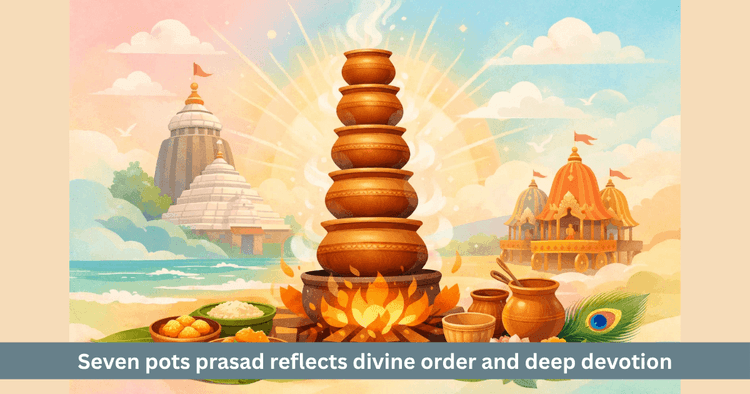
Table of Contents
The Jagannath Puri dham is not known only for its sacred darshan, the Rath Yatra and the sea shore. Its temple kitchen is equally revered, astonishing and deeply sacred in the devotional imagination. Among the many traditions connected with this kitchen, one especially famous belief says that 7 earthen pots are placed one above another to cook the sacred offering. The most astonishing part of this belief is that the food in the topmost pot cooks first, while the food in the pots below cooks later. Since this appears different from ordinary kitchen logic, devotees do not see it as a culinary detail alone. They connect it with the grace of Lord Jagannath and the living sanctity of temple tradition.
When a devotee hears of the kitchen of the Jagannath temple, the mind does not become curious only about the process of cooking. A deeper thought also arises. In a place where food is prepared for the Lord himself, why does every action seem to carry a dignity beyond ordinary life. For this reason, the 7 pot offering does not remain only a kitchen custom. It becomes a symbol of service, surrender, reverence, wonder and divine order.
Why is the Jagannath temple kitchen considered so special
The kitchen of the Jagannath temple is counted among the greatest and most sacred temple kitchens of India. It is not understood merely as a place where food is cooked. It is regarded as a field of daily service to the Lord. The food prepared here is not considered ordinary food. Once offered, it becomes Mahaprasad, meaning the great sanctified offering received by devotees. For that reason, every process in the kitchen carries not only order but also the spirit of purity, sacred discipline and agamic procedure.
In temple tradition, the kitchen is never a minor supporting part of religion. It is one of the main expressions of divine service. Food here is not seen only as nourishment. It is understood as a grace filled medium offered to the deity. That is why the 7 pot Mahaprasad creates not only amazement but also deep reverence in the hearts of devotees.
What does the tradition of the 7 pots say
According to local tradition, 7 earthen vessels are placed one above another in the temple kitchen and the sacred food is cooked in them. The most remarkable part of the tradition is that the food in the uppermost pot is believed to cook first, while the food in the pots below cooks later. In ordinary experience, the lower pot should cook first because it is nearest to the fire. Yet in the kitchen tradition of the Jagannath temple, the experience is described in the opposite way.
This is the point at which the process moves beyond ordinary cooking and becomes a living temple belief. Devotees who hear of it or witness it do not respond only with surprise. They receive it as a form of the Lord’s lila, meaning divine play, showing that in his sacred abode order is not understood only through visible rules.
Main points of the 7 pot tradition
• Earthen pots are placed one above another.
• This method of cooking is regarded as a distinctive mark of the temple kitchen.
• According to tradition, the topmost pot cooks first.
• Devotees connect this experience with divine glory and the tradition of sacred service.
Why does this episode fill people with wonder
The human intellect usually thinks in terms of cause and sequence. If the fire is below, then the lower vessel should cook first. That is the ordinary line of reasoning. Yet when it is said that in the Jagannath temple kitchen the top pot cooks first, wonder arises immediately within the mind. This wonder has kept the tradition alive across generations.
For the devotee, this wonder is not merely a disruption of logic. It is also the beginning of a feeling in which one accepts that within the domain of the Lord there may be experiences that appear beyond the limits of ordinary understanding. This is why the 7 pot offering is not only a culinary marvel. It also widens the vision of devotion.
Is this only a kitchen technique or something more
Temple tradition gives a beautiful answer to this question. The one who sees only from outside may call it a special cooking arrangement. But the one who sees it through the spirit of the Jagannath dham will receive it as the mysterious dignity of service. In a temple, food does not become sacred through fire alone. It is also sanctified through devotion, mantra, purity and the intention of offering it to the Lord.
That is why the meaning of this episode is not only that the top vessel cooks first. Another meaning is that in the kitchen of the Lord, every act is held within an order shaped by grace. There ordinary food becomes Mahaprasad and so its preparation too no longer remains ordinary.
What spiritual meaning can the 7 pot offering carry
If this tradition is viewed symbolically, it offers a beautiful spiritual teaching. Human beings usually think in terms of movement from below toward above. Yet divine grace is often felt as descending from above toward below. The top pot cooking first may also be seen as a symbol that the flow of divine grace does not always move according to human logic. It works by its own order.
This belief may also suggest that in what is offered to the Lord, grace matters more than sequence. Wherever devotion is present, even ordinary arrangements may begin to appear wondrous. In this way, the 7 pot Mahaprasad touches not only the outer cooking process but also the inner field of reverence.
Symbolic meanings received from this tradition
• The order of God can at times be different from human reasoning.
• Food offered to the Lord becomes not merely nourishment but a vessel of grace.
• This tradition may be seen as reflecting grace that descends from above.
• When joined with devotion, kitchen work becomes a sacred act.
Why is the use of earthen pots itself so meaningful
In Indian tradition, clay is not understood merely as a material. It represents the earth element, simplicity, purity, the power to hold and the nourishment of life. The fact that the sacred offering is cooked in earthen pots deepens the feeling that the food prepared for the Lord remains close to nature, close to purity and close to humble service.
An earthen vessel carries its own quiet dignity. It suggests simplicity rather than display. The kitchen of the Jagannath temple reflects this same spirit. The Lord may be the Lord of the universe, yet the food offered to him remains connected with the nearness of ordinary people and the simplicity of the earth. In this way the offering becomes a living bridge between the Lord and the people.
What place does this tradition hold in the making of Mahaprasad
The food of the Jagannath temple is not treated merely as cooked food. Once it is offered to the Lord, it becomes Mahaprasad, a deeply sanctified grace offering. Because of this, every process of the kitchen already begins to carry spiritual importance. The arrangement of the 7 pots belongs to that sacred order. It is not only a way of preparing food. It is also a prior act of consecrated offering.
Seen from this perspective, the top pot cooking first becomes part of a sacred memory teaching that the journey of Mahaprasad is different from the journey of ordinary food. There it is not only fire, water and grain that are active. There are also ritual order, mantra filled service, faith and the intention of offering.
How do Agama Shastra and local tradition keep this episode alive
This belief is generally associated with local tradition and Agama Shastra, meaning the sacred ritual texts and practices governing temple worship. Local tradition keeps it alive through lived memory, storytelling and generations of temple service. The agamic perspective sees the kitchen, the offering and the preparation of food as a disciplined sacred procedure. When both come together, such traditions do not remain merely stories. They become living religious experience.
This is one of the strengths of Indian temples. Scripture and local tradition do not move separately. Where the sacred texts provide order, local living faith turns that order into experience that can be felt. The 7 pot Mahaprasad is a beautiful example of this union.
Does this remain as meaningful in the present day
Yes, it remains just as meaningful even today. Modern life has given human beings many conveniences, yet it has not removed the hunger for wonder and reverence. When a traveler of today hears about the Jagannath temple kitchen, the same questions and the same attraction arise that have stirred the hearts of devotees for centuries. This is the sign of a great tradition, that its power remains alive even when times change.
This episode also gives an important lesson to modern life. Not every process should be seen only through usefulness. Some acts deserve to be seen through the lens of sacredness, patience and surrender. The Jagannath temple kitchen gives precisely this reminder.
A simple table to understand the 7 pot Mahaprasad
| Element | Spiritual and cultural meaning |
|---|---|
| 7 pots | A distinctive tradition of sacred temple cooking |
| Topmost pot | The remarkable belief that it cooks first |
| Earthen vessels | Simplicity, earth element and sacred cooking tradition |
| Mahaprasad | Food transformed into grace through offering |
| Local tradition | Living reverence rooted in experience |
The gentle teaching of Jagannath’s kitchen
The 7 pot Mahaprasad of the Jagannath temple teaches that where service is true, even an ordinary act can become extraordinary. Clay pots, fire, grain and water are all found in ordinary life as well. Yet when these are offered to the Lord, a sacred meaning awakens within them. This is why this episode is not only about kitchen order but also about the transformation brought by devotion.
It also teaches that not every truth is visible at the surface. Some things are known through experience, some through reverence and some through that humility in which a person accepts that within the realm of the divine, there may be far more than human understanding can contain.
The silent wonder of the sacred offering
This arrangement of 7 pots in the Jagannath temple kitchen is an episode in which wonder and reverence move together. The top pot cooking first gives the devotee the feeling that in the Lord’s kitchen, everything is understood as moving not only by visible rules but also by a divine order. That is why this story does not make the mind only reason. It also makes the heart humble.
In the end, this episode gives a new vision of food, service and sacred offering. It teaches that where there is offering to the Lord, even the kitchen can become sadhana, meaning spiritual practice and cooked food can become a form of grace. This is the most beautiful and enduring teaching of the 7 pot Mahaprasad.
Frequently asked questions
What is the tradition of the 7 pots in the Jagannath temple
In the temple kitchen, 7 earthen vessels are placed one above another and the sacred offering is cooked in them.
Why is the belief that the topmost pot cooks first so famous
Because unlike ordinary kitchen experience, it is believed here that the uppermost vessel becomes ready before the lower ones.
Is this only a matter of cooking technique
No. Devotees also connect it with the divine glory of Lord Jagannath’s kitchen and the tradition of sacred service.
What does the use of earthen pots signify
It suggests simplicity, the earth element, purity and a sacred cooking tradition.
With which traditions is this belief generally associated
It is generally associated with local tradition and Agama Shastra.
Get your accurate Kundali
Generate KundaliDid you like it?
Author

Pt. Abhishek Sharma (63)
Experience: 20
Consults About: Family Planning, Career
Clients In: Punjab, Haryana, Delhi
Share this article with friends and family
About ZODIAQ
ZODIAQ is an online Vedic Astrology platform. It connects clients seeking astrological advice to experienced astrologers with deep knowledge. Our users also generate kundali and perform kundali milan for free. ZODIAQ also offers services to the Astrologers. Astrologers utilize various offerings by ZODIAQ to serve their clients effectively.
If you are a User
Consult with experienced astrologers and seek their guidance. You can also order handwritten Janm Patrika report with life prediction prepared by experienced astrologers. Generate accurate Kundali, perform Kundali Matching and check horoscope and muhurat. Utilize our online library for all the necessary astrological and spiritual information.
If you are an Astrologer
Create accurate kundali for your clients and perform Kundali Matching for up to 5 people at a time. Write comprehensive Janm Patrika report for your clients with ZODIAQ. Check client details anytime by saving it in client directory. Become more productive by tracking how many clients you guide every day.
WELCOME TO
ZODIAQ
Right Decisions at the right time with ZODIAQ
