The Tribal Form of Lord Jagannath and the Living Tradition of Nilamadhava
By Pt. Amitabh Sharma
The message of India’s spiritual unity hidden in the story of the Sabara tribe, Nilamadhava, and King Indradyumna
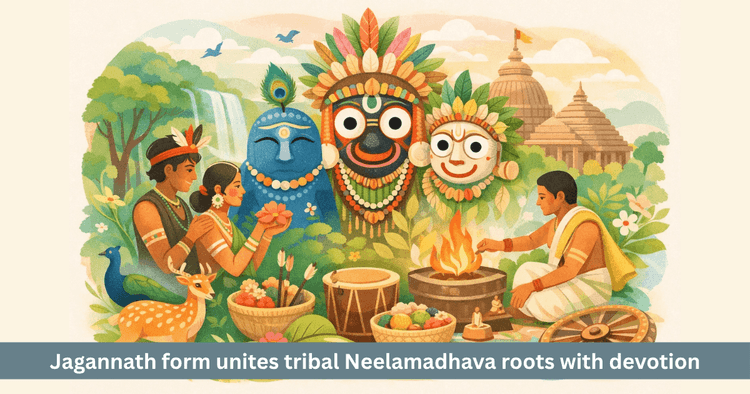
Table of Contents
Lord Jagannath is commonly known through Vaishnava devotion, the sacred dham of Puri, the Rath Yatra and Mahaprasad. Yet there is another deeply moving dimension of his form that connects him with the tribal traditions of India. This belief says that Lord Jagannath was originally the deity Nilamadhava, worshipped by the Sabara tribe. Later, King Indradyumna is believed to have brought that form and established it in the temple. This is not merely the story of a deity being moved from one place to another. It is a profound memory of the meeting of diverse spiritual streams within India.
One of the most beautiful aspects of this tradition is that even today, the memory of that tribal connection remains alive in the service of Jagannath dham. The Daitapati priests do not leave this tradition behind as a matter of the past. They continue to embody it in living practice. This makes it clear that the form of Lord Jagannath does not belong only to a royal temple structure. It also contains forest memory, folk devotion, tribal reverence, ancient continuity and universal divinity, all together.
Who was Nilamadhava
In the Jagannath tradition, the name Nilamadhava carries deep importance. It points toward that form of the deity who was originally worshipped by the Sabara tribe. Nilamadhava does not refer only to an image of worship. It also recalls a stage in which the Lord was present close to ordinary life, in the midst of nature and within tribal devotion.
The story of Nilamadhava teaches that Indian spirituality did not arise only in palaces, cities and great temple complexes. One of its great sources also lay in forests, mountains, rivers and the simple devotion of tribal communities. For this reason, the remembrance of Nilamadhava is not merely a tale of the past. It is also an acknowledgment that the divine presence cannot be confined to any single social structure.
Why is Lord Jagannath called a tribal deity
This belief is important because it connects the roots of Lord Jagannath with the devotion of the Sabara tribe. If Nilamadhava was originally a tribal deity, then the implication is that the foundation of the Jagannath tradition was not only a formal royal or strictly scriptural order. There was also a deep current of folk and tribal devotion flowing within it.
Seen this way, the form of Lord Jagannath appears profoundly inclusive. He is not only the deity of kings, not only the deity of temples and not only the deity of one tradition. He is a deity who arose from tribal sacred memory and became the beloved Lord of all. That is why his tribal form does not diminish his divinity. It expands it.
Main indications of this belief
• The roots of Lord Jagannath are understood as linked with folk and tribal devotion.
• The memory of Nilamadhava reflects the antiquity of tribal sacred reverence.
• This tradition teaches that the divine can manifest within every level of society.
• A major aspect of Jagannath’s glory is inclusiveness and acceptance.
What role is attributed to King Indradyumna
According to the Jagannath tradition, King Indradyumna heard about Nilamadhava and resolved to seek and establish that form in his kingdom. This is not only a story of royal enthusiasm. There is something deeper within it. When a king recognizes the importance of a tribal deity and installs that deity within a broader sacred structure, he is not only bringing an image. He is honoring a living tradition of reverence.
The story of King Indradyumna suggests that Indian religious tradition has often sought to weave folk memory and scriptural order, forest and city, common life and royal vision into one thread. The establishment of Nilamadhava in the form of Jagannath is understood as a great example of such union. It appears as a movement not of suppression but of honor, recognition and spiritual expansion.
Why is this story not only about relocation but also about transformation
When Nilamadhava becomes linked with the Jagannath tradition, the event no longer remains simply a matter of moving a deity from one place to another. It also becomes a sign of religious transformation, in which a local sacred tradition becomes connected with a broader Vaishnava and temple centered form of worship. In this process, the original memory does not vanish. It continues in a new form.
This is why Lord Jagannath cannot be fully understood only through the present temple image. One must also see the memory of Nilamadhava within him. Then it becomes possible to understand why the form of Jagannath is so unusual, so close to the people and so rich in emotional meaning. He is not merely a temple deity. He is the meeting point of many streams of Indian spiritual life.
Why is the importance of the Daitapati priests so deep
The Daitapati priests hold a very special place in the service tradition of the Jagannath temple. They are regarded as a living link to the tribal current that is believed to have continued from Nilamadhava into Jagannath. For this reason, their service is not seen only as priestly duty. It is regarded as the continuity of lineage memory and religious inheritance.
The Daitapati tradition proves that Jagannath dham did not forget its tribal roots. Even amidst temple formality, royal prestige and the grandeur of a major pilgrimage center, space was preserved for those whose community is believed to have been connected with the deity’s earliest form. In this way, the Daitapati priests are not only ritual servants. They are also guardians of memory.
Teachings received from the Daitapati tradition
• The tribal foundation of the temple tradition has been kept alive.
• Service is not only action but also the continuity of lineage and remembrance.
• Jagannath dham offers an example of an inclusive religious structure.
• The Daitapati priests form a living bridge between folk roots and temple worship.
Does this tradition reveal the inclusive nature of Indian religion
Yes, very clearly. This story of Lord Jagannath reveals the strength of Indian religion in which different ethnic, social, folk and scriptural traditions do not necessarily reject one another but may instead be embraced within a larger whole. The gradual establishment of a tribal deity as the beloved Lord of a wider society is a powerful example of that inclusive consciousness.
This tradition also teaches that the true power of religion lies not merely in expansion but in its capacity to accept. Where a folk deity is given honored place in a temple and where the service lineage of the original community is respected, religious life becomes more human and more expansive.
Why is the memory of Nilamadhava necessary for understanding Jagannath
If one looks only at the present temple form, Lord Jagannath may appear simply as the deity of a great Vaishnava pilgrimage center. But when the memory of Nilamadhava is brought in, his form becomes far more layered and alive. Then one sees within him forest culture, tribal reverence, folk devotion, royal establishment and scriptural Vaishnava thought, all present together.
For this reason, to know the story of Nilamadhava is not merely a matter of historical interest. It is a key to understanding the depth, closeness to the people and spiritual unity reflected in Lord Jagannath. Without this memory, the full richness of Jagannath’s form may remain unseen.
What is the cultural meaning of this tradition
From a cultural perspective, this story teaches that Indian civilization was not shaped from a single direction. It includes cities and forests, royal courts and tribal life, scriptures and oral memory. The tribal form of Lord Jagannath represents this many sided civilizational stream.
It also shows that the faith of a community can enter a wider national or religious consciousness only when it is treated with dignity. This is what the Jagannath tradition accomplished. It did not allow the memory of Nilamadhava to disappear entirely. It gave it a place within itself. That is a sign of cultural maturity.
What does the memory linked with the Vaishnava Khanda of the Skanda Purana suggest
This belief is generally associated with the Vaishnava Khanda of the Skanda Purana. This memory suggests that the form of Lord Jagannath is not only the result of the present temple order but part of a long process of puranic and folk religious development. When such a story enters the puranic tradition, it receives both religious gravity and wider remembrance.
It is also significant that within the Vaishnava tradition, the memory of Nilamadhava and the tribal root is given place. This reveals the maturity of Indian sacred thought. Here the tradition does not erase its earlier source. It accepts that source as the root of a great spiritual tree.
A simple table to understand this tradition
| Element | Spiritual and cultural meaning |
|---|---|
| Nilamadhava | Ancient divine form linked with the Sabara tribe |
| Lord Jagannath | Inclusive deity worshipped by the wider society |
| King Indradyumna | King who gave wider sacred recognition to a folk deity |
| Daitapati priests | Living guardians of the tribal service memory |
| Vaishnava Khanda | Puranic remembrance giving sacred foundation to the tradition |
Why is this belief important in the present time
Today, when there is much discussion about identity, tradition and cultural roots, this story of Lord Jagannath offers a deeply balanced teaching. It shows that true spirituality moves forward not by erasing the original reverence of a community but by honoring it. This lesson remains just as relevant now as it must have been in earlier centuries.
It is also socially important because it reminds us that the spiritual soul of India does not live only in one class or one formal structure. It is equally present within tribal communities, folk life and oral sacred traditions. The tribal form of Lord Jagannath expresses this truth in a very tender and powerful way.
The inclusive form that remains in remembrance
This tradition linking Lord Jagannath with Nilamadhava teaches that the divine form is never narrow. The Lord may appear as a folk deity worshipped in the midst of the forest and may also appear as the universally worshipped deity enshrined in a grand temple. This change is not contradiction. It is expansion.
This is the most beautiful lesson of the story. Where reverence is true, the divine may reveal itself in any form. And where religion is generous, it can honor all those forms within itself. The tribal form of Lord Jagannath stands as a radiant example of this generous and expansive Indian spirit.
Frequently asked questions
Who is Nilamadhava understood to be
Nilamadhava is generally understood as the sacred form worshipped by the Sabara tribe, from whom the early tradition of Lord Jagannath is believed to arise.
Why is Lord Jagannath called a tribal deity
Because according to the tradition, his original form was linked with the tribal deity Nilamadhava, who was later established within a broader temple tradition.
What role is attributed to King Indradyumna
It is believed that King Indradyumna brought Nilamadhava from there and established him in the temple, opening the path for wider worship.
What is the importance of the Daitapati priests
The Daitapati priests preserve the living memory of the tribal service tradition and hold an important place in the unique ritual life of the Jagannath temple.
With which source is this belief generally associated
It is generally associated with the Vaishnava Khanda of the Skanda Purana.
Get your accurate Kundali
Generate KundaliDid you like it?
Author
Pt. Amitabh Sharma (56 Years)
Experience: 20
Consults About: Family Planning, Career
Clients In: Punjab, Haryana, Delhi
Share this article with friends and family
About ZODIAQ
ZODIAQ is an online Vedic Astrology platform. It connects clients seeking astrological advice to experienced astrologers with deep knowledge. Our users also generate kundali and perform kundali milan for free. ZODIAQ also offers services to the Astrologers. Astrologers utilize various offerings by ZODIAQ to serve their clients effectively.
If you are a User
Consult with experienced astrologers and seek their guidance. You can also order handwritten Janm Patrika report with life prediction prepared by experienced astrologers. Generate accurate Kundali, perform Kundali Matching and check horoscope and muhurat. Utilize our online library for all the necessary astrological and spiritual information.
If you are an Astrologer
Create accurate kundali for your clients and perform Kundali Matching for up to 5 people at a time. Write comprehensive Janm Patrika report for your clients with ZODIAQ. Check client details anytime by saving it in client directory. Become more productive by tracking how many clients you guide every day.
WELCOME TO
ZODIAQ
Right Decisions at the right time with ZODIAQ
