Why Jagannath Temple Has No Visible Shadow
By Pt. Nilesh Sharma
The sacred mystery of light, architecture and divine presence in Puri Jagannath Temple
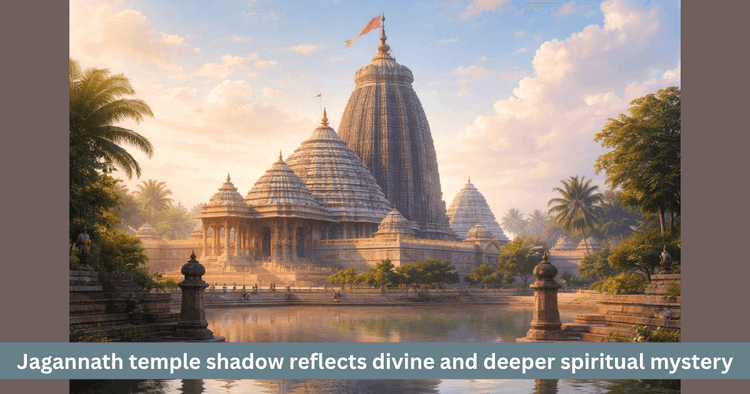
Table of Contents
In Indian temple tradition, certain sacred places are not merely centers of worship. They become living symbols where faith, architecture, experience and divine presence are felt together. The Shri Jagannath Temple of Puri is one such great pilgrimage center. Many special features connected with this temple have fascinated devotees, travelers, traditional scholars and seekers for centuries. Among them, one especially discussed belief is that the shadow of the main dome of Jagannath Temple does not clearly appear on the ground at any time of the day. This statement has long awakened wonder, devotion and contemplation in the minds of people.
This episode does not remain only a matter of structure. As soon as the mind pauses before this idea, a deeper spiritual question also arises. Is this only an effect of perspective, is it due to a special architectural arrangement or is it one of those experiences that devotees receive as a divine sign. Indian tradition often sees the greatness of a sacred site not only in stone, height, direction and construction but also in the consciousness accumulated there through generations. The belief connected with the shadow of Jagannath Temple belongs to this living tradition.
In the traditional understanding associated with Kapila Samhita, such signs are not viewed merely as physical details. They are also seen through the spiritual dignity and uniqueness of the pilgrimage site itself. That is why this episode should be approached not only with the eyes but also with the memory of tradition and the vision of devotion.
Why is this belief so widely known
Puri Dham is known for many extraordinary features. The temple flag, the Sudarshana Chakra, the Mahaprasada, the Ratha Yatra, the Nilachakra and the unique form of Lord Jagannath all make this sacred place remarkable. In that atmosphere, the belief connected with the shadow of the main dome is also remembered not as a mere architectural curiosity but as part of the living greatness of the temple.
This belief became especially famous because a shadow is considered a very ordinary and natural thing. If there is sunlight, a structure and height, then the formation of a shadow is expected. therefore when it is said that the shadow of such a vast and elevated temple is not clearly seen on the ground, the mind naturally pauses. From that pause arise both questions and reverence.
Thus this episode works on two levels
- On one level it creates architectural wonder
- On another it deepens the sense of divine presence
What does the absence of a visible shadow suggest spiritually
In Indian thought, both light and shadow have meanings beyond the physical. Light often symbolizes consciousness, knowledge, grace and the presence of the Divine, while shadow may sometimes be associated with limitation, illusion or dense worldly perception. From this perspective, when a devotee hears that the shadow of the main dome of Jagannath Temple is not seen on the ground, it is not received merely as an architectural observation. It is also taken as a symbol that the Lord’s glory transcends ordinary measurement.
This belief may awaken several spiritual impressions in the mind of a devotee
| Aspect of the belief | Spiritual meaning |
|---|---|
| The unseen shadow | Divine reality transcending ordinary limits |
| The main dome | The highest presence of the Lord |
| Absence of shadow on the ground | The glory of Jagannath beyond worldly measurement |
| Pilgrimage experience | A place to be felt, not merely observed |
Such an interpretation is not presented in the style of technical proof. It belongs more to the language of devotional experience. A pilgrimage place is not merely seen. It is lived.
Why is the architecture of Jagannath Temple considered so special
The Shri Jagannath Temple of Puri is held in high regard not only in the religious sense but also in the tradition of sacred architecture. Its towering main spire, its upward ascent, its structural arrangement and its strong visual presence against the sky all contribute to its majesty. In such temples, certain features sometimes remain remembered for generations as objects of wonder and reverence, even when they are not immediately explained in ordinary ways.
The main dome of Jagannath Temple is not merely the upper architectural element of the shrine. It becomes the visual center of the pilgrimage from afar. The one who sees it does not only see height in stone but often experiences in that height a symbol of ascent, elevation and inner rising. For this reason, the belief connected with its shadow also becomes more than an observation. It becomes part of pilgrimage experience.
Is this only a visual phenomenon or also an experience
A very important distinction must be understood here. Some things are merely seen, while others are primarily experienced. The belief about the shadow of Jagannath Temple belongs more to the second category. It is something that causes people not only to analyze but also to wish to stand before the temple and experience the space for themselves.
That is one of the defining qualities of a sacred pilgrimage. A great part of pilgrimage tradition rests on direct feeling and lived encounter. One may hear a story but upon arriving there, the same story takes on an entirely different meaning within. The same is true of this temple. The question of the shadow is not only about angle and structure. It is also about the sense of wonder that naturally arises when one stands before the temple.
How does Kapila Samhita give importance to this sign
The tradition connected with Kapila Samhita views many features of Jagannath Dham as marks of the greatness of the pilgrimage itself. In such sources, a special occurrence is not presented merely as a marvel but as a sign that reveals the unique dignity of the sacred place. In this light, the episode of the temple’s shadow suggests that Jagannath Dham has not been understood as an ordinary place. It is a field where many things take on a meaning beyond common expectation.
The importance of the source lies also in the fact that it reminds us that in Indian tradition the identity of a sacred site is not built only on physical detail. It is shaped by story, experience, collective memory and scriptural reverence together. Kapila Samhita represents this united vision.
How do devotees understand this belief
For devotees, the idea that the shadow of the temple’s main dome is not seen often deepens the feeling that Lord Jagannath is not merely a deity confined within a shrine but truly the Lord of the Universe, whose glory cannot be contained within ordinary rules. A devotee may feel that where ordinary objects cast shadows, Jagannath’s majesty is not confined to one visible law.
From the devotional point of view, this belief can awaken the following impressions
- The Lord’s greatness is beyond ordinary rules
- A pilgrimage is not just architecture but a field of consciousness
- What is not seen can still be the deepest sign
- God is understood not only through sight but through reverence
It is also important to remember that the purpose of devotional tradition is not always to bind every matter to outer proof. Sometimes its purpose is to preserve that living experience which has inspired devotion through generations.
The relationship between shadow and self awareness
If this episode is read more deeply, it also offers a suggestion about inner life. Human life is often governed by its own shadows. Hidden fears, memories, ego, insecurity and unresolved tendencies continue to influence decisions. In that sense, the temple of Jagannath seems to point toward a state in which shadow falls away and only the center of light remains.
This is a symbolic interpretation, yet it is deeply beautiful. The presence of the Lord seems to call the devotee toward a state where the shadows within are recognized and gradually transcended. In that sense, the main dome of the temple becomes not merely a structure but a symbol of the ascent of the soul.
What lessons does this feature of Jagannath Temple offer
The lessons that arise from this belief are not limited to temple description. They also point toward deeper truths of life.
First lesson: Not every truth reveals itself immediately
Some realities cannot be grasped at once. They require time, experience and humility.
Second lesson: Wonder itself can be a door to spirituality
It is not necessary that every question be solved immediately. Sometimes the presence of a question elevates the mind.
Third lesson: Divine presence cannot be reduced to ordinary rules
The sacred often operates beyond the boundaries that the human mind calls normal.
Fourth lesson: A pilgrimage is not merely a place to visit
It is a field where sight, feeling, story and experience together create spiritual meaning.
Is this episode still relevant today
Yes and very deeply. The modern person sees much but often experiences little. There is much measurement but little inward receptivity. In such a time, the belief connected with the shadow of Jagannath Temple reminds us that some truths are understood not only through analysis but also through humble wonder.
This also teaches the modern mind that not everything unseen is superstition and not every indirect experience is illusion. Some things must first be approached with reverence before they can be understood. That is the vision of pilgrimage and also the maturity of tradition.
The final radiance of this episode
The belief that the shadow of the main dome of Jagannath Temple is not clearly seen on the ground has attracted people for generations. But its true significance lies not only in the fact that it is a striking architectural phenomenon. Its deeper meaning is that Indian sacred consciousness has always experienced Jagannath Dham as a field where even ordinary rules begin to carry higher significance. Here the question of the shadow is not only about light and angle but also about vision and lived experience.
The tradition connected with Kapila Samhita teaches that the glory of God often shines most strongly where ordinary understanding comes to a pause. That pause gives birth to devotion. That wonder becomes the doorway to meditation. And for this reason, this special feature of Jagannath Temple becomes not merely a topic of discussion but a deep basis for reverence, contemplation and inner experience.
Frequently Asked Questions
What special belief is associated with Jagannath Temple
A widely known belief says that the shadow of the temple’s main dome is not clearly visible on the ground.
What is regarded as the main source of this tradition
The principal source associated with this tradition is considered to be Kapila Samhita.
How do devotees view this belief
Devotees see it as a sign of the unique glory and divine presence of Jagannath Dham.
Is this episode understood only architecturally
No. It is also understood spiritually, symbolically and as part of pilgrimage experience.
What lesson does this belief offer
It teaches that the glory of God should be understood not only through outer observation but also through reverence, experience and humility.
Get your accurate Kundali
Generate KundaliDid you like it?
Author

Pt. Nilesh Sharma (63)
Experience: 20
Consults About: Family Planning, Career
Clients In: Punjab, Haryana, Delhi
Share this article with friends and family
About ZODIAQ
ZODIAQ is an online Vedic Astrology platform. It connects clients seeking astrological advice to experienced astrologers with deep knowledge. Our users also generate kundali and perform kundali milan for free. ZODIAQ also offers services to the Astrologers. Astrologers utilize various offerings by ZODIAQ to serve their clients effectively.
If you are a User
Consult with experienced astrologers and seek their guidance. You can also order handwritten Janm Patrika report with life prediction prepared by experienced astrologers. Generate accurate Kundali, perform Kundali Matching and check horoscope and muhurat. Utilize our online library for all the necessary astrological and spiritual information.
If you are an Astrologer
Create accurate kundali for your clients and perform Kundali Matching for up to 5 people at a time. Write comprehensive Janm Patrika report for your clients with ZODIAQ. Check client details anytime by saving it in client directory. Become more productive by tracking how many clients you guide every day.
WELCOME TO
ZODIAQ
Right Decisions at the right time with ZODIAQ
