Shri Krishna’s Living Heart and the Meaning of Brahma Padartha
By Aparna Patni
Exploring the spiritual mystery behind Jagannath tradition and Krishna’s eternal essence
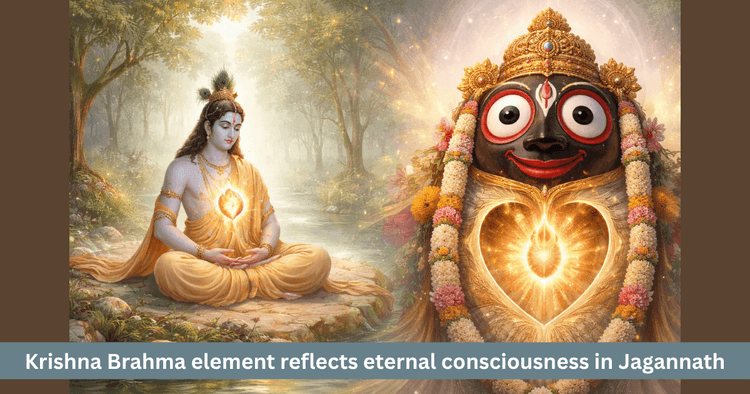
Table of Contents
In the Indian spiritual tradition, certain narratives are not limited to history or faith alone. They offer a profound understanding of life, death, body, consciousness and divine presence. The episode of Shri Krishna’s living heart belongs to that rare class of sacred traditions. At a simple level, the story appears wondrous. It is believed that when Shri Krishna gave up his mortal form, his entire body dissolved into the five elements, yet his heart did not perish. It continued to burn, continued to remain alive and was preserved as a divine center. In the Jagannath tradition, this sacred principle is understood as Brahma Padartha.
It is said in the Utkala Khanda of the Skanda Purana that Krishna’s body dissolved in the natural order, yet the divine essence within him did not come to an end. That is why in the Jagannath tradition there remains a deep belief that within the murti of Bhagavan Jagannath there still exists a divine center which cannot be understood through ordinary perception. It is known only through devotion, tradition and sacred ritual continuity. This is not merely a story about a heart. It is the story of that imperishable principle which does not end even when the body is gone.
This Episode Is Not Merely About a Miracle
If this story is treated only as a wonder tale, its real meaning becomes much smaller. In Indian philosophy, the heart of Bhagavan is not understood merely as a physical organ. The heart also signifies the center of consciousness, the source of compassion, the seat of divine love and the living presence of God. therefore when tradition says that Shri Krishna’s heart did not burn away, it does not only point toward a physical event. It also means that divine love, divine consciousness and the central essence of the avatar are not mortal.
This episode invites us to reflect upon several deeper questions:
- Does everything come to an end when the body perishes
- Is the presence of an avatar limited only to physical form
- Is there something that remains even after death
- Is the true nature of divinity located more in the unseen than in the seen
These questions make this narrative spiritually profound and enduring.
What Should Brahma Padartha Mean
In the Jagannath tradition, the expression Brahma Padartha is regarded as deeply sacred and inwardly mysterious. It is not understood as an ordinary object. Nor is it enough to dismiss it as a symbol alone. It points toward that divine principle which prevents the murti from remaining only a crafted form and makes it instead the center of a living presence.
Brahma Padartha may be understood through three dimensions:
| Dimension | Meaning |
|---|---|
| Physical | A sacred principle placed within the murti |
| Spiritual | A sign of the continuing presence of the Divine |
| Philosophical | The continuity of consciousness beyond bodily form |
This makes it clear that Brahma Padartha cannot be understood merely as a ritual element. It stands at the center of the Jagannath tradition as the faith that divinity may change form, yet it does not end.
Why Is It Specifically Referred to as the Heart of Krishna
This too is a very deep question. Tradition could have spoken about another part of the body or some other divine remnant, yet it especially speaks of the heart. In Indian spiritual language, the heart is not only the bodily center but also the center of feeling. Shri Krishna himself is the symbol of love, divine play, compassion, sweetness and the sacred bond between the Divine and the individual soul. therefore the survival of his heart means that the greatest message he brought into the world, the message of love that does not perish, continues to remain alive.
The symbolism hidden in this belief is beautiful:
- Krishna’s body dissolved into the elements but his principle of love did not disappear
- His avatar completed its visible form, yet the pulse of his consciousness remained
- His earthly presence withdrew, yet his living center of grace continued in Jagannath
- His heart became the sign that God’s love is greater than bodily form
Why Does This Belief Hold Such a High Place in the Jagannath Tradition
Bhagavan Jagannath of Puri is not understood merely as another form of Vishnu or Krishna. He is worshipped as a divine form in whom one sees the meeting of folk devotion, Vaishnava spirituality, regional sacred tradition and the balance of both bhoga and yoga. Even the form of his murti differs from conventional iconographic models. That difference itself indicates that divinity here is not confined to outer beauty according to classical standards. It is experienced as a living presence.
Within such a sacred tradition, the belief in Brahma Padartha establishes that Jagannath is not merely a memorial to Krishna. He is the continuing embodiment of that very living essence of Shri Krishna. That is why, for the devotee, the darshan of Jagannath becomes not only the viewing of a sacred image but the darshan of a divine heart that continues to pulse.
Does This Story Also Explain the Difference Between Body and Soul
Yes and very deeply. Indian philosophy repeatedly teaches that the body is mortal, while the essence of consciousness is not. The story of Shri Krishna’s living heart presents that same truth in a devotional and cultural form. The dissolution of the body into the five elements tells us that the body belongs to nature. The preservation of the heart signifies that the divine essence stands beyond nature.
This episode allows the distinction between body and consciousness to be understood in a simple but powerful way:
- The body changes
- Form disappears
- Even names may take on new expressions through time
- Yet the Brahman principle remains
That is why this episode is not only a sacred belief. It also expresses a subtle truth of Vedantic understanding.
What Is the Meaning of Fire in This Story
When it is said that Shri Krishna’s heart continued to burn, the fire here also has a special significance. Fire does not only destroy. In Indian tradition, fire also symbolizes purification, transformation, sacrament and the testing of truth. That which passes through fire and yet is not consumed cannot be considered ordinary. therefore the living heart in this story indicates something that stood beyond ordinary destruction. It was purified, sanctified and imperishable.
The symbolism of fire in this episode may be understood in the following way:
- That which is mortal is consumed by fire
- That which is divine becomes even more evident through fire
- Fire may reduce the body to ash but not the Brahman principle
- Thus Brahma Padartha becomes a symbol of imperishability beyond destruction
Can the Idea of a Beating Heart Within Jagannath Also Be Understood Symbolically
This is an important question and it may be understood on more than one level. For the devotee, it is a living truth of faith. For the philosopher, it is also an extremely powerful symbol. Symbolically, it means that the murti of Bhagavan Jagannath is not merely a fixed wooden form. It is a center of living divine presence. Just as the human body remains alive through the heart, the form of Jagannath is regarded as living through that inward Brahma Padartha.
Here, symbolism and devotion do not stand against each other. They deepen one another.
What Is the Emotional Meaning of This Story
For the devotee, this story is profoundly consoling. If Shri Krishna’s heart still lives in Jagannath, then it means that the Lord has not abandoned the world. He is present in another form. This feeling becomes the foundation of devotion. It says that God has not gone far away. His love, his heart and his center of grace are still alive.
That is why this episode awakens three powerful emotions in the heart of the devotee:
- Presence within separation
- Continuity within loss
- Living love within the unseen
This is what makes Jagannath devotion not merely ritual but a deep emotional and spiritual current.
What Can the Modern Mind Learn From This Story
The modern mind often depends heavily upon visible proof, logic and external form. This perspective has its value but some truths of life do not unfold through logic alone. Certain realities are understood only through experience, symbol and tradition. The story of Shri Krishna’s living heart teaches the modern person that what is most essential may not always be visible and yet it may be what is most alive.
For the present age, this story teaches us:
- There is something greater than bodily form
- Love may endure beyond death
- Tradition is not merely about the past but also about living experience
- Divine presence is recognized not only through the eyes but through the heart
The Final Illumination of This Episode
The tradition of Shri Krishna’s living heart and the Brahma Padartha within Jagannath belongs to those profound dimensions of Indian spirituality where faith, philosophy, symbol and devotion come together. It is said in the Utkala Khanda of the Skanda Purana that Shri Krishna’s body dissolved into the five elements, yet his heart remained. This is not merely a story of marvel. It reveals the truth that the love of the avatar, the consciousness of the Divine and the Brahman principle are beyond death.
therefore it may be said that the Brahma Padartha within Jagannath represents that immortal divine heart which reminds the world that the love of God never comes to an end. Form changes, the body fades but the divine pulse remains. That is the most beautiful and deepest meaning of this sacred narrative.
Frequently Asked Questions
Where is the story of Shri Krishna’s living heart found
It is said in the Utkala Khanda of the Skanda Purana that Krishna’s body dissolved into the five elements, yet his heart remained.
What is Brahma Padartha understood to be
In the Jagannath tradition, it is understood as the divine principle within the murti that signifies the living presence of the Lord.
Why is the heart specifically mentioned
Because the heart symbolizes Shri Krishna’s love, compassion and living consciousness.
Does this story also have a philosophical meaning
Yes, it expresses the mortality of the body and the continuity of the Brahman principle.
What lesson does this story offer today
It teaches that what is most alive is not always known through the eyes but through faith and the heart.
Get your accurate Kundali
Generate KundaliDid you like it?
Author

Aparna Patni (63)
Experience: 20
Consults About: Family Planning, Career
Clients In: Punjab, Haryana, Delhi
Share this article with friends and family
About ZODIAQ
ZODIAQ is an online Vedic Astrology platform. It connects clients seeking astrological advice to experienced astrologers with deep knowledge. Our users also generate kundali and perform kundali milan for free. ZODIAQ also offers services to the Astrologers. Astrologers utilize various offerings by ZODIAQ to serve their clients effectively.
If you are a User
Consult with experienced astrologers and seek their guidance. You can also order handwritten Janm Patrika report with life prediction prepared by experienced astrologers. Generate accurate Kundali, perform Kundali Matching and check horoscope and muhurat. Utilize our online library for all the necessary astrological and spiritual information.
If you are an Astrologer
Create accurate kundali for your clients and perform Kundali Matching for up to 5 people at a time. Write comprehensive Janm Patrika report for your clients with ZODIAQ. Check client details anytime by saving it in client directory. Become more productive by tracking how many clients you guide every day.
WELCOME TO
ZODIAQ
Right Decisions at the right time with ZODIAQ
