Nabakalebara: The Sacred Process of Renewal and Rebirth in the Jagannath Tradition
By Pt. Suvrat Sharma
A divine spiritual ritual reflecting the continuity of life, death, and the eternal soul
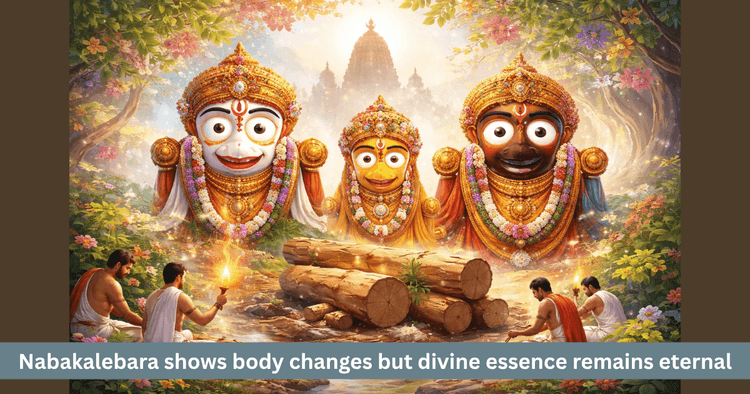
Table of Contents
In the Indian spiritual tradition, there are many rituals that are not merely forms of worship but living expressions of deep truths about life, death, transformation and continuity. The tradition of Nabakalebara associated with Bhagavan Jagannath, Bhagavan Balabhadra, Maa Subhadra and Shri Sudarshana belongs to that rare class of sacred processes. At first glance, it may appear to be only the replacement of deities but inwardly it reveals the philosophical truth long proclaimed in Indian thought, that the body changes, yet the divine essence does not.
It is mentioned in the Madala Panji that at fixed intervals, generally after 8, 12 or 19 years, when special astrological and calendrical conditions arise, the old sacred forms of the deities are ceremonially replaced. The previous forms are respectfully placed into the earth through a deeply sacred process and new forms are created from specially chosen neem wood, known as daru. This is not merely an act of ritual craftsmanship. It is a profound spiritual transition in which the entire town of Puri enters an extraordinary sacred atmosphere. During this period, even the city’s electricity is cut off, making it clear that this is not an event to be casually observed but a mystery to be inwardly experienced.
What Does the Word Nabakalebara Mean
The word Nabakalebara is made of two parts. Naba means new and kalebara means body. Thus, Nabakalebara literally means assuming a new body. The term itself beautifully unites devotion, philosophy and living ritual. To say that Bhagavan assumes a new body reflects a deeply subtle spiritual understanding. Here the deity is not treated as a static image but as a living sacred presence.
This tradition teaches a profound truth. For human beings too, the body is not permanent. Birth, decline, transition and renewal are all part of existence. Nabakalebara transforms this truth into divine play. It shows that change is not destruction. At times, change itself becomes the means of continuity.
Why Does This Process Not Take Place Every Year
Nabakalebara is not an annual celebration. It takes place only when special astrological conditions are fulfilled. Traditionally, the year in which the lunar month of Ashadha contains an adhika masa or extra month, is regarded as suitable for this sacred event. That is why it does not happen every year but only after long intervals. This rarity is one reason why devotees experience it as a deeply precious and extraordinary occurrence.
Its importance increases even more because it reminds us that certain spiritual events are not governed by ordinary calendar time alone. They unfold in accordance with a cosmic rhythm. Nabakalebara is an expression of that divine rhythm.
Key points that explain the uniqueness of Nabakalebara
- It is not merely replacement of idols but a living expression of the philosophy of rebirth
- Its timing is determined not by routine dates but by special astrological alignment
- It unites ritual carving, mantra, secrecy, tradition and collective devotion
- It helps devotees understand the distinction between body and divine essence
Why Is the Search for Daru So Important
One of the most mysterious and emotionally powerful parts of Nabakalebara is the search for daru. The new sacred forms are not made from any ordinary wood. Specially marked neem trees are sought for this purpose. This is not like an ordinary search in a forest. It is governed by ritual process, sacred signs, dreams, inherited knowledge and strict traditional rules. Those who are entrusted with this task do not see it as a mere responsibility but as a form of divine command.
Many sacred signs are observed in the selection of daru. The tree’s location, the presence of nearby river or cremation ground, serpent signs, divine markings, branch formation and other traditional symbols all become part of the discernment. This means that the new body of Bhagavan is not taken from arbitrary material but from a recognized sacred living tree. In this way, the ritual also expresses a profound bond between divinity and nature.
What Is the Meaning of Burying the Old Forms
This is among the most moving traditions of Nabakalebara. The old sacred forms are not discarded, burned or neglected. They are reverently offered to the earth in a sanctified place within the temple complex. This act reflects the remarkable sensitivity of Indian spirituality. The previous murti is not regarded as an old object. It is the former body of Bhagavan and so it is honored in the same way one would honor the departed body of a deeply revered being.
The deeper philosophical meaning of this act is profound:
- The body changes but the indwelling essence remains
- The old form is worthy of reverence because it too once bore divine presence
- Change does not mean rejection but honored transition
- Death and rebirth are not opposites but two stages of one cycle
That is why Nabakalebara is not only a celebration of new sacred forms. It is also a process of bidding farewell to the previous body with deep reverence.
Why Is the Electricity of the City Cut Off
This is one of the most mysterious aspects of Nabakalebara. In modern terms, it may seem extraordinary that the city’s electricity is cut during the process. Yet in spiritual terms, it is deeply meaningful. The transfer of the divine principle within Bhagavan, regarded as one of the most secret and sacred moments in the entire ritual, is not performed under ordinary public light or external visibility. Here darkness does not symbolize fear. It symbolizes sacred concealment.
This darkness carries several subtle meanings:
| Element | Deeper Meaning |
|---|---|
| Electricity being cut | Sacred distance from the outer world |
| Darkness | Symbol of womb, secrecy and rebirth |
| Restricted participation | Protecting the divine act from ordinary gaze |
| Silent atmosphere | Giving central place to the inward spiritual process |
This darkness may be understood almost like the sacred darkness of gestation. Just as life is formed in hiddenness before birth, the new body of Bhagavan too reaches completion within this holy concealment.
Is This a Direct Symbol of Rebirth
Yes and perhaps one of the most vivid collective expressions of rebirth in Indian tradition. Nabakalebara directly proclaims that form changes but presence does not. A new body is made but devotees know that this is not a new deity. It is the same Bhagavan manifest in a renewed form. This is one of the most beautiful expressions of rebirth.
The process gives ritual form to the Vedantic teaching that the essential self changes bodies, yet does not perish. Nabakalebara does not leave this truth as an abstract doctrine. It transforms it into celebration, sacred action and collective experience.
The Emotional Relationship Between Nabakalebara and the Jagannath Tradition
In the Jagannath tradition, Bhagavan is experienced in a deeply intimate and living way. He falls ill, rests, comes out upon the chariot and in Nabakalebara assumes a new body. Because of this living nearness, the devotee’s relationship with Jagannath does not remain limited to worship. It becomes a form of participation. When Nabakalebara takes place, devotees do not see it merely as a religious event. They experience it almost as if they are standing near one of the most intimate moments in the divine life of Bhagavan.
That is why during this sacred period, separation, joy, reverence, wonder and devotion all arise together.
Major emotional currents present in this ritual
- Separation, because the previous body is being left behind
- Joy, because a new divine form is emerging
- Mystery, because the inner process remains hidden
- Faith, because devotees know that Bhagavan has not gone anywhere but only assumed another form
Does Nabakalebara Offer a Teaching for Human Life Too
This is a very important question. Nabakalebara is not only a temple ritual. It is also a profound mirror for human existence. It reminds us that change is unavoidable. Bodies change, relationships change, situations shift, identities evolve. Yet if the inner center remains true, then change need not be destructive. It may become a means of growth.
Nabakalebara also teaches:
- Not every change should be feared
- Giving respectful farewell to what is old is also a spiritual act
- Assuming a new form is not weakness but a sign of living continuity
- What is inwardly real remains even when the outer form changes
The Meeting of Tradition, Scripture and Sacred Mystery
The Nabakalebara tradition described in the Madala Panji is not only a matter of scriptural instruction. It unites folk devotion, temple order, the lineage of the daita servitors, sacred craftsmanship, secret rites and the living culture of Jagannath bhakti. That is why it cannot be understood merely as a ritual law. It is a living cultural body in which history and divinity breathe together.
The atmosphere in Puri during Nabakalebara shows that in the Indian tradition, sacred rituals are not merely mechanical ceremonies. They are also acts of collective spiritual renewal.
The Deepest Message of This Tradition
The greatest beauty of Nabakalebara is that it does not treat death as an end. It treats it as a doorway of transformation. The old form departs, the new form appears, yet Bhagavan remains the same. This understanding offers deep consolation even to the human heart. It becomes possible to see that change of form is not loss alone. It may also be a new expression of continuity.
That is why it would be inadequate to describe Nabakalebara as merely the changing of idols. It is truly a festival of the impermanence of the body and the continuity of divinity.
The Final Reflection
Nabakalebara of the Jagannath tradition is one of those great sacred inheritances of Indian spirituality in which philosophy, devotion, mystery, astrology, craftsmanship and folk life all become visible together. The process described in the Madala Panji teaches that Bhagavan himself assumes a new body, so that human beings may understand that continuity can remain even when form changes. The respectful burial of the previous sacred forms, the carving of the new ones from chosen daru and the intense secrecy of the entire process together make Nabakalebara a truly extraordinary spiritual event.
therefore it may be said that Nabakalebara is not only a festival of the Jagannath Temple. It is a living remembrance of the truth that what is truly divine never comes to an end. It simply assumes a new body.
Frequently Asked Questions
What does Nabakalebara literally mean
Nabakalebara means new body or assuming a new sacred form.
After how many years does this ritual take place
It usually occurs after intervals of 8, 12 or 19 years when special astrological conditions arise.
What are the new murtis made from
The new forms are carved from specially identified neem wood, known as daru.
What happens to the old murtis
They are respectfully buried within the temple complex through a sacred process.
Why is the electricity cut during Nabakalebara
Because the process is considered deeply secret and sacred and it is protected from ordinary public visibility.
Get your accurate Kundali
Generate KundaliDid you like it?
Author
Pt. Suvrat Sharma (63)
Experience: 20
Consults About: Family Planning, Career
Clients In: Punjab, Haryana, Delhi
Share this article with friends and family
About ZODIAQ
ZODIAQ is an online Vedic Astrology platform. It connects clients seeking astrological advice to experienced astrologers with deep knowledge. Our users also generate kundali and perform kundali milan for free. ZODIAQ also offers services to the Astrologers. Astrologers utilize various offerings by ZODIAQ to serve their clients effectively.
If you are a User
Consult with experienced astrologers and seek their guidance. You can also order handwritten Janm Patrika report with life prediction prepared by experienced astrologers. Generate accurate Kundali, perform Kundali Matching and check horoscope and muhurat. Utilize our online library for all the necessary astrological and spiritual information.
If you are an Astrologer
Create accurate kundali for your clients and perform Kundali Matching for up to 5 people at a time. Write comprehensive Janm Patrika report for your clients with ZODIAQ. Check client details anytime by saving it in client directory. Become more productive by tracking how many clients you guide every day.
WELCOME TO
ZODIAQ
Right Decisions at the right time with ZODIAQ
