The Secret of the Sudarshan Chakra: Why the Nilachakra Always Appears to Face You
By Aparna Patni
The fascinating mystery of Nilachakra revealing architecture, faith and the divine omnipresence in one powerful symbol
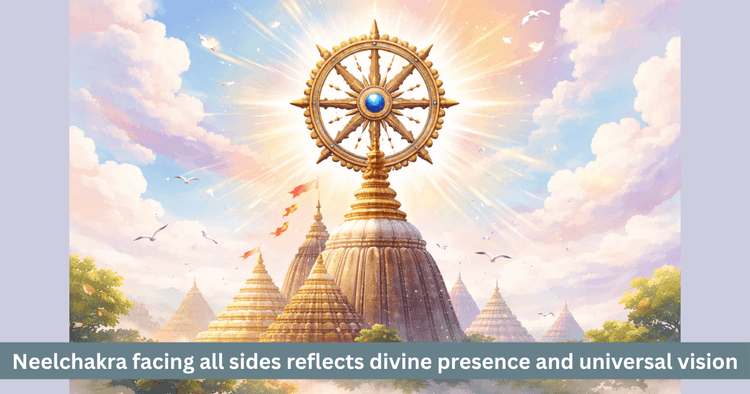
Table of Contents
In the sacred traditions of India, certain temple features do not awaken devotion alone. They also stir the mind, the intellect and the inner eye together. The towering shrine of Shri Jagannath, the unique form of the Lord, the grandeur of the Ratha Yatra, the sanctity of Mahaprasada and the remarkable presence of the Nilachakra together make Puri far more than an ordinary pilgrimage site. Among these special features, one of the most widely discussed beliefs is that the Nilachakra placed atop the temple appears to face you from any corner of Puri. At first hearing, this inspires only amazement. But when the mind pauses before it, the subject grows beyond architecture and becomes a profound symbol of vision, centeredness, divine omnipresence and the intimate bond between the Lord and the devotee.
The Nilachakra is not viewed merely as a metal disc fixed upon the summit of the temple. It is understood as a sign of the Lord’s presence, protection, awareness and sacred watchfulness. The traditional belief says that wherever one stands in Puri, the face of the Nilachakra appears turned toward the viewer. This experience does not only fill the observer with wonder. It also creates the feeling that the Lord is not seated at a distance. He is looking toward every devotee from every direction. That is why this phenomenon cannot be described adequately as an architectural curiosity alone. It is also a living spiritual sign.
In the traditions of Vastu Shastra and lok katha, the Nilachakra is regarded as deeply significant. On one side it reflects remarkable sacred design. On the other it gives the devotional mind the experience that the Divine remains constantly present. That is its deepest attraction.
What is the Nilachakra and why is it considered so sacred
The Nilachakra installed atop the Shri Jagannath Temple is not treated as an ordinary wheel. It is a sacred ashtadhatu, an eight metal alloy, disc and is revered as a symbol of auspiciousness, protection and divine force. Its placement at the summit of the temple is not merely decorative. It gives outer form to the spiritual idea that a temple is not only a building but a living divine center.
The Nilachakra is considered sacred for several reasons
- It is placed at the highest point of the temple
- It is regarded as a sign of the Lord’s vigilant presence
- It is associated with the spirit of Sudarshan
- It becomes a means of darshan even from afar
When the very summit of the temple becomes a divine sign, the wheel upon it ceases to be only a structural element. It becomes a living focal point of sacred sight.
Why is it associated with the Sudarshan Chakra
In the Jagannath tradition, the Nilachakra is not seen only as an architectural disc. Many devotees connect it with the Sudarshan principle of Lord Vishnu and Lord Jagannath. Sudarshan is not merely a weapon. Its deeper meaning includes right vision, divine protection, the cutting of adharma and the preservation of dharma. Seen from this perspective, the Nilachakra upon the temple summit becomes a continuous sign that the Lord’s awareness is not confined within the sanctum. It extends over the whole field.
If this symbol is read deeply, it becomes clear that Sudarshan is not only the discus of battle. It is also the wheel of consciousness. It is the vision that cuts through confusion. It is the force that draws life back toward its center. This gives the Nilachakra an even greater significance.
Why does it appear to face you from every direction
This is the question that has fascinated people for generations. Popular belief says that from any corner of Puri, the face of the Nilachakra appears turned toward the observer. Some understand this as the result of architectural genius, some as an effect of visual perspective and many devotees receive it as a sign of divine presence. In Indian tradition, these levels are often not placed against one another. Architecture, symbolism and experience together create the meaning of a sacred place.
This feature may be understood at three levels
| Level | Meaning |
|---|---|
| Vastu | A special proportion and structural arrangement |
| Vision | The effect produced according to the observer’s position |
| Spiritual sign | The Lord keeps his gaze upon every devotee |
These layers do not oppose each other. What is remarkable in design may become a sign in devotion. What appears as visual wonder may become inner experience in spiritual life.
How does folklore understand this episode
Folklore often explains such sacred features in a language that is simpler and more intimate than formal analysis. In devotional oral tradition, the Nilachakra is understood as a sign that Lord Jagannath does not face only one direction. He is all seeing and therefore the wheel upon the summit too appears to turn toward every devotee. It becomes a silent assurance from the Lord that the one who comes to behold him is also being beheld.
This is a very beautiful feeling, because it is free from complication yet full of intimacy. The devotee feels not only that one is seeing the temple but that the temple too is seeing the devotee. This is one of the great tendernesses of Jagannath devotion.
Is the Nilachakra only an architectural object
No. If it is treated only as a structural object, its spiritual and cultural meaning becomes too small. The Nilachakra is a central part of the temple’s identity. Fixed upon the summit, it does not express height alone. It also becomes a symbol of direction, center and divine watchfulness.
The Nilachakra may be understood in several ways
- As a visible identifier of the temple
- As a sign of the sacred boundary of Jagannath Dham
- As an emblem of the Lord’s Sudarshan vision
- As a call drawing the devotee back toward the center
It is therefore more accurate to say that the Nilachakra is architecture, symbol and experience together.
The significance from the perspective of Vastu Shastra
In Vastu Shastra, the summit, direction and upper elements of a temple carry great importance. A temple is not formed only from the ground upward. Its rise toward the sky is equally significant, because the structure is seen as a bridge between earth and the higher realms. For this reason, the disc, flag or finial upon the temple top is never merely ornamental. It indicates force, direction and sacred purpose.
In relation to the Nilachakra, the perspective of Vastu may suggest
- Because it stands at a high central point, its visual effect spreads widely
- Its position and structure may create the impression of frontal presence for the viewer
- The geometry of the entire temple summit deepens that experience
While the tradition does not reduce the matter entirely to technical reasoning, the architectural aspect enriches the meaning of the phenomenon.
What is the deepest meaning of this for a devotee
If a devotee is asked why the Nilachakra appears to face every direction, the answer may be very simple. It is because the Lord looks toward everyone. This is perhaps the most living meaning of the entire tradition. The Lord is within the sanctum but his presence extends from the shrine upward into the sky. The Nilachakra becomes the visible sign of that invisible gaze.
For the devotee this may awaken many feelings
- The Lord is not only worship worthy but relational
- He is not distant but present
- He is not passive but attentive
- He belongs not to one but to all
This is why the sight of the Nilachakra becomes for many people not merely admiration of structure but a deep devotional experience.
The connection between the Nilachakra and inner spiritual practice
If this episode is read beyond outer marvel and brought into inner practice, it reveals another profound teaching. The human mind runs in many directions. Its attention remains scattered. It moves away from its own center. In such a condition, the summit wheel that appears to face the viewer from every direction seems to say that wherever you stand, the center is still calling you back.
In this way the Nilachakra becomes not merely something to look at but a symbol for meditation. It suggests that no matter how many directions life takes, the center of truth remains one. To return toward the Lord is to return toward inner steadiness.
Is there only wonder in this episode or also instruction
There is both. Wonder arrests the mind. Instruction transforms it. The phenomenon of the Nilachakra first astonishes and then teaches. It teaches that
- what stands highest holds the widest vision
- what remains centered can relate to every direction
- what is joined to God is not confined to one angle
- what sees the devotee awakens trust within the devotee
Thus, through the Nilachakra, a visible feature becomes the doorway to profound spiritual contemplation.
Why is this belief important in the modern age
One of the deepest problems of modern life is fragmentation. Attention is divided, life is split into parts and the mind has lost its center. In such a condition, the sign of the Nilachakra becomes very meaningful. It suggests that no matter how scattered life may seem, there is still a center that remains turned toward you from every direction.
This belief also teaches modern people that vision is not merely the act of looking. It is also the act of being connected. If the Lord’s wheel appears to face every viewer, it means that divine presence is not reserved for a chosen few. It can reach every person who lifts the gaze upward.
The final light of this episode
The belief that the Nilachakra atop Jagannath Temple appears to face the observer from every corner of Puri is not merely an interesting statement. It is a remarkable meeting of Vastu, folk tradition, devotion and spiritual symbolism. The traditions of Vastu Shastra and lok katha may explain it in different language, yet both lead finally toward one deep experience, which is that the Lord’s vision is not limited. He remains present toward every devotee from every direction.
The Nilachakra becomes the visible symbol of the truth that the God who stands at the center can touch all directions at once. That is why its darshan is not merely an upward glance. It is also a movement inward. When a devotee in Puri feels that the Nilachakra is facing one’s direction, the heart may awaken to the insight that the Lord is never too far away. One only needs to lift the gaze.
Frequently Asked Questions
What is the Nilachakra
The Nilachakra is the sacred eight metal alloy wheel installed upon the summit of the Jagannath Temple.
Why is it associated with the Sudarshan Chakra
Because it is regarded as a symbol of the Lord’s divine vision, protection and the spirit of Sudarshan.
Why does it appear to face every direction
According to traditional belief and experience, its position and form create the impression that it faces each observer.
What is regarded as the main source of this belief
This tradition is associated with interpretations from Vastu Shastra and with local devotional folklore.
What do devotees learn from this
They experience that the Lord’s gaze remains equally present upon all and that he is near from every direction.
Get your accurate Kundali
Generate KundaliDid you like it?
Author

Aparna Patni (63)
Experience: 20
Consults About: Family Planning, Career
Clients In: Punjab, Haryana, Delhi
Share this article with friends and family
About ZODIAQ
ZODIAQ is an online Vedic Astrology platform. It connects clients seeking astrological advice to experienced astrologers with deep knowledge. Our users also generate kundali and perform kundali milan for free. ZODIAQ also offers services to the Astrologers. Astrologers utilize various offerings by ZODIAQ to serve their clients effectively.
If you are a User
Consult with experienced astrologers and seek their guidance. You can also order handwritten Janm Patrika report with life prediction prepared by experienced astrologers. Generate accurate Kundali, perform Kundali Matching and check horoscope and muhurat. Utilize our online library for all the necessary astrological and spiritual information.
If you are an Astrologer
Create accurate kundali for your clients and perform Kundali Matching for up to 5 people at a time. Write comprehensive Janm Patrika report for your clients with ZODIAQ. Check client details anytime by saving it in client directory. Become more productive by tracking how many clients you guide every day.
WELCOME TO
ZODIAQ
Right Decisions at the right time with ZODIAQ
