The Devotion of Salabega: A Unique Story of Lord Jagannath’s Compassion
By Pt. Sanjeev Sharma
The unwavering devotion of a Muslim devotee that became a timeless example of love and surrender in Jagannath tradition
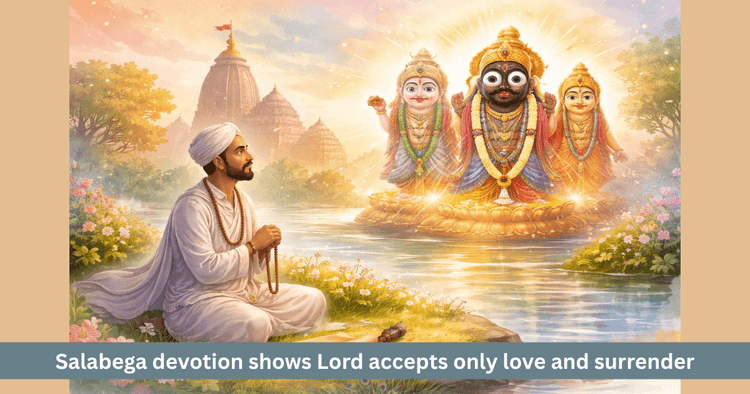
Table of Contents
The glory of Lord Jagannath is not limited only to the grandeur of the temple, the magnificence of the Rath Yatra or the depth of Vaishnava tradition. One of his greatest qualities is believed to be that he looks at the heart of the devotee, not at caste, birth, creed or social identity. The story that brings this truth forth in a deeply moving way is the story of the Muslim devotee Salabega. This is not merely a devotional episode. It is a living expression of that spiritual vision in which the greatest identity before the Lord is only love, surrender and true reverence.
This story holds a special place in the Jagannath tradition because devotion here does not appear confined within a narrow religious boundary. Instead, one sees a devotee whose social background belongs to a different stream, yet whose heart is wholly offered to Lord Jagannath. That is why the name of Salabega is remembered not only as that of a devotee but as a symbol of inclusive devotion, single minded love and the compassion of Jagannath.
Who was Salabega
Salabega is remembered in the Jagannath tradition as a great poet devotee. His life shows that the path toward God opens not only through birth but through the call of the heart. He is understood to have belonged to a Muslim background, yet his mind became so immersed in the devotion of Lord Jagannath that his name itself became a permanent part of the tradition of Jagannath bhakti.
His devotion was not limited to emotional remembrance alone. He gave voice to his longing, prayer, separation and yearning for darshan through poetry. That is why the memory of Salabega is not linked only with a miraculous story. It is also linked with devotional poetry, the cry of the soul and a heart yearning for the Lord.
Why is the story of Salabega considered so important
Many stories of saints and devotees are found in Indian bhakti tradition, yet the story of Salabega carries a very special tenderness and deep social meaning. It is not only an example of the fact that the Lord hears the devotee. It goes further and shows that in the presence of the Lord, outer identities may become secondary and the truth of the heart may become primary.
One of the most distinctive features of Jagannath dham is that the Lord is regarded as deeply close to ordinary people and full of compassion. The story of Salabega brings this feeling out with even greater clarity. It teaches that where the heart is sincere, divine grace can become wider than all the boundaries created by society.
Main indications of the story of Salabega
• The basis of devotion is not birth but the surrender of the heart.
• The grace of Lord Jagannath is understood as inclusive.
• The memory of Salabega lifts devotion above social boundaries.
• This story presents love as the deepest language of religion.
What was the nature of Salabega’s devotion to Lord Jagannath
The devotion of Salabega is regarded as deeply single minded and filled with feeling. He was not merely one who remembered the Lord by name. He was a seeker whose soul yearned for the darshan and grace of Lord Jagannath. In his compositions one repeatedly finds the feeling that the Lord was not for him only a deity to be worshipped but the center of life, the refuge of the heart and the final source of consolation.
In such devotion there is less formality and more intimacy. This same intimacy appears in the Jagannath bhakti of Salabega. For him the Lord was not only an image established in a temple. He was the Lord who hears the cry of the devotee, comes into the devotee’s path and accepts the devotee’s love. This is why the story continues to touch devotees deeply even today.
What does the episode of the chariot stopping after Salabega’s death signify
According to the sacred memory, after the death of Salabega, when his body came before the ratha, meaning the chariot of Lord Jagannath, the chariot stopped on its own. It is also said that it did not move forward until the soul of Salabega received due honor. This episode is not seen merely as an extraordinary event. It is understood as the visible sign of that unseen bond between the Lord and the devotee which does not end even after death.
The feeling of this episode is deeply profound. The stopping of the chariot appears to declare that the Lord does not overlook his beloved devotee. The body lies before the chariot, yet the center of the story is the dignity of the soul and the acceptance of devotion. For devotees, this episode has become a symbol of the truth that genuine love for the Lord never goes in vain.
Why is the stopping of the chariot understood as spiritually profound
In the Rath Yatra, the chariot of Lord Jagannath is not seen merely as a ceremonial vehicle. It is regarded as a moving symbol of divine grace, of the Lord’s desire to reach the people and of sacred compassion in motion. If that chariot stops for the honor of a devotee, then the meaning becomes far deeper than anything ordinary. It is as though the Lord himself acknowledges that the love of the devotee is precious to him.
The stopping of the chariot also symbolizes that the movement of God is not directed only by time, schedule or outward arrangement. At times it pauses in response to the cry of devotion. This is why the story of Salabega does not evoke only wonder. It also offers the feeling that the Lord himself protects the honor of his devotee.
Teachings received from the stopping of the chariot
• For the Lord, true devotion is of the highest value.
• The dignity of the devotee is not limited only to earthly life.
• The stopping of the chariot is seen as a symbol of direct divine acceptance.
• This story shows that the Lord never forgets the devotee.
What does it mean that the soul of Salabega received honor
Here honor is not merely a matter of funeral ritual or formal respect. The feeling of the story is that the soul of a supreme devotee like Salabega received from the Lord the reverence it truly deserved. It teaches that in devotion, outer titles do not decide worth. The state of the soul does. The one who has called the Lord with love has a secure place in the heart of the Lord.
In this sense, the story of Salabega also offers deep consolation. A person’s worldly life may be limited. Social identity may be surrounded by debate. Yet if the soul is truly joined with God, it may receive a dignity greater than any earthly order can bestow.
Does this story reveal the inclusive consciousness of devotion
Yes, very clearly. This story brings forth the inclusive consciousness of bhakti in a powerful way. Before Lord Jagannath, Salabega had the identity of a Muslim devotee, yet even more than that, he was a devotee whose heart was wholly surrendered to the Lord. For this reason the story inspires society to reflect on whether God can truly be confined within narrow identities.
The memory of Salabega teaches that true devotion often dissolves the walls human beings have erected among themselves. His honor within the Jagannath tradition may be understood as proof that the love of God is greater than the boundaries created by society.
What is the importance of the compositions of the poet devotee Salabega
The place of Salabega is important not only in story tradition but also in devotional literature. His compositions are regarded as evidence of his longing, surrender and inner attachment to Lord Jagannath. When a devotee turns love into words, it no longer remains only poetry. It becomes prayer, separation, yearning and the testimony of the soul.
For this reason, the significance of his compositions is not merely literary. It is also spiritual. They show that devotion is not only the intellectual language of one tradition. It can also be the music arising from the heart, capable of awakening reverence across generations.
What can a seeker learn from this story
The story of Salabega offers deep teaching to every seeker. It tells us that in order to reach God, the first necessity is to make the heart true. If there is no love within, outer identity has little value. But if there is love within, the Lord himself can make a way.
This story also teaches that in devotion there is great importance in humility, yearning, waiting and trust. The belief that the soul of Salabega received honor assures the seeker that the Lord does not leave unheard any true voice of devotion.
Main teachings from the story of Salabega
• Before the Lord, the greatest identity is devotion.
• True love can continue to have power even beyond death.
• For God, the truth of the soul matters more than social identity.
• Devotional literature can keep reverence alive within the seeker.
A simple table to understand this tradition
| Element | Spiritual and cultural meaning |
|---|---|
| Salabega | Poet devotee from a Muslim background |
| Lord Jagannath | Divine form of inclusive grace and compassion |
| Stopping of the chariot | Divine honor and acceptance of the devotee |
| Honor to the soul | Immortality of devotion and spiritual dignity |
| Devotional poems | Living remembrance of love, longing and surrender |
Why is the story of Salabega important in the present age
Today, when society is often troubled by many forms of identity, division and separation, the story of Salabega offers a very tender and powerful message. It teaches that the heart of religion does not beat in division but in acceptance, compassion and love. The stopping of Lord Jagannath’s chariot for his devotee becomes a symbol of the truth that for God, the language of love stands highest.
This story remains relevant because it invites the human being to look within. Is devotion merely the observance of tradition or is it truly the state of the heart. The life and memory of Salabega answer this question with rare beauty.
The compassionate pause of remembrance
This story of Salabega and Lord Jagannath reveals a form of devotion in which love accepts no walls. The cry of the devotee becomes so true that even the Lord’s chariot comes to a halt. This pause is not merely an event. It is the visible form of compassion. It is as though the Lord himself is saying that he never leaves true love behind.
This is the greatest power of the story. It teaches that what is joined to the heart in devotion can move beyond the limits of time, death and identity. That is why the memory of Salabega has become not merely an episode in the Jagannath tradition but a lasting light of inclusive love.
Frequently asked questions
Who was Salabega
Salabega is remembered as a great poet devotee of Lord Jagannath who, though linked with a Muslim background, remained immersed in Jagannath bhakti.
What is the meaning of the chariot stopping in the story of Salabega
It is understood as a symbol of the Lord Jagannath’s divine honor, love and acceptance toward his devotee.
Is the devotion of Salabega regarded as an example of inclusive bhakti
Yes. His story shows that for the Lord, the true heart matters more than social boundaries.
What is the importance of the compositions of Salabega
His compositions are regarded as a living spiritual memory of his love, longing and surrender to Lord Jagannath.
With which source is this tradition generally associated
It is generally associated with the compositions of the poet devotee Salabega.
Get your accurate Kundali
Generate KundaliDid you like it?
Author

Pt. Sanjeev Sharma (63)
Experience: 20
Consults About: Family Planning, Career
Clients In: Punjab, Haryana, Delhi
Share this article with friends and family
About ZODIAQ
ZODIAQ is an online Vedic Astrology platform. It connects clients seeking astrological advice to experienced astrologers with deep knowledge. Our users also generate kundali and perform kundali milan for free. ZODIAQ also offers services to the Astrologers. Astrologers utilize various offerings by ZODIAQ to serve their clients effectively.
If you are a User
Consult with experienced astrologers and seek their guidance. You can also order handwritten Janm Patrika report with life prediction prepared by experienced astrologers. Generate accurate Kundali, perform Kundali Matching and check horoscope and muhurat. Utilize our online library for all the necessary astrological and spiritual information.
If you are an Astrologer
Create accurate kundali for your clients and perform Kundali Matching for up to 5 people at a time. Write comprehensive Janm Patrika report for your clients with ZODIAQ. Check client details anytime by saving it in client directory. Become more productive by tracking how many clients you guide every day.
WELCOME TO
ZODIAQ
Right Decisions at the right time with ZODIAQ
