Amarkantak and Narada: Awakening Divinity Through Austerity
By Aparna Patni
Where nature and penance awaken higher consciousness
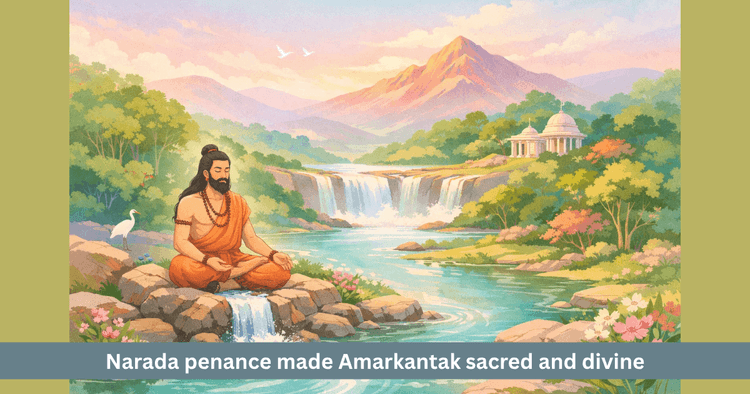
Table of Contents
In the spiritual tradition of India, there are certain places that cannot be described merely as sacred geography. They become centers of living consciousness. There the mountains are not only mountains, the waters are not only waters and the forests are not only landscapes. Together they create an atmosphere in which the human mind naturally begins to turn inward. Amarkantak is one such holy place. It is known as a source of rivers, a land of sages and a region where nature and spiritual practice meet in rare harmony.
In the Reva Khanda of the Skanda Purana, Amarkantak is presented not merely as a physical location but as an awakened spiritual field. It is here that the river Narmada is believed to arise. And this same land is also linked with a profound episode concerning the austerity of Narada Muni. When a sage like Narada, who moves through all three worlds and is regarded as a source of wisdom, chooses a place for tapas, that place can no longer remain ordinary. It becomes a silent teacher in itself.
Why is Amarkantak more than a mountain region
To the outer eye, Amarkantak may appear as a beautiful region of hills, forests, pathways and streams. But in the Indian spiritual view, the value of a place is not measured only by its visual beauty. It is also measured by the kind of energy, sage lineage and memory of practice that dwell there. That is why Amarkantak is special.
Its atmosphere is considered deeply favorable for spiritual discipline. Height, solitude, clean air, pure water and the presence of quiet nature together help draw the mind away from outer disturbance. This is why sages and seekers have long come to this region for contemplation and austerity. It does not merely attract visitors. It inwardly calls the seeker.
The significance of Amarkantak may be understood through these points:
- It is linked with the origin of Narmada
- It is remembered as an ancient land of tapas
- Its natural atmosphere supports contemplation
- Its spiritual memory still draws people inward
Why did Narada Muni choose Amarkantak for tapas
Narada Muni does not live a life of fixed residence. He is always moving. He is present among gods, kings, seekers and devotees. He carries knowledge, awakens devotion and at times becomes an active instrument in divine unfolding. If such a being chooses to remain at one place for tapas, it becomes natural to ask why that place was chosen.
The story says that Narada performed intense austerity in Amarkantak. This tapas was not for worldly gain, supernatural powers or personal achievement. It was for inner purification, spiritual steadiness and the realization of ultimate truth. This makes the story deeply meaningful. Even one who is a messenger of wisdom enters tapas. This shows that in spiritual life the journey never truly ends. The greater the consciousness, the subtler the refinement it seeks.
Some subtle reasons behind Narada’s choice may be understood as follows:
| Aspect | Deeper meaning |
|---|---|
| Solitude | Return of the mind toward the inner self |
| Purity of nature | Softening and settling of consciousness |
| Region of Narmada’s source | Union of water and austerity |
| Ancient sage lineage | Spiritually prepared land |
Was Narada’s tapas merely a personal practice
This is an important question. From an ordinary perspective, the austerity of a sage may seem like a private spiritual act. But Indian spiritual understanding says that the tapas of a great sage does not remain confined to that sage alone. Its influence enters the land, the water, the air and the subtle field of the place itself. That is why some places remain alive as tirthas for centuries.
The tapas of Narada likewise did not remain a private event. It is said to have filled the whole region with a special spiritual charge. When a being of elevated consciousness remains for a long time in remembrance of God, austerity and inner stillness, the place itself becomes spiritually transformed. It is no longer only a natural landscape. It becomes a cultivated sacred field.
This is why Amarkantak is not seen merely as a scenic destination. It is seen as a living land of tapas.
How does the atmosphere of Amarkantak deepen spiritual practice
The natural structure of Amarkantak itself works like a companion to sadhana. Dense forests soften the mind. Mountains teach stillness. Flowing waters suggest inward purification and movement. Open sky expands the inner sense of being. When all these are experienced together, the mind naturally begins to turn away from outer agitation and move toward its own center.
This is one of the greatest qualities of the place. Here sadhana does not happen only through the effort of the seeker. Nature itself becomes a fellow practitioner. In an age when human beings are constantly surrounded by noise, speed and external pressures, a place like Amarkantak reminds us that silence is power and nature can be a teacher.
The spiritual qualities of Amarkantak’s atmosphere include:
- Silence that steadies the mind
- Nature that softens consciousness
- Water that evokes purity
- Memory of sages that deepens inner receptivity
Why does the connection with the source of Narmada make this story deeper
The importance of Amarkantak increases even more because it is associated with the origin of the river Narmada. Narmada is not regarded in India as merely a river. She is worshipped as a goddess. Her waters are believed to carry not only physical purification but also mental clarity, spiritual quietude and sacred grace. This is why many paths of spiritual practice are connected with her.
When the story says that Narada Muni performed tapas in this very land, the link between austerity and Narmada becomes even more meaningful. This is not merely a sage meditating beside a river. It is the meeting of great tapas with a land from which sacred water itself arises. Narada’s austerity on the very soil of Narmada’s origin gives the place an even deeper spiritual significance.
The combined meaning of Narmada and Narada’s tapas may be seen as follows:
| Element | Spiritual indication |
|---|---|
| Narmada | Purification and sacred flow |
| Amarkantak | Origin and awakening |
| Narada’s tapas | Upward movement of consciousness |
| Their union | Sanctification of the land itself |
Are nature and spiritual practice truly connected
This is one of the most beautiful and relevant teachings of the story. Many think that spiritual practice belongs only in temples, meditation rooms or ritual spaces. But the sage traditions of India repeatedly teach that nature itself is a companion to sadhana. When a human being lives in balance with nature, the mind becomes more receptive, softer and inwardly more humble.
Amarkantak is a living example of this truth. Here mountains teach stability. Forests teach silence. Water teaches flow. Sky teaches vastness. If the seeker is attentive, every element of nature becomes spiritual instruction. Narada Muni’s tapas here is therefore not only personal discipline. It is also an example of the meeting of nature and awakened consciousness.
How did Narada’s tapas become a lasting energy in this land
A deep principle of Indian tirtha tradition is that the austerity of great beings remains in the land. From a modern perspective this may sound symbolic, yet spiritually it is highly meaningful. A place where mantra has been repeated, where the Divine has been remembered in silence and where ego has been melted through tapas becomes inwardly altered.
Narada’s austerity gave such a sanctifying impression to Amarkantak. This is why many who go there feel that the place is not only beautiful but inwardly calming. This is not viewed merely as psychological suggestion. It is also understood as the lingering presence of a sage tradition that remains alive in the subtle atmosphere.
This may be understood through the following points:
- The tapas of a sage does not remain only within the sage
- Spiritual discipline can sanctify a place
- A tirtha lives not only by history but by ongoing memory of practice
- The sacredness of Amarkantak is deepened by this lineage of consciousness
What does Amarkantak remind us of in the present age
Modern life has become highly external. Human beings live amid noise, speed, pressure and constant activity. In such a condition, it becomes difficult for the mind to return inward. Places like Amarkantak remain relevant because they remind us that to rediscover inner stillness, one sometimes must move away from the outer crowd.
The tapas of Narada teaches that true spiritual practice is not only for gaining information or religious merit. It is for understanding oneself. It is for quieting the mind, softening ego and leading consciousness to a level where one can see oneself more clearly.
For modern life, this episode offers the following teachings:
- Sacred places carry not only religious but also inner psychological value
- Living close to nature may deepen spiritual practice
- Silence can become one of the greatest teachers
- The purpose of tapas is not power but inner purification
Is the sacredness of Amarkantak only a matter of story
This is a natural question for the modern mind. If one insists on viewing everything only through the lens of historical proof, much of spiritual meaning remains lost. The sacredness of Amarkantak does not lie only in the claim that some sage once meditated there. It also lies in the fact that for centuries people have lived this place as a land of tapas, the source of Narmada, a field of sage memory and a place of inward peace.
The power of a sacred place lies not only in its past but also in its present experience. If a place even today humbles the mind, awakens silence within and brings a person closer to oneself, then it is sacred. The story of Narada strengthens this understanding in a powerful way.
Where spiritual practice is done in the right spirit, nature too becomes sanctified
Ultimately the episode of Amarkantak and Narada Muni teaches that spiritual discipline does not transform only the practitioner. It transforms the place as well. When tapas is performed in the right spirit, not for ego but for inner purification, its influence becomes expansive. It sanctifies the land, gives sacred meaning to water and makes the atmosphere itself contemplative.
That is why Amarkantak is not only the source of Narmada. It is also a symbol of that deep unity where sage austerity, nature and divinity meet. Narada’s tapas makes this land not merely memorable but spiritually experienceable. That is the deepest light of the story.
FAQs
Why is Amarkantak considered so sacred
It is regarded as the source of Narmada, an ancient land of tapas and a spiritually awakened region associated with sages.
Why did Narada Muni perform tapas at Amarkantak
According to the story, he practiced austerity there for self purification, deeper realization and the experience of ultimate truth.
How does the source of Narmada deepen this episode
Since Narmada is worshipped as a goddess, Narada’s tapas at her place of origin unites land, water and austerity in a profound spiritual way.
Can the tapas of a sage sanctify a place
Indian spiritual tradition holds that the austerity of great sages leaves a subtle impression in the land and atmosphere.
What is the greatest teaching of this story
It teaches that when spiritual practice is undertaken in the right place and with the right inner attitude, it sanctifies not only the seeker but also the surrounding world.
Get your accurate Kundali
Generate KundaliDid you like it?
Author

Aparna Patni (63)
Experience: 20
Consults About: Family Planning, Career
Clients In: Punjab, Haryana, Delhi
Share this article with friends and family
About ZODIAQ
ZODIAQ is an online Vedic Astrology platform. It connects clients seeking astrological advice to experienced astrologers with deep knowledge. Our users also generate kundali and perform kundali milan for free. ZODIAQ also offers services to the Astrologers. Astrologers utilize various offerings by ZODIAQ to serve their clients effectively.
If you are a User
Consult with experienced astrologers and seek their guidance. You can also order handwritten Janm Patrika report with life prediction prepared by experienced astrologers. Generate accurate Kundali, perform Kundali Matching and check horoscope and muhurat. Utilize our online library for all the necessary astrological and spiritual information.
If you are an Astrologer
Create accurate kundali for your clients and perform Kundali Matching for up to 5 people at a time. Write comprehensive Janm Patrika report for your clients with ZODIAQ. Check client details anytime by saving it in client directory. Become more productive by tracking how many clients you guide every day.
WELCOME TO
ZODIAQ
Right Decisions at the right time with ZODIAQ
