Dhruva’s Guru: The Mantra That Made a Child Immortal
By Pt. Sanjeev Sharma
Dhruva’s austerity, mantra practice and transformation into the Pole Star under Narada Muni’s guidance
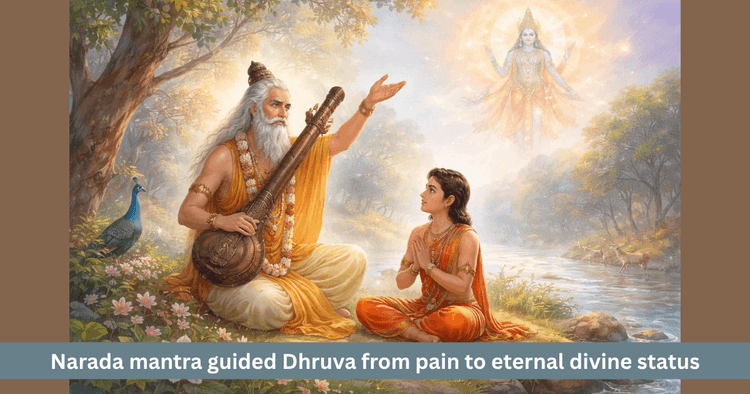
Table of Contents
The story of Dhruva is one of those timeless spiritual narratives in which the pain of a child, the strength of resolve, the power of austerity and the grace of divine attainment all come together. It is not merely a story of devotion. It is also the story of a moment when inner hurt does not destroy a person but awakens something far deeper. In this entire journey, the most decisive figure is Narada Muni, because he did not offer Dhruva mere comfort. He turned his pain toward sadhana, mantra and union with the Divine.
As described in the Vishnu Purana, this episode shows that the right guidance received at the right time can completely change the direction of a life. Dhruva was a prince, yet what he carried within himself was not royal contentment but a deep wound. To be deprived of a father’s affection, to be insulted by a stepmother and to feel rejected in one’s own home is unbearable even for an adult, and much more for a child. But this very wound became the beginning of his journey. If there had been only insult and no guide, the story would have remained a tale of sorrow. Because of Narada Muni, it became the story of Dhruva Tara, the Pole Star.
How was the resolve born in Dhruva’s heart
Dhruva did not receive the natural affection of his father Uttanapada in the way he longed for. Though he lived in the palace, he carried a quiet inner loneliness. When his stepmother insulted him and said that if he wanted the love of his father or a high place, he should first earn the grace of the Lord, those words entered his heart like an arrow. This was not merely insult. It was a challenge to his very sense of being.
Even at that young age, Dhruva’s mind was not ordinary. He did not simply weep and remain broken. He did not sink into complaint alone. A fierce determination arose within him that he must attain such a place from which no one could remove him. At first this longing came from hurt but gradually it became an unshakable resolve. This is why the story of Dhruva is not only a story of devotion. It is also a story of inner firmness.
The roots of Dhruva’s resolve were:
- Deprivation of his father’s affection
- The cruel words of his stepmother
- A wound to his self respect
- The longing to attain a place beyond rejection
What did Dhruva have and what did he not have when he walked into the forest
Dhruva left his home and went toward the forest. This is a deeply moving scene, because a small child leaves the palace carrying neither scriptural training, nor the methods of austerity, nor the guidance of a guru. He has only pain, resolve and an intense urge to find the Lord. This is one of the most beautiful aspects of the story. Many spiritual journeys begin not with complete knowledge but with a deeply burning inner necessity.
Dhruva did not have:
- Knowledge of austerity
- The method of meditation
- Guidance of a teacher
- Spiritual experience
But he did have:
- Unbreakable resolve
- Deep pain
- An intense desire to attain something supreme
- The courage not to turn back
It was at this exact point that Narada Muni entered his life.
Why was the appearance of Narada Muni so decisive
Narada Muni was not merely a wandering sage. He was the kind of guide who appears before the right seeker at the right moment. His arrival in Dhruva’s life was not accidental. It was part of that divine order which awakens when a soul has become inwardly ready.
Narada did not immediately give him a mantra. First he spoke with Dhruva. He tried to persuade him to return home, saying that such a hard resolve and severe austerity were not appropriate at such a young age. This was not discouragement in the ordinary sense. It was a test. Narada wanted to know whether Dhruva’s resolve was a passing emotional reaction or something far deeper.
When he saw that Dhruva could not be shaken, he accepted him. This is one of the marks of a true guru. The guru first tests the depth of the seeker, then gives direction.
Why did Narada first try to stop Dhruva
This episode reveals a very deep dimension of the guru disciple relationship. A true guru does not immediately convert every emotional intensity into spiritual practice. He first sees whether the seeker’s determination is stable. Dhruva was very young. Narada knew that severe tapas cannot be sustained by emotional hurt alone. That is why he first suggested that Dhruva go back.
Behind this testing there were important reasons:
- To understand the depth of Dhruva’s resolve
- To see whether he was acting only from temporary hurt
- To know whether his goal was momentary or enduring
- To ensure that the mantra would not be given in vain
When Dhruva remained unmoved, Narada understood that this child was extraordinary.
What was the mantra that changed Dhruva’s life
When Narada saw the firmness of Dhruva’s intention, he gave him the great mantra
Om Namo Bhagavate Vasudevaya
This was not merely a collection of sacred words. It was a stream of consciousness. Within it was surrender, remembrance and orientation toward Lord Vasudeva. Narada did not merely give the mantra. He also taught Dhruva the discipline through which the mantra could awaken within him. He instructed him in meditation, repetition, concentration and austerity.
The power of the mantra may be understood in the following way:
| Aspect | Meaning |
|---|---|
| Om | The primordial sound of ultimate being |
| Namo | Surrender of ego |
| Bhagavate | Turning toward the Divine |
| Vasudevaya | Taking refuge in Lord Vasudeva |
This was the moment when Dhruva’s pain began to transform into bhakti, devotion.
Narada gave not only a mantra but also a vision
Many people think that the central point of this story is only the giving of a mantra. But the truth is deeper. Narada did not only teach Dhruva what to chant. He also taught him how to understand the purpose of spiritual effort. Dhruva’s original longing was for place and recognition but Narada redirected that longing toward the Divine.
He made Dhruva understand that tapas is not merely hardship. It is the gathering of the entire mind into one sacred focus. That is why Dhruva’s repetition of the mantra did not remain mechanical sound. It gradually became the very center of his being.
The main elements of Narada’s guidance were:
- Testing the resolve
- Giving mantra initiation
- Teaching the method of practice
- Raising the seeker’s goal to a higher plane
Why is Dhruva’s austerity considered so extraordinary
Dhruva did not merely repeat the mantra. He absorbed it into himself. His japa was not mechanical. It became the pulse of his own life. Gradually his practice became so deep that his mind withdrew from outer life and became wholly fixed in the Lord. For such concentration to arise in a young child was extraordinary.
The tradition says that his tapas became so intense that its force was felt across the cosmos. This is not meant merely as exaggeration. It points to the truth that when a seeker’s consciousness becomes intensely concentrated, its power no longer remains personal. It becomes universal in effect.
The main dimensions of Dhruva’s tapas were:
- Steady japa
- Restraint of the senses
- One pointed concentration
- Never turning away from the goal
What was the greatest transformation when Lord Vishnu appeared
When Lord Vishnu finally appeared before Dhruva, the greatest miracle was not only the vision of the Lord. The deepest miracle was the transformation that had already taken place within Dhruva. The child who had begun his practice out of wounded pride and longing for an unshakable place had now risen far beyond those earlier desires.
This is one of the most important spiritual truths in the story. The fruit of true practice is not merely fulfillment of desire. It is the transformation of desire itself. Dhruva was no longer inwardly the same. His vision had changed. His heart had changed. His pain had dissolved in the presence of the Divine.
This transformation unfolded through three stages:
- Pain became resolve
- Resolve became practice
- Practice became devotion and awakening
What is the symbolic meaning of Dhruva Tara
Lord Vishnu granted Dhruva the place that is known as Dhruva Tara, the Pole Star. This is not merely an astronomical place. It is the symbol of stability, steadfastness, devotion and an unshakable spiritual center. Dhruva’s very name came to represent that consciousness which does not waver despite circumstance.
To become Dhruva Tara is not merely to attain height. It means becoming such a center that one remains steady and also becomes a point of direction for others. That is why Dhruva’s story is not only one of personal attainment. It is also a story of enduring spiritual firmness.
The spiritual meaning of Dhruva Tara may be understood as:
| Symbol | Meaning |
|---|---|
| Stability | Remaining firm in one’s goal |
| Height | The ascent of consciousness through practice |
| Light | Becoming an inspiration for others |
| Immortality | A life and name made timeless through sadhana |
Why is Narada’s role the greatest in the entire story
If Narada had not appeared in Dhruva’s life, his resolve might have remained without direction. Pain could take him into the forest but not necessarily to God. Pain gives fire but not direction. It is the guru who transforms that fire into sadhana. This is exactly what Narada did.
He turned Dhruva’s wound into strength. He turned insult into austerity. He transformed the stubbornness of a hurt child into the path of devotion. That is why Dhruva’s attainment was not only the result of his tapas. It was also the fruit of right guidance received at the right time.
Narada’s role may be understood through these points:
- He recognized the fire within Dhruva
- He tested the depth of his resolve
- He gave mantra and method
- He transformed pain into spiritual ascent
Why is the story of Dhruva and Narada so relevant today
Even today many people experience rejection, insult, neglect and inner hurt. In some form, a Dhruva lives within many human beings, longing for love, recognition, stability or a place that cannot be taken away. But if such pain does not meet a guide like Narada, it may turn into anger, bitterness or despair.
This story teaches that a true teacher is not merely one who speaks wisdom. A true teacher recognizes the hidden capacity within a struggling soul and gives it direction. That is why this episode remains alive even in the present age.
The major teachings for our time are:
- Insult is not always the end. It may be the beginning of awakening
- Resolve requires direction through a guide
- Mantra is not mere sound. It may become a doorway of consciousness
- Right guidance can give immortal meaning to life
Where resolve and direction meet, immortality is born
The greatest message of Dhruva’s story is this, pain alone is not enough, resolve alone is not enough and opportunity alone is not enough. When firm resolve and right direction come together, even the impossible becomes possible. Narada gave Dhruva that direction. Through that direction, a hurt child became Dhruva Tara.
The light of this story still tells us that the deepest wound of life, when placed in the hands of a true guide, can become the greatest spiritual strength.
FAQs
What inspired Dhruva to go into the forest
The hurt of being deprived of his father’s affection and the insulting words of his stepmother gave rise to an unshakable resolve within him.
Why did Narada Muni first try to stop Dhruva
He wanted to test whether Dhruva’s decision was only an emotional reaction or a truly stable resolve.
What mantra was given to Dhruva
He was given the mantra
Om Namo Bhagavate Vasudevaya
What is the spiritual meaning of Dhruva Tara
It symbolizes stability, unwavering devotion, a high spiritual goal and timeless inspiration.
What is the greatest teaching of this story
It teaches that when pain, resolve, a true guide and right direction come together, life can be transformed into immortal attainment.
Get your accurate Kundali
Generate KundaliDid you like it?
Author
Pt. Sanjeev Sharma (63)
Experience: 20
Consults About: Family Planning, Career
Clients In: Punjab, Haryana, Delhi
Share this article with friends and family
About ZODIAQ
ZODIAQ is an online Vedic Astrology platform. It connects clients seeking astrological advice to experienced astrologers with deep knowledge. Our users also generate kundali and perform kundali milan for free. ZODIAQ also offers services to the Astrologers. Astrologers utilize various offerings by ZODIAQ to serve their clients effectively.
If you are a User
Consult with experienced astrologers and seek their guidance. You can also order handwritten Janm Patrika report with life prediction prepared by experienced astrologers. Generate accurate Kundali, perform Kundali Matching and check horoscope and muhurat. Utilize our online library for all the necessary astrological and spiritual information.
If you are an Astrologer
Create accurate kundali for your clients and perform Kundali Matching for up to 5 people at a time. Write comprehensive Janm Patrika report for your clients with ZODIAQ. Check client details anytime by saving it in client directory. Become more productive by tracking how many clients you guide every day.
WELCOME TO
ZODIAQ
Right Decisions at the right time with ZODIAQ
