Hanuman and Narada's Musical Contest: When Devotion Went Beyond Art
By Pt. Narendra Sharma
A tale from Adbhuta Ramayana revealing the deeper meaning of devotion, art, and surrender
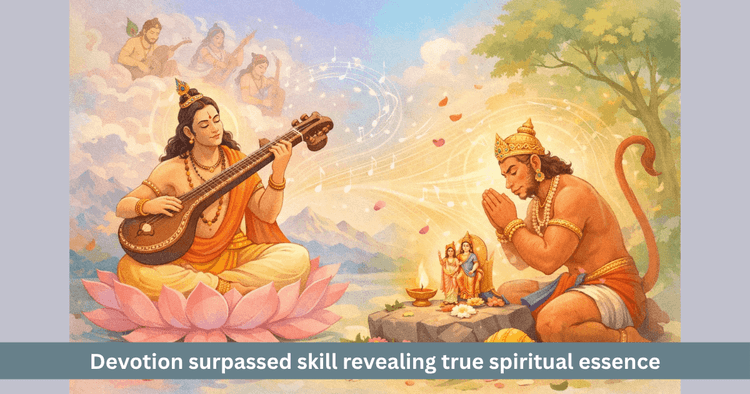
Table of Contents
In the spiritual tradition of India, both Narada Muni and Hanuman are regarded as extraordinary symbols of music and devotion. On one side stands Narada, renowned for his divine veena and refined musical mastery. On the other stands Hanuman, whose devotion is so deep that every utterance arising from him touches the heart directly through the name of Shri Rama.
A fascinating episode described in the Adbhuta Ramayana presents a kind of musical contest between them. Yet this was not merely an artistic competition. It revealed the subtle distinction between art and art filled with devotion, between skill and surrender, between ego and love centered expression. That is why this story is not important only for lovers of music. It is equally significant for every seeker, artist and person walking the path of inner refinement.
Why is this episode considered so special
The depth of this story lies in the fact that two divine beings stand face to face, and neither of them belongs to an ordinary level of expression. Narada is the symbol of celestial music. His veena, his voice and his chanting of the Divine Name make him unique. Hanuman is not usually introduced as a formal musical master, yet his voice carries such Rama bhakti that it moves consciousness at the deepest level. This is the central power of the episode.
The story forces us to ask a very subtle question. What is true greatness. Is it only technical mastery. Is it discipline and training. Is it presentation and structure. Or does the inner feeling behind expression decide its highest power. The Adbhuta Ramayana answers this question in a deeply moving way.
The uniqueness of the episode may be understood through the following points:
- It places music and devotion on the same field
- It reveals the subtle difference between ego and humility
- It does not reject art but raises it to its highest possibility
- It shows that without God centered feeling, excellence remains incomplete
Why did pride arise within Narada Muni
According to the story, there came a time when Narada Muni developed pride in his musical art. This was not simple confidence. It gradually became a subtle ego within him. He began to feel that no one could equal him in music. This is a very human moment, and that is why the story feels so alive. For here even a divine sage is shown undergoing inner examination.
When a human being becomes aware of ability, two directions become possible. In one direction, the gift is seen as a blessing of the Divine, and humility deepens. In the other, the same gift is taken as personal glory, and inward hardness begins to grow. For a time, Narada appears touched by the second tendency.
This subtle pride may be understood in the following way:
| Condition | Initial form | Later effect |
|---|---|---|
| Awareness of skill | Confidence | Ego if not watched |
| Praise | Encouragement | Self fascination if unchecked |
| Feeling of superiority | Subtle pride | Weakening of devotional softness |
| Mastery in art | Excellence | A veil upon pure feeling |
Why is Hanuman’s role here so extraordinary
Hanuman does not appear merely as another participant. He appears as the representative of the truth that a voice filled with devotion may surpass even the finest art. His greatest quality is that he never claims any gift as his own. His strength belongs to Rama, his wisdom belongs to Rama, his action belongs to Rama and his life belongs to Rama. That is why when he sings, the singer does not remain at the center. Rama remains at the center.
This is the decisive difference in the story. Narada’s music at that moment remained centered in artistic excellence. Hanuman’s music remained centered entirely in the Lord. When the artist steps back and the Beloved becomes central, expression changes in its essential nature.
How did the musical contest begin
According to the episode, a discussion on music arose and it was decided that both Narada Muni and Hanuman would offer their own musical expression. Outwardly this may look like a contest. Inwardly it was a divine test. What was to be seen was not merely who was the greater performer but what force truly lived within each expression.
Narada Muni performed first. He played his veena and sang in a melodious and refined voice. His music was beautiful, measured and deeply attractive. Those who heard him became captivated. His tone was pure, his rhythm precise and his artistry undeniable. The story itself acknowledges this greatness. So the meaning of the episode is not that Narada lacked musical attainment. The difference lay in the completeness of feeling.
What was the greatness of Narada’s music
Narada’s music was not ordinary pleasant singing. It was the kind of music that belonged to celestial assemblies. His veena did not merely produce sound. It drew the consciousness of listeners. So when the story says that those present became enchanted, it is not exaggeration. His art was indeed magnificent.
The major qualities of Narada’s music may be seen in the following:
- Purity of tone
- Precision of rhythm
- Exceptional mastery in veena playing
- A beautiful and luminous vocal presence
Yet the deeper suggestion of the Adbhuta Ramayana is that this alone was not enough. In terms of art, Narada was exalted. But in terms of complete devotion, another height still remained.
What changed when Hanuman began to sing
After Narada, Hanuman began to sing with the name of Shri Rama on his lips. This was not merely another musical performance. It was the flowing out of his Rama bhakti. There was no desire to display talent in it. There was only love, surrender and invocation. This is the difference between outward music and sound arising from the soul.
The story says that there was such force in Hanuman’s song that even a hard stone placed nearby began to melt. This is a profoundly symbolic moment. The stone is not only an outer object. It is also a symbol of hardness, ego, insensitivity and inner rigidity. The sound born of Hanuman’s devotion had such power that even something stone like could become fluid.
This is not merely miracle. It is a declaration that pure devotion carries a force capable of doing what mere performance cannot.
What does the melting of the stone symbolize
The melting stone in this story is filled with layered meaning. It may be understood in several ways:
- The warmth of devotion can melt inner rigidity
- True remembrance of the Divine Name can soften hardness of consciousness
- Where art reaches its limit, love goes beyond
- Sound centered in the Divine may affect even matter itself
At an inward level, the story suggests that the stone within human beings, ego, pride, heaviness and subtle hardness, can also melt through true devotion. Hanuman’s song is described as something that not only affects stone but also transforms the inner being.
Why did Narada’s veena become stuck in the stone
Here the story takes a deeply moving turn. After Hanuman’s devotion had melted the stone, Narada Muni later tried to remove his own veena from that same softened stone but he could not pull it out. Where Hanuman’s devotion had melted the rock, Narada’s veena remained trapped in it.
This is a rich spiritual symbol. It does not mean that Narada’s art was insignificant. It means that skill reached a certain level but devotion went beyond it. Where there was only music, it became limited. Where there was music filled with Rama, even stone melted.
The story quietly reveals a deep truth here:
| Element | State of Narada Muni | State of Hanuman |
|---|---|---|
| Music | Great art | Expression immersed in devotion |
| Center | The musician’s excellence | Remembrance of Shri Rama |
| Result | Attraction | Transformation |
| Effect | On listeners | Even upon the stone |
What did Narada Muni learn from this event
This experience became a deep inner lesson for Narada Muni. He understood that technical skill, musical knowledge and artistic attainment alone do not make expression complete. Unless there is true feeling, humility and surrender to the Divine, something remains lacking at the deepest level.
This is the central teaching of the story. Even a great being like Narada learns through this divine play that the peak of art is not where the artist shines most brightly but where the artist steps aside and the Beloved shines through.
This lesson belongs not only to Narada but to every seeker.
Does this story mean that art is less important
No, not at all. The story does not belittle art. In fact, it raises art to its highest possibility. It says that art is great but when it joins devotion and humility, it touches the Divine. Skill alone may win admiration. But skill filled with devotion may become transformative.
So the real conclusion is not that practice, knowledge and refinement have no value. Rather the conclusion is:
- Skill is necessary
- Discipline is necessary
- But humility and surrender are also essential
- Only then does art become complete
Why is this story so relevant in present life
Today is an age of achievement, display, comparison and identity built around accomplishment. Some are proud of knowledge, some of art, some of success and some of recognition. In such a world, the story of Hanuman and Narada becomes especially relevant. It reminds us that achievement is not the final measure. What gives it depth is the inner feeling behind it.
This story invites us to ask:
- Is humility joined with our talent
- Is our work only performance or also surrender
- Do we see our skill as personal glory or as grace
- Does our work merely impress others or does it melt hearts
When devotion completes art
Hanuman’s music was powerful because there was no self display in it. There was only Shri Rama. That is why his song could melt even stone. Narada’s music too was extraordinary but at that moment a subtle layer of pride had entered it. The whole message of the story rests in this very fine distinction.
When art is placed at the feet of the Divine, it no longer remains merely art. It becomes worship. When sound arises not from ego but from love, it is not merely heard. It is experienced. And when devotion enters art, even what appears ordinary may begin to carry extraordinary power.
Where feeling becomes the final force
In the end, the deepest message of this episode is that true power does not lie only in skill but in the feeling through which skill is expressed. Ego limits art. Devotion joins it to the infinite. Pride places the self at the center. Surrender places the Divine there. And where the Divine becomes central, even stones may melt.
This story reminds us that the same truth applies in every field of life. Whether it is music, knowledge, service, speech or action, if love, humility and surrender are added, then the same work rises from the ordinary and receives a divine touch.
FAQs
Where is the musical contest of Hanuman and Narada described
This episode is associated with the Adbhuta Ramayana, where the difference between music and devotion filled music is revealed.
What was Narada Muni’s main mistake in this story
A subtle pride had entered his heart regarding his musical excellence, and that affected its fullness.
Why was Hanuman’s music so powerful
Because it flowed not merely from skill but from pure, deep and selfless devotion to Shri Rama.
What does the melting stone symbolize
It symbolizes the power of true devotion to melt hardness, rigidity and ego.
What is the greatest teaching of this story
It teaches that art and skill become complete only when devotion, humility and surrender are joined to them.
Get your accurate Kundali
Generate KundaliDid you like it?
Author

Pt. Narendra Sharma (63)
Experience: 20
Consults About: Family Planning, Career
Clients In: Punjab, Haryana, Delhi
Share this article with friends and family
About ZODIAQ
ZODIAQ is an online Vedic Astrology platform. It connects clients seeking astrological advice to experienced astrologers with deep knowledge. Our users also generate kundali and perform kundali milan for free. ZODIAQ also offers services to the Astrologers. Astrologers utilize various offerings by ZODIAQ to serve their clients effectively.
If you are a User
Consult with experienced astrologers and seek their guidance. You can also order handwritten Janm Patrika report with life prediction prepared by experienced astrologers. Generate accurate Kundali, perform Kundali Matching and check horoscope and muhurat. Utilize our online library for all the necessary astrological and spiritual information.
If you are an Astrologer
Create accurate kundali for your clients and perform Kundali Matching for up to 5 people at a time. Write comprehensive Janm Patrika report for your clients with ZODIAQ. Check client details anytime by saving it in client directory. Become more productive by tracking how many clients you guide every day.
WELCOME TO
ZODIAQ
Right Decisions at the right time with ZODIAQ
