The Liberation of Nalakuvara and Manigriva: A Curse That Became the Path to Freedom
By Pt. Amitabh Sharma
The deeper story of Narada Muni’s curse as grace, leading from ego to liberation and divine blessing
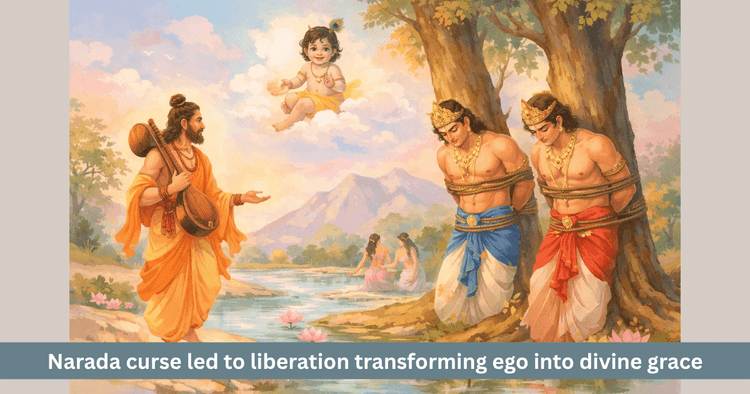
Table of Contents
Many stories connected with Narada Muni reveal that his actions should never be understood only at the surface level. What first appears harsh, punishing or severe often carries deep grace within it. The story of Nalakuvara and Manigriva is one of the finest examples of this truth. It is not only the story of two divine beings falling and rising again. It is also a story about ego, restraint, stillness, waiting and finally divine grace.
This episode, described in the Bhagavata Purana, concerns the two sons of Kubera, Nalakuvara and Manigriva. They were immersed in luxury, comfort and privilege. Gradually that abundance gave rise not to humility but to pride. A life that should have moved in gratitude and awareness began to sink into indulgence, arrogance and forgetfulness of inner dignity. It is at this point that Narada Muni enters, not as a mere observer but as a guide whose intervention would completely redirect their destiny.
How did prosperity make them spiritually blind
Nalakuvara and Manigriva were the sons of Kubera, and therefore wealth, pleasure and privilege were naturally available to them. Yet great comfort brings great testing. If a person is not inwardly awake, abundance may slowly lead one away from restraint, humility and self remembrance.
This is exactly what happened to them. Their wealth did not deepen their maturity. It strengthened their intoxication. They forgot the dignity of their birth, their values and their conduct. What emerged outwardly as shamelessness had inwardly begun as a loss of consciousness.
Their condition may be understood through the following points:
- Luxury increased pride instead of humility
- Pleasure made them careless rather than inwardly alert
- Freedom moved them away from dignity
- Ego made them blind to their own conduct
Why is the water sport episode so important
One day Nalakuvara and Manigriva were engaged in water sport with celestial women. This was not merely a moment of enjoyment. It became the moment in which their true inner condition was revealed. At that very time, Narada Muni arrived. The arrival of Narada is never treated as accidental. He often appears precisely where consciousness needs to be shaken.
When the celestial women saw Narada, they became ashamed, covered themselves and withdrew. This response showed that some sense of decorum still remained in them. But Nalakuvara and Manigriva were so drowned in intoxication and arrogance that they displayed no restraint at all. This was not merely poor manners. It was a direct expression of ignorance, ego and insensitivity.
At that moment Narada understood that this was not a passing mistake. If they were not stopped, they would fall much further.
Why did Narada Muni curse them
At first glance, it may seem that Narada cursed them in anger. But when the event is understood deeply, the curse appears more as spiritual treatment than punishment. Narada perceived the real disease beneath their outer behavior. That disease was ego. When ego rises to such a point that a person loses dignity, restraint and awareness, then even a severe intervention may become a form of compassion.
Narada cursed them to become trees. This sounds harsh but it carries a profound symbolic and spiritual meaning. The beings who had become restless and intoxicated in movement would now have to learn stillness, silence and waiting. The ones proud of their freedom and beauty would now stand rooted, motionless and unable to display themselves.
The corrective wisdom hidden in this curse may be understood as follows:
| Outer event | Inner meaning |
|---|---|
| Curse to become trees | A halt imposed upon ego |
| Standing still | Restlessness brought to silence |
| Inability to speak | Learning to listen inwardly |
| Waiting through time | Becoming ready for grace |
Was this only punishment or also a blessing
This is where the story becomes especially beautiful. Narada did not merely curse them. He also gave them a blessing. He declared that when Lord Krishna would descend to Earth, He Himself would liberate them. This transforms the entire direction of the story. Their becoming trees is no longer only a fall. It becomes a waiting for redemption.
Narada’s action teaches that a true sage does not simply punish and abandon. He also provides the way toward upliftment. He does not merely declare someone fallen. He also secures the possibility of rising again. That is why this curse was in reality a curse filled with grace.
The two layers of the event may be seen together:
- The breaking of ego
- The assurance of future liberation
How did becoming trees turn into a form of spiritual practice
Nalakuvara and Manigriva stood as two Arjuna trees upon the bank of the Yamuna. They could no longer act according to whim. They could not enjoy, escape, display or pursue pleasure. The life that had once been full of motion, indulgence and vanity was now reduced to silence, stillness and waiting.
This offers one of the deepest teachings of the entire story. Sometimes a person becomes so filled with noise that life itself must force stillness upon that person. Those who do not stop by wisdom are sometimes stopped by circumstance. This is what happened to them. Becoming trees was not humiliation alone. It became a form of inner pause.
Their life as trees may be understood as a spiritual discipline in the following way:
- Silence turned them inward
- Stillness restrained their restlessness
- Helplessness weakened their pride
- Waiting made them worthy of grace
How did child Krishna liberate them
Time passed. Then came the very moment Narada had foretold. In one of His childhood lilas, Mother Yashoda had tied Krishna to a mortar. The child Krishna dragged that mortar between the two Arjuna trees. By His touch and movement, the trees were uprooted and fell. At that moment Nalakuvara and Manigriva emerged again in their divine forms.
This is not merely a charming childhood scene. It is a revelation of a deeper truth, that where a person cannot transform by personal effort alone, the touch of divine grace can complete the change in a single moment. Years of stillness, waiting and silent purification reached completion in that one moment of Krishna’s playful contact.
The liberation contains three clear levels:
| Level | Meaning |
|---|---|
| Fall of the trees | Breaking of hardened ego |
| Return of divine form | Recovery of true consciousness |
| Krishna’s touch | Grace completing redemption |
Why did they consider Narada’s curse a blessing
When they returned to their original divine form, Nalakuvara and Manigriva offered deep gratitude to the Lord. They also understood that Narada’s curse had truly been a blessing. Had that intervention not taken place, they would have continued sinking deeper into arrogance and degradation.
This is the most powerful point in the story. Not every hard experience is an enemy. Some experiences appear to break us but are actually saving us. They understood that Narada had not humiliated them. He had rescued them.
What is the spiritual meaning of stillness in this story
This story is especially relevant today because modern life is full of motion. Human beings are constantly running through success, pleasure, ambition and outer achievement. In such a life, one often forgets how to stop. Yet one of the deep wisdoms of life is that sometimes stillness itself is the greatest medicine.
Nalakuvara and Manigriva becoming trees teaches that when a person has wandered too far, one must pause and see oneself. This stillness may look like limitation from the outside but inwardly it can become preparation for rebirth.
For present life, this story offers the following teachings:
- Not every obstacle is purely negative
- A pause in life may become an opportunity for self recognition
- In the intoxication of success, values may be forgotten
- True grace may sometimes come in a severe form
Is there always a possibility of growth hidden within discipline
This is an important question. The answer suggested by this story is yes, when correction comes from a being of wisdom, compassion and vision, then even discipline may contain the possibility of upliftment. Narada’s curse was not reactive. It was awakening centered. It contained restraint, direction, hardship and hope all at once.
This teaches that even discipline must be understood carefully. Sometimes it is not meant for destruction but for purification. That is why the story of Nalakuvara and Manigriva is not merely a curse narrative. It is a story of refinement and redemption.
Where harsh experience becomes a form of grace
Ultimately this story teaches us not to see every difficult experience only as an enemy. Some events stop us, shake us, interrupt our momentum and place us at the very point from which true transformation begins. Narada Muni’s curse was exactly of that nature.
Its deepest message is this, ego brings a person downward, stillness brings a person back to self awareness and divine grace lifts one upward again. That is why this is not primarily a story of punishment. It is a story of redemption. Here the curse does not become the end. It becomes the path to liberation.
FAQs
Who were Nalakuvara and Manigriva
They were the two sons of Kubera who became intoxicated by wealth and forgot restraint, dignity and awareness.
Why did Narada Muni curse them
He cursed them in order to break their ego, stop their fall and redirect them toward spiritual correction.
Why were they made into trees
Becoming trees gave them stillness, silence, waiting and inner pause, all of which were necessary for their transformation.
How did Krishna liberate them
Child Krishna dragged the mortar between the two trees, causing them to fall and restoring them to their divine forms.
What is the greatest teaching of this story
It teaches that many times the hardest experiences become the very path through which true correction and liberation arrive.
Get your accurate Kundali
Generate KundaliDid you like it?
Author

Pt. Amitabh Sharma (56 Years)
Experience: 20
Consults About: Family Planning, Career
Clients In: Punjab, Haryana, Delhi
Share this article with friends and family
About ZODIAQ
ZODIAQ is an online Vedic Astrology platform. It connects clients seeking astrological advice to experienced astrologers with deep knowledge. Our users also generate kundali and perform kundali milan for free. ZODIAQ also offers services to the Astrologers. Astrologers utilize various offerings by ZODIAQ to serve their clients effectively.
If you are a User
Consult with experienced astrologers and seek their guidance. You can also order handwritten Janm Patrika report with life prediction prepared by experienced astrologers. Generate accurate Kundali, perform Kundali Matching and check horoscope and muhurat. Utilize our online library for all the necessary astrological and spiritual information.
If you are an Astrologer
Create accurate kundali for your clients and perform Kundali Matching for up to 5 people at a time. Write comprehensive Janm Patrika report for your clients with ZODIAQ. Check client details anytime by saving it in client directory. Become more productive by tracking how many clients you guide every day.
WELCOME TO
ZODIAQ
Right Decisions at the right time with ZODIAQ
