Narada Bhakti Sutra: The Subtle Science Between Love and the Divine
By Pt. Amitabh Sharma
Understanding devotion not just as emotion but as a deep spiritual discipline
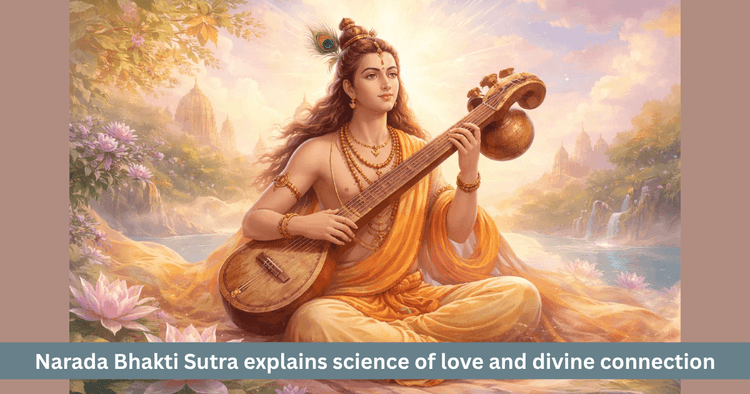
Table of Contents
In the Indian spiritual tradition, Narada Muni is often remembered as a wandering sage, a messenger across realms and a singer of the Divine Name. Yet to understand him only in these roles would be to limit the depth of his personality. Narada is also regarded as one of the profoundest philosophers of devotion. His work known as the Narada Bhakti Sutra stands as clear evidence that bhakti, devotion, is not merely emotion. It is also a deep, structured and experiential wisdom.
This text teaches that bhakti is not a passing emotional surge, nor is it a vague sentimental state. It is a subtle inner path through which a human being gradually loosens ego, fear, expectation and separation, and comes to dwell in love for the Divine. That is why the Narada Bhakti Sutra may rightly be understood as a kind of science of love.
Why is the Narada Bhakti Sutra considered so special
The greatest uniqueness of this text lies in the fact that it does not reduce devotion to outer ritual alone. It does not say that bhakti exists only in worship, only in temples, only in singing or only in certain religious acts. Instead, it presents bhakti as an inner state of being in which the Divine becomes the center of life itself.
Traditionally the text is said to contain 84 sutras, aphoristic teachings. Each sutra is short, yet its meaning is vast. This is the beauty of its style. It does not multiply words. It condenses essence. One sutra may be read in moments, yet contemplated for years. This is why the text remains small in form and immense in depth.
Its importance may be understood through the following points:
- It presents bhakti as an existential state, not merely ritual
- It places love at the center of spiritual life
- It explains the path in simple language with profound meaning
- It remains relevant for every sincere seeker
Is devotion limited only to worship and chanting
The answer given by the Narada Bhakti Sutra is clear, no. Worship, japa, chanting, singing, vows and rituals may become supports for devotion but they are not the complete reality of bhakti. If the heart remains dry, if love is absent, if ego remains untouched and if one’s relation to God remains transactional, then external acts alone do not fulfill the essence of devotion.
In this text, bhakti is understood as love. It is love free from condition. It is love not based on gain. It is love rooted in surrender and trust. This is one of the most beautiful and deepest aspects of the whole work.
This view of bhakti may be understood in the following way:
| Outer form | Inner meaning |
|---|---|
| Worship | A means of remembrance |
| Japa | Turning the mind toward the Divine |
| Kirtan | Expression of love |
| Surrender | Melting of ego |
| Bhakti | Dwelling lovingly in God |
Why may this be called a science of love
At first sight, love and science may seem like words belonging to very different worlds. One appears emotional, the other systematic. Yet the Narada Bhakti Sutra shows that pure love too has a subtle structure within it. It has a beginning, a growth, stages, tests and a final fruit.
That is why it may be called a science of love. Just as science studies process and principle, this text also explains the principles and states of devotion. Just as science studies development, this text also shows how the consciousness of a seeker changes over time. And just as science does not stop at theory alone, bhakti here too is not merely described but meant to be realized.
This science of love may be understood through the following points:
- Bhakti has a beginning
- Bhakti develops through inner change
- Bhakti reaches maturity
- Bhakti bears fruit in transformed consciousness
According to the Narada Bhakti Sutra, what is true devotion
According to the Narada Bhakti Sutra, true devotion is that state in which the seeker gradually lets go of ego and becomes established in love for the Divine alone. In such love there is no fear, because love rests in trust. There is no selfishness, because love gives more than it calculates. There is no bargaining, because love does not trade.
When devotion reaches this level, God is no longer merely an object of worship. The Divine enters lived experience itself. The seeker begins to feel that the Lord is not confined to image or ritual alone but becomes present within memory, reverence, feeling and surrender.
The marks of true bhakti may be understood as follows:
- A decrease in ego
- Growth of selfless love
- Natural remembrance of the Divine
- Greater inner authenticity than outer display
- Consciousness rising beyond fear and desire
How does the journey of devotion begin
This text also helps us understand that bhakti does not usually arise all at once in its complete form. It has a beginning. Sometimes it begins through holy company. Sometimes through suffering. Sometimes through a question, grace or contact with a saint. First there is the sense that the Divine is needed. Then the heart turns. Then remembrance begins. Then connection deepens. Then love awakens. Then steadiness appears.
This journey is deeply human. It may include fluctuations. At times the mind will be absorbed, at times distracted. At times faith will be strong, at times questions may arise. But in Narada’s vision, if the direction is true, then the seeker slowly changes from within.
This journey may be viewed in the following way:
| Stage | What happens within the seeker |
|---|---|
| Beginning | Turning toward the Divine |
| Practice | Interest in remembrance and japa |
| Maturity | Deepening of love |
| Inner transformation | Reduction of ego |
| Higher state | Abiding in the Divine |
Is this text meant for everyone
One of the most inclusive features of the Narada Bhakti Sutra is that it does not restrict devotion to one class, one social order, one stage of life or one level of scholarship. It does not insist that one must first become a great scriptural intellectual before becoming fit for devotion. Nor does it say that only renunciates can enter this path. Instead, it makes bhakti universally available.
According to the spirit of this text, anyone whose heart carries sincerity, humility and the possibility of love can walk the path of devotion. This is what gives the work its deep spiritual inclusiveness. Here the qualification of the heart becomes more important than intellectual complexity.
This vision remains highly relevant even today because it reminds us that the path to God does not open only through argument but also through a true heart.
What is the relation between devotion and ego
The Narada Bhakti Sutra repeatedly suggests that devotion is deeply connected with the gradual softening of ego. As long as the seeker remains centered in self importance, the relationship with the Divine cannot become complete. God may still be treated as a means for fulfilling personal desire. But as love becomes pure, the Divine is no longer used as a tool. The Divine becomes the Beloved Reality.
An important subtle point must be understood here. Ego does not exist only in pride. It can also exist in hurt, expectation, complaint and even in the feeling of spiritual accomplishment. This is why the path of devotion makes a seeker inwardly honest. One begins to see one’s own motives, expectations and hidden self centeredness more clearly.
Can outer religious action and inner devotion remain separate
Yes, and this is one of the most relevant teachings of the text. A person may visit temples, chant mantras, observe vows and sing hymns, yet inwardly remain full of self interest, comparison, display and expectation. In such a case there is outer religiosity but devotion is not yet mature.
The Narada Bhakti Sutra reminds us that outer action and inner condition must come together. When they unite, devotion becomes full of rasa, sacred sweetness. Then worship is no longer only a procedure. It becomes preparation for living contact.
This is why the text encourages inward examination:
- Is chanting only sound or also remembrance
- Is worship only action or also love
- Is there more expectation than surrender in devotion
- Is God being treated as means or as the center of life
Why is the Narada Bhakti Sutra especially important today
Today many people reduce devotion to external religious habit. Some see it only as tradition. Some as ritual form. Some as emotionality. Some as cultural identity. In such a time, the Narada Bhakti Sutra offers extraordinary clarity. It teaches that real devotion arises from within. External practices may support it but the central transformation happens in the heart.
In an age of stress, fragmentation and excessive outwardness, this text reminds us that the deepest human need is not success alone but relationship. Bhakti is the divine form of that relationship. When love becomes purified and turns toward the Divine, it reconnects the person inwardly, gives steadiness and makes identity more transparent and true.
For present life, this text offers these major directions:
- Do not reduce devotion to outer ritual alone
- Give the Divine an inner place in life
- Practice freeing love from condition and calculation
- Try to make devotion a continuous inner state
Where love itself becomes the path
The final message of the Narada Bhakti Sutra is profoundly beautiful. It says that the simplest and deepest path to the Divine is love. Not ordinary attachment but pure, selfless, surrendered love that finds rest in God. This love gradually transforms the seeker. It softens hardness, reduces ego, calms fear and widens consciousness.
For this reason, the text is not merely a collection of aphorisms. It is an inner path. It teaches that true devotion does not create a separate life from this one. It fills this very life with the Divine. Where love becomes pure, devotion appears. Where devotion appears, God is no longer far. And where God is no longer far, the meaning of life changes completely.
FAQs
What is the Narada Bhakti Sutra
It is a small but deeply profound text associated with Narada Muni that explains the nature, path and fruit of devotion through aphoristic teachings.
How many sutras are traditionally said to be in it
Traditionally the text is said to contain 84 sutras.
How does this text understand devotion
It understands devotion not merely as ritual but as a state of selfless and pure love toward the Divine.
Why can it be called a science of love
Because it explains the stages, development and fruit of devotion in a clear and subtle way.
What is the greatest teaching of this text
It teaches that true, selfless and surrendered love is the simplest and deepest path to God.
Get your accurate Kundali
Generate KundaliDid you like it?
Author

Pt. Amitabh Sharma (56 Years)
Experience: 20
Consults About: Family Planning, Career
Clients In: Punjab, Haryana, Delhi
Share this article with friends and family
About ZODIAQ
ZODIAQ is an online Vedic Astrology platform. It connects clients seeking astrological advice to experienced astrologers with deep knowledge. Our users also generate kundali and perform kundali milan for free. ZODIAQ also offers services to the Astrologers. Astrologers utilize various offerings by ZODIAQ to serve their clients effectively.
If you are a User
Consult with experienced astrologers and seek their guidance. You can also order handwritten Janm Patrika report with life prediction prepared by experienced astrologers. Generate accurate Kundali, perform Kundali Matching and check horoscope and muhurat. Utilize our online library for all the necessary astrological and spiritual information.
If you are an Astrologer
Create accurate kundali for your clients and perform Kundali Matching for up to 5 people at a time. Write comprehensive Janm Patrika report for your clients with ZODIAQ. Check client details anytime by saving it in client directory. Become more productive by tracking how many clients you guide every day.
WELCOME TO
ZODIAQ
Right Decisions at the right time with ZODIAQ
