Why Narada Muni Was Cursed to Wander: A Curse That Became a Blessing for All Worlds
By Pt. Amitabh Sharma
The divine purpose behind Devarshi Narada’s constant wandering and the deep mystery of devotion behind it
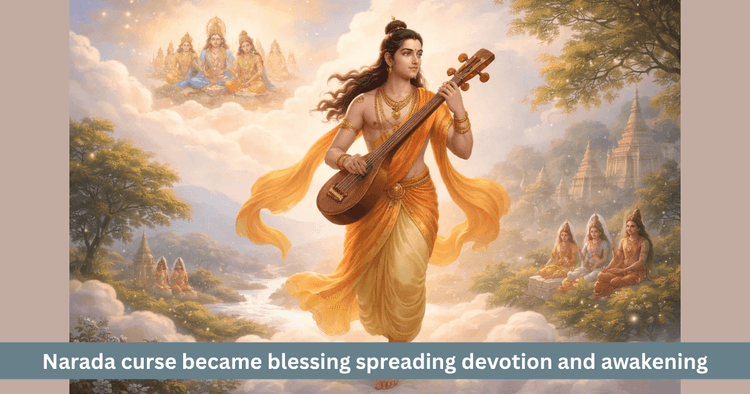
Table of Contents
In the Indian spiritual tradition, the name of Narada Muni immediately evokes the image of a divine sage who moves constantly through different realms, appears in many sacred narratives, connects devas, asuras, sages and human beings and carries the current of spiritual awakening wherever he goes. He is not merely a messenger. He is a carrier of bhakti, wisdom, discernment and divine restlessness of the soul. Yet very few people know that behind his ceaseless wandering lies a deep story, one that begins as a curse and slowly reveals itself as a profound blessing.
This episode is associated with the Sixth Skandha of the Shrimad Bhagavata Purana, where an important event between Daksha Prajapati and Narada Muni is described. This is not merely a story of disagreement between two great beings. It also reveals the subtle tension between worldly continuity and renunciation, between expansion and liberation, between social duty and spiritual truth. For this reason, the narrative remains meaningful not only as sacred memory but also as a timeless way of understanding life.
How does the story begin with Daksha Prajapati and his sons
Daksha Prajapati is remembered as one of the important figures connected with the expansion of creation. His orientation was toward order, continuity, lineage and worldly growth. He had prepared his 10,000 sons with the purpose that they would enter household life, continue creation and carry forward the line of descent. For him, this was not merely a family arrangement. It was part of the sacred duty of cosmic continuation.
In many traditions, these sons are referred to as the Haryashvas. They were sent for discipline, reflection and guidance so that they might later fulfill their role in the right way. Daksha’s intention was clear. He wanted them to move toward the path of worldly participation. Everything was aligned in that direction until the decisive turning point arrived through their meeting with Narada Muni.
This beginning may be understood through the following points:
- Daksha Prajapati’s aim was expansion of creation
- His sons were being prepared for that responsibility
- They were expected to move toward the path of household life
- The arrival of Narada Muni changed the direction of the entire story
What did Narada Muni say to Daksha’s sons
When Daksha’s sons went in search of discipline and spiritual understanding, they encountered Narada Muni. Narada did not merely give them a few teachings. He placed before them the deepest question of life itself. He made them reflect on the impermanence of the world, the mortality of embodied existence, the instability of worldly identity and the true aim of the soul.
His speech was not merely learned. It was awakening. He led them to ask whether worldly expansion alone could be the ultimate purpose of life when the whole field of worldly existence is unstable and changing. His words stirred a profound transformation within them. They began to see that if the soul is meant for the highest truth, then a life spent only in outward continuation may remain incomplete.
The influence of Narada’s teaching may be understood through the following:
- He led them to reflect on the difference between soul and world
- He awakened discernment between the lasting and the temporary
- He raised the question of the final purpose of life
- He shifted attention from action alone to the meaning of action
Why did Daksha’s sons give up the path of worldly life
The effect of Narada Muni’s teaching was so deep that Daksha’s sons chose the path of renunciation, vairagya, dispassion and self knowledge instead of the path of worldly expansion. This was not an impulsive decision. It was the result of profound inner awakening. They felt that if the search for truth was delayed, life might be spent merely in outer activity.
This decision stood in direct contrast to Daksha Prajapati’s intention. Where Daksha saw life centered in lineage, continuity and creative duty, his sons had now turned toward liberation, wisdom and realization. This is the first major tension in the narrative. Two valid perspectives stand before one another.
On one side stood:
- Expansion of creation
- Duty of household life
- Continuity of lineage
- Worldly order
On the other side stood:
- Renunciation
- Self knowledge
- Awareness of impermanence
- Search for the Supreme Truth
Why did Daksha Prajapati become so angry
When Daksha learned that his sons had abandoned the worldly path, he became intensely angry. For him, this was not only a matter of their taking to renunciation. He felt that Narada Muni had ruined his purpose, lineage, responsibility and creative intention. In his eyes, the very sons he had prepared for the work of creation had now been diverted away from it.
Daksha’s anger is natural within the logic of the narrative, because from his point of view Narada had indeed intervened in the path of worldly duty. This is what makes the episode so deep. It does not present one side as entirely wrong and the other as entirely right. Daksha stands for cosmic continuity. Narada stands for spiritual awakening. One protects worldly order, the other opens the path of liberation.
The feelings behind Daksha’s anger included:
- Fear that his lineage would not continue
- A sense that the work of creation had been interrupted
- Pain that his purpose had been overturned
- Direct blame placed upon Narada
What was the curse given to Narada Muni
In anger, Daksha Prajapati cursed Narada Muni that he would never be able to remain in one place. He would continue moving from place to place and would not be able to stay anywhere for more than 2 ghadi, a traditional unit of time. At first sight this curse appears severe. For a seeker, steadiness, concentration and a place of stay are normally seen as valuable. In that sense, the curse seems to condemn Narada to endless motion.
Yet this is exactly the point where the story rises beyond its outer form. The punishment becomes the greatest opportunity for spiritual service. Narada could not remain in one place, and therefore he reached every place. He did not belong to one region, and therefore he became available to all. He could not settle, and therefore his message could not become limited.
The outer and inner meanings of the curse may be seen in the following way:
| Aspect | Outer meaning | Inner meaning |
|---|---|---|
| Inability to remain settled | Punishment | Opportunity for universal spiritual service |
| Moving from place to place | Wandering | Spreading wisdom across many realms |
| Not staying beyond 2 ghadi | Lack of rest | Continuous awakening and continuous sacred work |
How did this curse become a blessing
This is the most wondrous part of the story. If Narada Muni had remained in one place, his influence might also have remained limited to that one space. He might have become the teacher of one ashrama, one region or one line of disciples. But the curse of Daksha made him a traveler of all three worlds. He moved among devas, among asuras, among kings, seekers and sages, and wherever he went he planted seeds of dharma, devotion and awakening.
This ceaseless wandering became his identity. He came to be known as Devarshi, the divine seer. He became the carrier of spiritual dialogue, and the hidden catalyst behind many great transformations in sacred narratives. If he had remained settled, he may not have served the worlds in such an expansive way.
From here emerges a major life teaching:
- Not every punishment truly destroys
- Not every obstacle lacks hidden grace
- What first appears painful may later become one’s purpose
- Life’s direction often opens through unexpected disruption
What is the spiritual meaning of Narada’s endless wandering
The wandering of Narada is not merely geographical travel. It also holds a deep spiritual meaning. Wherever he goes, he awakens consciousness. He does not remain in one place because truth itself should not remain confined. Wisdom should not belong to one location alone. Devotion should not stay limited to one group. The message of dharma must also reach places where darkness, confusion, pride or sorrow are present.
Seen in this way, the wandering of Narada becomes a form of divine service. He is not merely a traveler between realms. He is a bearer of truth. The curse became a blessing because it transformed his inner spiritual purpose into a universal movement.
Does this story teach us to see sudden change in a new way
Yes. This is one of the greatest contemporary teachings of the episode. Many times in life we interpret change immediately as problem, loss, punishment or disorder. A job changes, a place changes, relationships shift, plans collapse and stability disappears. At such a moment it may feel as though everything is going wrong. But the story of Narada Muni teaches that not every change is destruction. Some changes carry us toward the very field in which our larger purpose is waiting.
This story teaches us the following:
- Instability is not always negative
- Restlessness may be preparing a deeper direction
- The purpose hidden in change is rarely understood at once
- With patience, even a curse may reveal itself as grace
Why is the life of Narada Muni seen as an ideal of spreading wisdom
If Narada never remained fixed anywhere, one major reason is that his life became devoted to the spreading of wisdom, devotion and sacred dialogue. He did not become the teacher of one isolated ashrama. He became an awakener across realms. He is not merely a sage who lectures. He is one who stirs consciousness into movement. Wherever he goes, something changes.
The life of Narada teaches that truth is not meant only to be preserved. It must also be carried to the places that need it. Wisdom kept only as stored possession has limited effect. But wisdom that travels, speaks and serves becomes alive.
What does this story say for modern life
The modern human being also seeks stability, yet life repeatedly places one in motion. Circumstances change, locations shift, relationships move, priorities transform and inner meaning evolves. At such times this story offers deep reassurance. It teaches that not every instability should be read as failure. It may be the opening through which one’s larger work, wider service or deeper understanding is beginning.
The curse of Narada also teaches that if dharma, devotion and truth remain alive within, then outward instability cannot make life meaningless. On the contrary, that very instability may become the expansion of meaning.
Where the curse itself becomes the path
In the end, the story of Narada Muni teaches a deeply subtle spiritual truth. What appears at first as punishment, scattering or loss may actually become the beginning of a larger sacred work. Daksha intended punishment but that punishment turned Narada into a traveler across realms. He could not remain in one place, and because of that he reached every place. He did not belong to one region, and because of that he became available to all beings.
This is the greatest life teaching of the story, that every condition may contain a hidden opportunity. To recognize that opportunity is true wisdom. Once it is recognized, even a curse becomes a path, an obstacle becomes sadhana, spiritual discipline, and wandering itself becomes a means of blessing the worlds.
FAQs
Who gave Narada Muni the curse
Narada Muni was cursed by Daksha Prajapati in anger after Daksha’s sons turned away from household life.
Why did Daksha become angry with Narada Muni
He felt that Narada had turned his sons away from the path of worldly expansion and lineage.
What exactly was the curse
The curse was that Narada Muni would not be able to remain settled anywhere and would not stay in one place beyond 2 ghadi.
How did this curse become a blessing
Because it enabled Narada Muni to move through all the worlds, spreading devotion, wisdom and dharma everywhere.
What is the greatest teaching of this story
It teaches that what first appears as punishment or obstruction may later become the doorway to one’s larger purpose.
Get your accurate Kundali
Generate KundaliDid you like it?
Author

Pt. Amitabh Sharma (56 Years)
Experience: 20
Consults About: Family Planning, Career
Clients In: Punjab, Haryana, Delhi
Share this article with friends and family
About ZODIAQ
ZODIAQ is an online Vedic Astrology platform. It connects clients seeking astrological advice to experienced astrologers with deep knowledge. Our users also generate kundali and perform kundali milan for free. ZODIAQ also offers services to the Astrologers. Astrologers utilize various offerings by ZODIAQ to serve their clients effectively.
If you are a User
Consult with experienced astrologers and seek their guidance. You can also order handwritten Janm Patrika report with life prediction prepared by experienced astrologers. Generate accurate Kundali, perform Kundali Matching and check horoscope and muhurat. Utilize our online library for all the necessary astrological and spiritual information.
If you are an Astrologer
Create accurate kundali for your clients and perform Kundali Matching for up to 5 people at a time. Write comprehensive Janm Patrika report for your clients with ZODIAQ. Check client details anytime by saving it in client directory. Become more productive by tracking how many clients you guide every day.
WELCOME TO
ZODIAQ
Right Decisions at the right time with ZODIAQ
